EECFA 2020 Summer Construction Forecast – Pandemic edition

The 2020 Summer EECFA Construction Forecast Report was released on 29 June. It can be purchased, and a sample report can be viewed at www.eecfa.com. EECFA (Eastern European Construction Forecasting Association) conducts research on the construction markets of 8 Eastern-European countries.

Southeast Europe

Construction in the ‘small countries’ of EECFA (Bulgaria, Croatia, Romania Serbia, Slovenia) will be bruised by the pandemic effects this year, causing a drop in construction outputs. The two exceptions are Croatia and Bulgaria where civil engineering could compensate for the losses in building construction. Already in 2021, we are likely to see positive growth rates in all 5 countries.

Bulgaria. Although there was no ban on construction works during the two-month state of emergency in Bulgaria, construction output growth will be hampered by the COVID-19 crisis. The economic uncertainty and rising unemployment are expected to hold back real income growth, which will mainly affect the property market. The growth driver in 2021 is set to be the completion of many large-scale office buildings, while industrial and warehousing construction is also to contribute positively. Output in civil engineering will be driven by road and public utility constructions where EU funds play a major role. The energy sector will also have a net positive impact because of the ongoing works of the Bulgarian part of ‘Turkstream’ in 2020 and 2021. Thus, total construction output in Bulgaria is to remain almost unchanged in 2020 (+0.3%) while in 2021 it is set to grow by 9.2%.

Croatia. COVID-19 and the Zagreb earthquake have dramatically weakened the short-term outlook for most building construction in Croatia. Civil engineering, though, will remain relatively unscathed. For buildings, COVID-19 has greatly affected both supply and demand for construction services, while the Zagreb earthquake has primarily influenced demand, in some subsectors in less than straightforward ways. Civil engineering as a whole remains strong despite the pandemic and the earthquake, but demand will vary considerably from subsector to subsector. Croatia’s July 5 elections will significantly influence the country’s policy responses to the problems it faces, but no matter who wins, the consequences of the two crises will affect the country’s construction sector for years to come.

Romania. All segments of the Romanian construction market have been impacted, in one way or another, by the pandemic and the measures taken to mitigate it. Like the rest of the EU, Romania is passing through a recession, with GDP and public consumption dropping significantly in 2020. Recovery is expected for 2021, but Romania’s bounce-back might be slower than the EU-average, since there is a lack of infrastructure and public funding availability. New residential construction is predicted to perform worse than previously expected in both 2020 and 2021 due to lower demand. The non-residential subsector is also forecasted to have a rough couple of years, with companies rethinking their office needs and retail consumption trends shifting. In addition to the recession, low efficiency in EU funding absorption is also holding back civil engineering. Overall, we predict construction activity in Romania to suffer a 2.1% decline in 2020, but to recover slightly in 2021, as the economy stabilizes.

Serbia. The beginning of the year was exceptionally strong for all subsectors, announcing another year of steaming outputs, but it was broken by the pandemic state of emergency and movement restrictions in April 2020. The fact that Serbia had a lockdown in the midst of an economic and construction recovery will make it one of the more resilient economies as fast recovery is expected. On the other hand, this extraordinary event will definitely affect the overall result in 2020, with still uncertain severity. After restrictions were cancelled, rebound followed on both residential and commercial markets. Home transactions had a stellar recovery in May, and the retail segment also reports pre-crisis turnovers in June. The good news is that none of the planned projects was cancelled, while several large land transactions in May 2020 announce investments will go forward. What scenario will play out still depends on the epilogue of this crisis and the eventual follow-up events during the course of this year.    

Slovenia. Construction industry in 2020 and 2021 will be characterized by the short-term disruption resulting from COVID-19, and a more favourable long-term demand for construction services. The former itself, due to a 3-month long lockdown, could potentially decrease construction works by more than 10% in 2020, but anti-crisis measures, including a boost to civil-engineering construction, will be supportive. The forecasted decline in construction output in 2020 is thus 5,5%. Several big projects that started shortly before the onset of the pandemic have resumed after the lockdown such as the construction of the Second Railway Track to Port Koper and the Third Axis Road. These and a major raise in public housing (mostly in Ljubljana) should lead to a total construction output rise of 2,6% in 2021. In such a scenario, construction output will not decrease below EUR 3 billion in either 2020 or 2021, and might even act as a stabilizer for the country’s overall economic activity in contrast to the financial crisis of 2008 when a depression in construction activity represented a drag on economic development for almost a full decade.

East Europe

The ‘big countries’ of EECFA (Russia, Turkey, Ukraine) are also set to be hammered by the pandemic effects this year. Worsened by the underlying economic problems in these countries, they will likely register far bigger slumps in their construction output in 2020 than the ‘small countries’ of EECFA. But growth could return next year in Turkey and Ukraine, whereas Russia could experience a slight decline still.

Russia. The volume of construction market in 2019 is expected to have exhibited a minimal negative correction (-0.2%) due to the high base in 2018, and the decline in civil engineering caused by the completion of many big-league projects. 2020 is to see a considerable drop in construction (-7.4%) owing to a set of negative factors that the economy is battered by: falling oil prices, nosediving ruble exchange rates, as well as the subsequent COVID-19 pandemic and the long-lasting lockdown. All this has led to an economic crisis that will be felt throughout 2020-2021 and is to cause a recession in all segments of the construction market, except for strategically important ones such as infrastructure, healthcare and agriculture-related constructions. In 2021, due to the expected recovery trends in some segments of non-residential and civil engineering construction, the rate of decline will likely be noticeably slower, but the general negative dynamics will likely continue and the construction market is predicted to post a decrease by another 0.5%.

Turkey. The economy was in the process of recovering in early 2020 but had to confront with the COVID-19 problem from mid-March on, after the first positive case was diagnosed. To deal with it, the Government had to allocate big sums of money, which inevitably reduced funds to be used for projects. Precautionary measures for the pandemic and the falling exchange rate of the Turkish Lira against the Euro (by 13,65% between January-June 2020) caused declines in demand for many goods and services, including real estate. Incentives such as mortgage loans by state-owned banks for home buyers under market interest rates and at 90% loan-to-value ratio have become very effective: granted loans reached about 101,000 in the first four weeks of June. Building construction permits registered a historical peak in 2017, but massive drops in the next two years, which continues with a mild fall in Q1 2020. Completions, however, did not decrease in the same way as starts until Q1 2020, mainly because there are big backlogs of construction in every segment, except for wholesale and retail trade buildings. For this reason, building occupancy permits are set to continue to remain higher than construction permits during the following years. Nonetheless, we foresee further market contraction this year. Recovery could start in 2021.

Ukraine. Over the past four years, construction market of Ukraine was on a recovery path, but the pandemic and the consequent economic crisis dramatically worsened construction trends and expectations in the country. Current indicators of the volume of capital investments and a drop in construction volumes suggest a slump in the construction market. Under such conditions, state support and bank lending would remain a reliable means for the construction market, but developers stopped borrowing during the lockdown, and bankers predict a great decrease in business lending. Future construction trends will largely depend on the dynamics of the economic recovery. The government’s economic recovery program contains no targeted measures to support the construction industry or mortgage lending, leaving builders alone in the fight against the crisis. Residential market is expected to shrink most in 2020 and each sub-sector is foreseen to come back in 2021.

Source of data: EECFA Construction Forecast Report, 2020 Summer

EECFA 2019 Winter Construction Forecast

The 2019 Winter EECFA Construction Forecast Report has been released. It can be purchased, and a sample report can be viewed at www.eecfa.com. EECFA (Eastern European Construction Forecasting Association) conducts research on the construction markets of 8 Eastern-European countries.

Southeast Europe

Building construction market of the Balkan countries of EECFA is in prosperity phase. In the 2016-2019 period the market size expanded by 30%. We think that the current cycle is getting closer to the peak and for the upcoming 2 years we foresee a deceleration. One extreme is Serbia’s building construction market. It well outperformed the rest of the countries in the past 4 years and hardly sees any further expansion. As we are getting closer to the end of the current EU programming period, the civil engineering submarket is projected to contribute more positively to total construction market growth.

Bulgaria. Construction output in Bulgaria continues its recovery as both building and civil constructions are contributing. Residential construction is boosted by increasing real wages and low interest rates on housing loans which make buying a home more and more affordable. Persistent demand for contemporary office premises, along with the ongoing expansion of industrial and warehousing projects, will likely continue to be a tailwind for non-residential construction in 2019-2021. Civil engineering construction is forecasted to continue its upward trend in line with EU fund absorption. Growth here in the upcoming years will be fuelled by large transport infrastructure projects and the public utility sector. Total construction output is set to grow by 8.7% in 2019, and to add another 6.5% in both 2020 and 2021.

Croatia. Construction in Croatia is in transition. Some sectors are reaching the limits of catch-up growth. Others are only now beginning to benefit from it. While the direction and inevitability of this transition is clear, the timing is less so, with each sector likely to follow its own, unique path. This said, certain factors, among them emigration, the slowness of key reforms (especially regarding the judiciary), rising construction costs, the government’s ability to secure EU and other official funds and increased international competition for the tourists on which, for better or worse, Croatia’s economy relies, will affect all construction sectors. The outlook is by no means grim. Croatia is not nearly done with its transition, certainly not as far as construction is concerned. Many opportunities remain.

Romania. Romania’s construction subsectors have seen different trends. Residential and non-residential have been on a growth path for several years, while civil engineering has been declining since 2015. Residential construction should remain the main contributor to growth in the forecast period on the back of increased income and high demand for new construction, though regulatory and tax changes have slowed down the subsector. Romania’s economic growth, one of the strongest in the EU, and increased public consumption are feeding the need for new non-residential construction; however, increased skilled labour shortages and costs keep the segment in check, hindering development. For civil engineering, increased construction costs, elections and government changes counter much of the potential growth. Overall, construction across Romania is predicted to expand by 6.4% in 2019 but switch to a lower gear in both 2020 and 2021.

Continue reading EECFA 2019 Winter Construction Forecast

Turkish Construction Sector Seeking Ways to Reverse the Slump

Written by Prof. Dr. Ali TUREL, EECFA Turkey

Turkish construction is in crisis in more fronts. High interest rates due to high inflation cloud the situation of construction players. As well as this, high negative real housing price changes with real construction costs being in positive numbers are creating adverse market conditions for housebuilders. Construction companies active in civil engineering have decreasing workloads due to the October 2018 presidential decree not to tender new projects except for priority ones and due to the reduced available central and local budgets for projects this year. The construction sector in Turkey is seeking ways to come out of this crunch.

The Bosphorus Strait, Istanbul, Turkey – Source: Buildecon


How it all started

The colossal devaluation of the Turkish Lira, having started in November 2016, shook Turkey’s construction industry in August 2018. Even though construction costs and interest rates increased against the backdrop of rising exchange rates in 2017, there were exceptional historical peaks in construction and occupancy permits that year. The crisis hit in 2018 with construction permits in floor areas being almost half of the permits of 2017. Occupancy permits went up by 5% in floor areas though, due to the large backlogs of construction in almost every sector. Housing sales also climbed 5% and amounted to 1,409 million by end 2018.

Trends similar to 2018 in building construction and occupancy permits in floor areas continued in the first quarter of 2019 with a 37.7% shrinkage in construction permits and a 29.4% rise in occupancy permits. Annual rate of change in the Building Construction Cost Index decreased from 28.11% in January 2019 to 25.45% in May 2019. Since rates of change in Consumer Price Index were 20.35% and 18.71%, respectively, real rises in building construction cost in the same two months were a respective 6.4% and 5.7%.

Civil engineering projects have been battered by the presidential decree issued in October 2018 requiring all ministries not to tender new projects except for priority ones, on the one hand, and by the lower allocated budget for projects to central and local governments in 2019 than in the previous year, on the other. TUIK, the Turkish Statistical Institute, calculated a 10.9% drop in construction sector in the Gross Domestic Product (GDP) in the Chain Linked Volume Index in the first quarter of 2019 against the same period of 2018. 

Feeling the pinch

Construction industry in Turkey is much concerned with the changes in housing prices and sales since about three quarters of building permits in Turkey are for house building. National average of the annual change in the Housing Price Index accounted for 3.60% in January 2019 and 1.57% in May 2019, implying that real annual changes in housing prices in these months were -13,9% and -14,4%, respectively. High negative real housing price changes when real construction costs are in positive numbers are unfavourable market conditions for housebuilders. Furthermore, decreasing housing sales, by 21.7% in the first 6 months of 2019 and 48.6% in June 2019 compared to the same time periods of 2018, create additional strains in the housing market.

Continue reading Turkish Construction Sector Seeking Ways to Reverse the Slump

EECFA 2019 Summer Construction Forecast

On 24 June 2019, the 2019 Summer EECFA Construction Forecast Report up to 2021 was published. Full reports can be purchased, and a sample report can be viewed at www.eecfa.com. EECFA (Eastern European Construction Forecasting Association) conducts research on the construction markets of 8 Eastern-European countries.

Southeast Europe

Good years are predicted to continue in the construction markets of Eastern and Western Balkan countries of EECFA. Altogether around 15% cumulated real growth is foreseen for the region as a whole in 2019-2021. The annual pace of growth, however, is gradually decelerating on the forecast horizon. In this upcoming period civil engineering is expected to outperform building construction in all countries, except for Romania.

Bulgaria’s construction output remains on a growth path since both building construction and civil engineering continue to expand. Residential construction is still an attractive investment due to increasing profitability on the back of a positive change in disposable income and low interest rates. Growth in non-residential construction is backed by the acceleration in office segment and a stable performance in manufacturing and warehousing. Civil engineering is to be driven by road and public utility segments, while major projects in railway construction are struggling to start. Construction output is projected to grow by 5% in 2019 and 4% in 2020. The end of the EU programming period of 2014-2020 will likely give and additional boost of 7% in 2021.

Construction in Croatia is at a crossroads. Some sectors that have shown strong catch-up growth will soon slow. Others, so far less favored, will soon benefit from such growth. The country is also at a crossroads in another sense. An aging population, continued emigration, rising construction costs and increased international competition for tourists will threaten a number of construction sectors unless wise political choices are made. All in all, though, while the forecast for the Croatian construction industry as a whole is not as sunny as it once was and while patches of cloud have begun to appear in some places, other areas are expected to enjoy significantly more favorable conditions than in the past.

Romania’s construction is set to grow by 6% in 2019. Residential construction, after a remarkable growth between 2016 and 2018, might be hindered by legal and policy changes. Despite some concerns over the contrary, residential activity is still predicted to remain one of the main drivers of the Romanian construction market, at least until 2020. Demand remains high for most types of non-residential construction as well. But talent shortages and higher operating costs would, likewise, limit the growth of the segment. Of notable interest is the expected growth in civil engineering segments which considerably dropped after 2015 but are to return to a positive trend with renewed interest due to availability of national and EU funding and increased public interest in the election years.

In Serbia the booming cycle is now encompassing practically all construction segments, with strong performance in both buildings and civil engineering. While residential and non-residential buildings were leading the growth in the previous period, civil engineering is expected to again take charge in 2019. With increased spending in road construction and major large-scale projects now underway in energy and railroad, there is a strong expansion of outputs in this forecast horizon. Although extensive growth in previous years already doubled outputs in many segments, particularly in buildings, there is yet more to come. Total construction output in 2021 will likely at least double the volumes from 2015.

Construction industry in Slovenia continues to grow fast, recording a second consecutive year of double-digit growth. Based on strong economic growth, easy access to credit and strong demand for residential housing, its foundation would remain strong also in 2020 unless a major external shock reversed the current optimism on the market. Even in such case, there are several large civil engineering projects, especially the construction of a new railway towards Port Koper that began in early 2019, that will induce growth in construction output for several years. 

East Europe

The East-European countries EECFA covers show a completely different picture from that of the Balkan. The cumulated growth expectation of the region is -1% for 2019-2021. Turkey’s construction market is in such trouble as previously predicted, and this drags down the whole region’s performance. On country level, only Turkey sees negative cumulated growth until 2021, while Russia is prognosticated to be moderately positive. And Ukraine can reach the highest growth rates. In each country civil engineering is forecast to perform better (less worse in case of Turkey) than building construction until 2021.

In 2018 Russia’s construction output registered a higher-than-expected growth of 2.4%, thanks to the partial revision of construction statistics and the completion of major infrastructure projects related to the FIFA World Cup. In 2019, though, with the disappearance of these two growth factors, construction output is set to be near zero. Forecast for 2020-2021 is more optimistic (2.8%-3.3% per year) as economic growth is expected to accelerate and state funding for the industry will likely have a major push. Civil engineering and housing construction will enjoy most state funding directed to new road and railway projects, energy infrastructure and residential real estate developers.

In August 2018 the economy of Turkey trembled owing to the massive depreciation of Lira that greatly hit many sectors, especially construction. Building permits also dropped sharply last year, after historical peaks a year earlier, but completion of buildings in terms of floor area rose by 5%. This trend continues in 2019, but housing sales declined by 20% in the first five months, together with large decreases in real housing prices.Further, building material output registered a more than 20% drop within a year until May 2019. Construction companies experience a hard time and those active in civil engineering have decreasing workloads due to the presidential decree (issued in October 2018) not to tender new projects except for priority ones. Plus, the budget to central and local governments for projects this year is less than last year. Against this backdrop, recovery in the construction sector can only begin in 2021.

The Ukrainian construction industry has all the conditions for a sustainable growth in the future by an estimated 6.8% rise this year, a 3.6% increase in 2020 and a 7.2% growth in 2021. A positive trend is the systemic state support for the industry, including more transparent and clear rules of the game in the construction market, simplification of permits, and powerful investment support, especially in civil engineering. Hindering construction industry, and the economy as a whole, though, is the lack of financing. The slight drop in residential construction is offset by the growth of non-residential and civil engineering subsectors.

____________

Source of data: EECFA Construction Forecast Report, 2019 Summer

Contact information: www.eecfa.com, info@eecfa.com

EECFA 2018 Winter Construction Forecast

EECFA (Eastern European Construction Forecasting Association), conducting research on the construction markets of 8 Eastern-European countries, released its 2018 Winter Construction Forecast Reports on 5 December 2018. Key findings are summarized below. Full reports can be purchased, and a sample report can be viewed at www.eecfa.com.

In many previous forecast rounds we have argued for a soft-landing scenario in Turkey. However, the dramatic fashion of the currency depreciation in summer 2018 unearthed many structural problems of the construction industry and made us revise our forecast to an even more pessimistic one. Unlike the stop-and-go like reactions to previous crises, we tend to believe in a stop-and-stay scenario this time. In Russia, we are less pessimistic thanks to a recently announced governmental program expected to affect the market positively.

EECFA-EE3

Optimism still prevails in the Eastern and Western Balkan countries of EECFA. For the region as a whole the new forecast sees just a little downward revision. However, on country level, the stories are different. Less optimism in Croatia and more optimism in Serbia and Slovenia compared to the previous forecast round. In Romania, the largest construction market of this region, the outlook of the building construction submarket has been adjusted downward.

EECFA-SEE5

Bulgaria. Construction output in Bulgaria is speeding up with an expected growth of 7.4% in 2018. Residential construction continues to expand on the back of increases in economic activity and real disposable income, and historically low interest rates on housing loans. Additionally, the non-residential segment is also predicted to grow driven mainly by office and industrial constructions. Civil engineering construction has continued its recovery path in 2018, Continue reading EECFA 2018 Winter Construction Forecast

EECFA 2018 Summer Construction Forecast

The Eastern European Construction Forecasting Association (EECFA) – the forecasting association conducting research on the construction markets of 8 Eastern European countries – has released its 2018 Summer Construction Forecast Reports up to 2020. The main findings of the reports are summarized below. The full reports can be purchased, and a sample report can be viewed at eecfa.com

Construction up to 2020 in ‘South-East Europe-5’ (Bulgaria, Croatia, Romania, Serbia, Slovenia)

The region is posting a strong economic growth which is fuelling building construction. Some of the region’s housing markets are seeing record-breaking results, so the first voices for overheating appeared. We think these markets are far from it, though. At the same time, construction labour shortage, due to economic migration from these countries to Western Europe, is one factor giving cause for concern in the future. With accelerating absorption of EU funds, civil engineering is expected to contribute positively to growth all the way on the forecast horizon.

Bulgaria

Construction output in Bulgaria continues its recovery and is expected to reach an 8.8% growth in 2018. The star performer is the residential construction segment, benefitting from improved employment and real disposable income, as well as the ongoing process of the concentration of population in big cities. Additionally, the steady economic development will increase investments in non-residential projects. Civil engineering construction is forecasted to contribute strongly in the next few years after EU fund absorption started catching up. Therefore, estimations for 2019 and 2020 are for an additional growth of 7.1% and 6.0%, respectively.

Croatia

Croatia’s construction output is likely to grow at a respectable rate until 2020 (by an estimated 2.2% in 2017 and a forecast 11.6%, 6.2% and 4.0% in 2018, 2019 and 2020, respectively). Particularly well performing sectors include hotel construction, education and health and certain civil engineering subsectors, especially railways. A global trade war, fallout from the Agrokor crisis and rapidly rising construction costs are threats to Croatia’s construction industry. And all are now significantly more likely to occur than they were at the time of EECFA’s 2017 Winter Report. But fortunately, none yet constitutes an imminent danger. In 2021 or soon thereafter growth will probably begin to tail off in a number of important sectors as Croatia’s catch-up phase gradually comes to an end, but exactly when and how this will occur is not yet clear.

Romania

The housing and non-residential segments are set to continue their excellent performance in 2018, and, in spite of an underwhelming performance in the civil engineering segment, the total growth of the construction sector in 2018 is forecasted to reach 7.1% (up from +6.8% in Winter 2017). As projects co-funded by the EU are starting to be implemented, Continue reading EECFA 2018 Summer Construction Forecast

Housing Production and Housing Price Relationship in Turkey

This paper is to elaborate on the paradoxical situation Turkey is facing: while building construction cost has risen by 22.8 per cent in nominal, 9.8 per cent in real prices, real housing prices have decreased by up to 7 percent.

Written by Prof. Dr. Ali Türel, Çankaya University, Department of City and Regional Planning, Ankara, Turkey

Residential project EX-115 (Golden Horn Sea View Apartments) under construction in Eyüp, Istanbul, Turkey. Source: http://www.extraproperty.com

In terms of total floor area, Turkey is the leading producer of housing in Europe. Annual starts are around 1 million dwelling units with about 150 million m2 of total gross floor areas, and completions are 750 thousand on average having between 110-120 million m2 of gross floor area. The number of newly formed households in recent years has been between 500 and 550 thousand, and when renewal of risky housing against natural disasters is added, annual housing need can be estimated as 650 to 700 thousand dwelling units. Housing starts between 2010 and 2016 were about twice, and housing completions about 50 per cent greater than the number of newly formed households. Syrian refugees may also have created additional housing demand, by as much as 500 thousand dwelling units since the beginning of the war in Syria.

High levels of housing production occur without much state intervention to the housing market, as most of the conventional housing policies of the welfare state have not been introduced in Turkey. The supply side is favoured more than demand side in state policies, as evidenced by incentives recently provided to builders. Some additional construction rights beyond that determined by Floor Area Ratio (FAR) for each parcel were granted to builders by a By-law in 2013. Such additions, most of which can be made at the basement of buildings, were limited by 30 per cent of FAR in 2017 due to reactions of professional organizations. Another incentive of the 2013 By-law is reducing rear garden distance that enables builders to produce housing on parcels that had insufficient depth according to the former By-law. Otherwise, housing markets operate under a highly competitive environment without much state intervention. Primary support to moderate-to-lower income people in housing acquisition is producing housing on publicly owned land by the Housing Development Administration (HDA), a Department attached to the Prime Ministry selling at affordable conditions. Continue reading Housing Production and Housing Price Relationship in Turkey

EECFA 2017 Winter Construction Forecast and Revision

EECFA (Eastern European Construction Forecasting Association) – the forecasting association conducting research on the construction markets of 8 Eastern-European countries – published its 2017 Winter Construction Forecast Reports on 4 December. A concise summary on the main findings is outlined in this article. Please consider that foreseen development stories are rather different for the 3 submarkets (residential, non-residential, civil engineering) of construction in the countries we cover. In Russia, for example, civil engineering is expected to drive the total market back to expansion. Unless you need only an impression about the total market, we kindly suggest consulting with our reports.

Construction outlook up to 2019 in South East Europe: the countries EECFA dubs ‘South East Europe-5’ are Bulgaria, Croatia, Romania, Serbia and Slovenia. The overall picture is still very optimistic, but the expansion rate of the total construction market has been revised a bit downward, mostly due to the worsened expectation in EU fund absorption on the forecast horizon. This affects largely the civil engineering submarket, where 9% cumulated growth is foreseen for 2018-2019 for the region as a whole. In a very favorable macro environment where money is cheap, building construction is set to continue to recover; with a 17% cumulated market growth predicted for the upcoming 2 years. Shortage of skilled labour in construction is a major constraint of a more rapid growth, though.

Bulgaria: the country is facing a 7% growth in total construction output in 2017 as EU funds of the new cycle are fuelling civil engineering construction which dragged down the whole sector in 2016. Thus, total construction output comes from a very low level; in 2016 it nosedived by 35.2% (compared to the forecasted 31.1%). In 2018, the construction sector is set to register a 5.6% increase (as opposed to the 6.4% forecasted earlier), while 2019 should bring a 5.7% rise (up from the +4.5% predicted formerly).

Croatia: the good news for construction growth in Croatia is the country’s increasing capacity to obtain EU funds, at which the current government seems to be getting better and better. Continued strong growth in GDP, private consumption, retail turnover and industrial production should also benefit construction. Total construction output growth is estimated to be 6.3% for 2017, which has been revised down from the 11.2% growth expected in summer due primarily to caution shown by buyers, bankers and developers in the residential segment and to delays in some government-led, civil-engineering projects. Continue reading EECFA 2017 Winter Construction Forecast and Revision

EECFA 2017 Summer Construction Forecast and Revision

We have released our summer construction forecast on 16 June 2017 on Bulgaria, Croatia, Romania, Russia, Serbia, Slovenia, Turkey and Ukraine. This post intends to summarize the most important projections for these construction markets for the years 2017-2019. These are our main findings; for a deeper understanding, please consult our reports. You can contact us on eecfa.com.

Outlook for the EECFA regions

The highly optimistic outlook for South East Europe is maintained by EECFA. Leaving behind the transitory 2016, when the absorption of funds available in the new EU programming period (2014-2020) was still at a low level, the upcoming years are characterized by a bigger expansion of the construction market than that of GDP. Building construction is predicted to well outperform the total market, with a yearly average rate of 9% over the horizon. The small growth in the region’s total civil engineering market is attributed to the negative expectations in Romania.

Sideway moves, no further market expansion on the horizon are what we consider the most probable scenario for the 3 East European markets together. Turkey and Russia, being far the two biggest markets we cover in EECFA, is expected to show some similarities. In both countries our forecasts are moderately optimistic in the civil engineering market. While in the building construction market the outlook is clearly negative for Russia and neutral for Turkey. In Ukraine, the recovery experienced in 2016 is predicted to be sustained until 2019. Both building construction and civil engineering could expand further with a relatively good pace. Continue reading EECFA 2017 Summer Construction Forecast and Revision

EECFA 2016 Winter Forecast

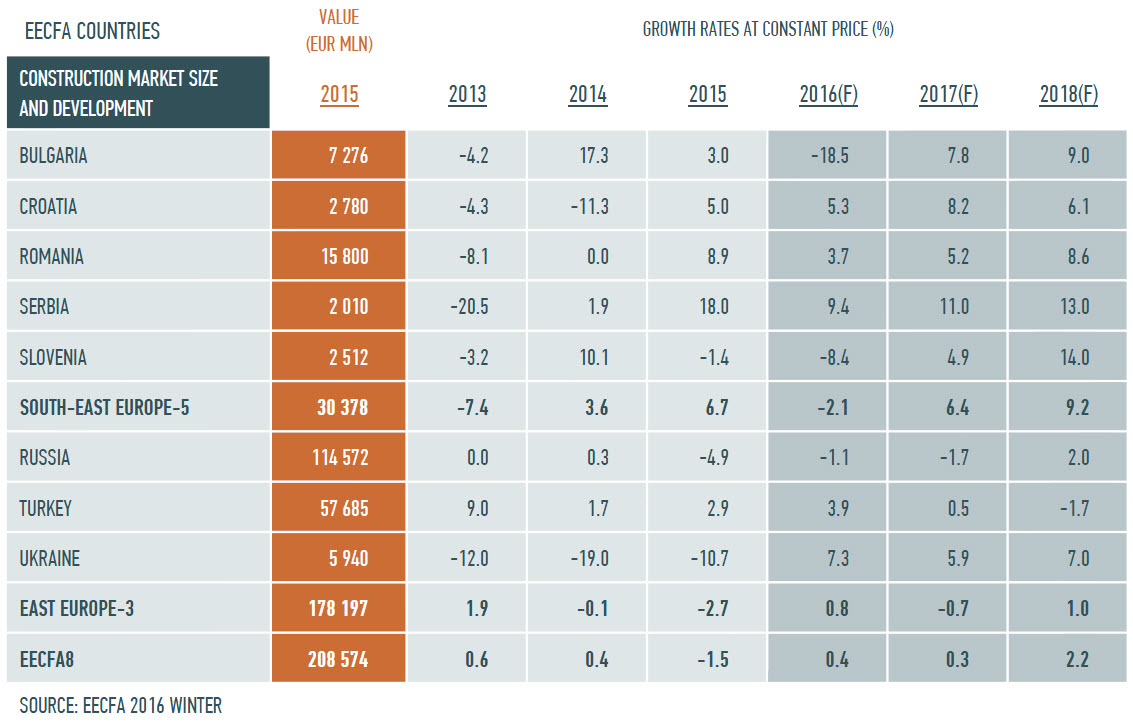
EECFA has released its winter construction forecast reports on 2 December 2016. In this post you will find the concise summary on our expectations for the 8 construction markets we are dealing with: Bulgaria, Croatia, Romania, Russia, Serbia, Slovenia, Turkey and Ukraine. You can also find us and our reports on eecfa.com.

eecfa_pressgraph


Regional outlook

South-East Europe is very optimistic. After the transitory 2016, when shrinkage in the civil engineering market in the EU countries of the region dragged down the region’s total performance, high growth is expected to characterize the total construction market in the upcoming years. Each EECFA country of the region predicts an expansion beyond 5% for 2017 and a further increase for 2018. Building construction, coming back from low levels, is predicted to expand faster than civil engineering in 2017.

Eastern Europe is at a standstill as a whole. In Russia, we expect a prolonged decline. The total construction market is not predicted to expand before 2018, and we believe that the growth of civil engineering sub-market can only alleviate the loss awaited in building construction in 2017. In Turkey, our stories for the upcoming years is rather similar to that of Russia, slight optimism in civil engineering, slight pessimism in building construction leads to a total market which is not predicted to grow until 2018. In Ukraine, all-round recovery is forecasted. From the very low levels, we expect relatively high growth rates for 2017 and 2018.

eecfa-_presstable

Continue reading EECFA 2016 Winter Forecast