Written by Prof. Dr. Ali Türel and Prof. Dr. Leyla Alkan Gökler, EECFA Türkiye
In H1 2026 Türkiye saw construction costs go up, which is biting into private housebuilders’ profit margins, while house price growth decelerated in real terms. Permit numbers grew in the first half of the year thanks to the public housing schemes of the government. However, Q2 2026 was already weaker in building permits and construction production, so it remains to be seen whether these public programs will keep residential construction strong.
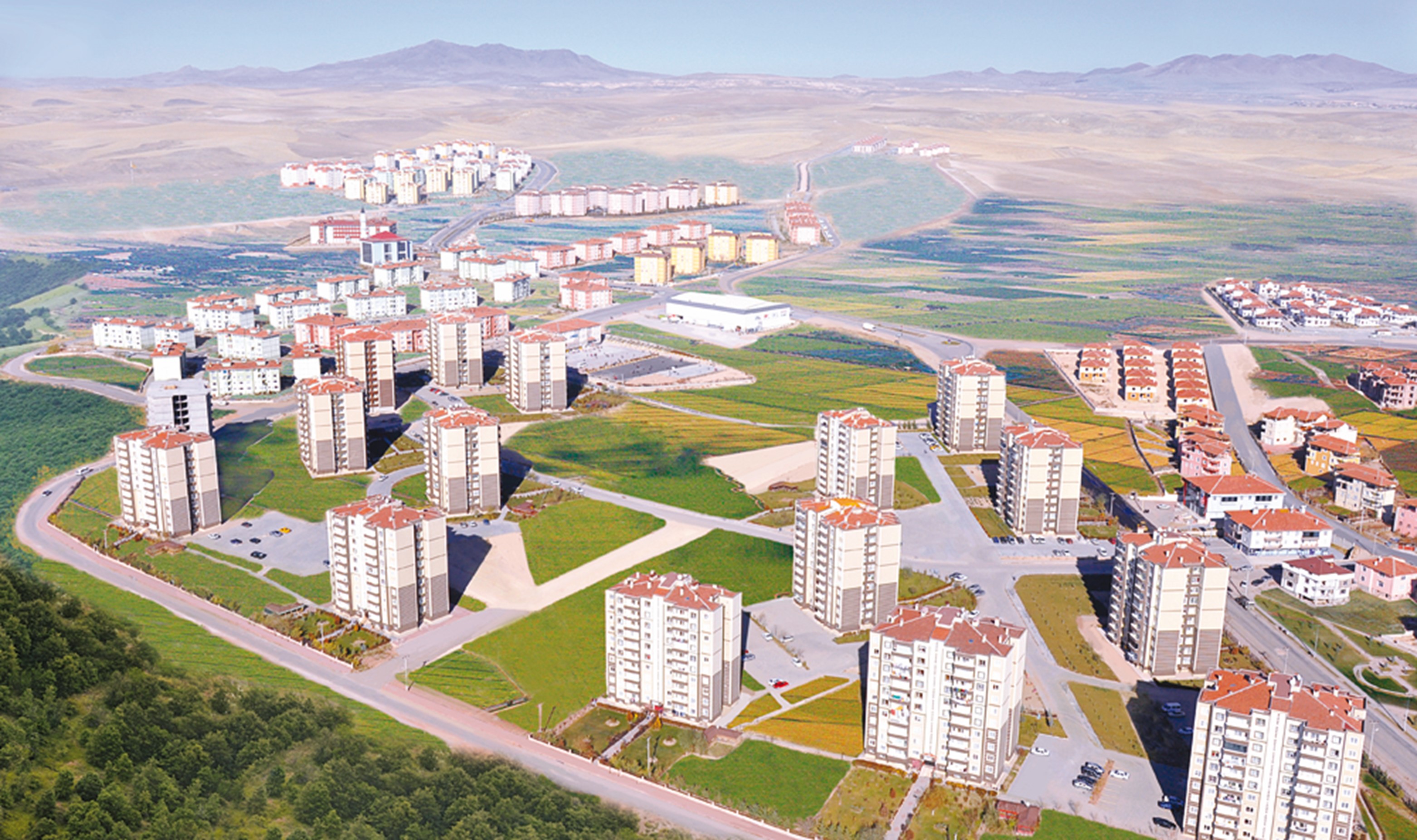
Residential buildings and non-residential development in Ankara – Photo by Prof. Dr. Leyla Alkan Gökler
H1 2026 statistics: construction costs, house prices, building permits
According to the statistics gathered and published by the Turkish Statistical Institute (TurkStat), a comparison of the monthly rates of change in the Consumer Price Index (CPI) and the Construction Cost Index (CCI) for residential buildings shows that construction costs increased at a slower pace than inflation in 2025. In January 2026, however, CCI recorded a considerable increase, while during the remainder of the first half of the year it generally continued to rise at a higher pace than inflation.
A comparison of the monthly rates of change in the Consumer Price Index (CPI) with the House Price Index (HPI) for 2026, published by the Central Bank of Türkiye, indicates that house prices also increased at a slower rate than inflation through June. Looking at the cumulative changes in these three indicators during H1 2026, CPI added 17.76% in June compared to December 2025, while HPI rose by 13.20% and CCI by 20.07%. These figures indicate that house prices grew at a slower pace than inflation during H1 2026, implying a decline in house prices in real terms. In particular, following the sharp increase in the building construction cost index in January 2026 over the rate of increase in house prices, this would inevitably cause a significant decline in profit margins for housing producers.
The number of dwelling units granted building permits reached 513,731 in H1 2026, indicating that construction permits were issued for 35,071 more dwelling units than in H1 2025. In terms of completed dwellings, occupancy permits were issued for 306,687 residential units during H1 2026, representing an increase of 28,990 units compared with the same period of 2025.
New housing developments at the Fringe of Ankara – Photo by Prof. Dr. Ali Türel
Public housing programs
Over the past three years the number of dwelling units granted building permits posted a massive growth, exceeding one million units in 2025, one of the main reasons being the rapid housing reconstruction program undertaken or financed by the government following the major earthquakes of 2023. By the end of 2025, the construction of as many as 455,000 urban and rural housing units, the majority of the post-earthquake housing units to be built, had been completed and delivered to legal beneficiaries.
The Housing Development Administration (HDA, the central government institution) has also been preparing a new social housing program with the intention of providing quake-resistant, low-cost housing with affordable prices, comprising 500,000 housing units since October 2025. Therefore, despite rising construction costs, housing construction continues at a relatively strong pace, with publicly developed housing accounting for a substantial share of building permits. Rise in the building construction cost index at a higher rate can also be related to the effects of the new social housing program of the HDA, and the remaining works of the reconstruction program of earthquake-damaged housing.
High-rise housing developments in Ankara – Photo by Prof. Dr. Leyla Alkan Gökler
Construction output
Despite the increase in building permits during H1 2026, this momentum has struggled to translate into actual construction output. Calendar-adjusted Construction Production Index declined by 3.1% year-on-year in May and by 6% in June. These falls may be linked to the nearing completion of earthquake reconstructions, as well as the 9.5% fall in housing permits in Q2 2026, although completions have continued to grow since Q2 2025, most likely under the effects of the completed reconstruction of the remaining earthquake-damaged housing.
With house price increases remaining below the rise in construction costs, the slowdown in construction output suggests that increasing cost pressures and narrowing profit margins are constraining the pace of the private sector’s housebuilding activity. Housing demand is also negatively affected by high interest rates as mortgage credits could be used in only 22% of housing transactions in 2026.
Residential market forecast for Türkiye up to 2028 is available in the EECFA Forecast Report Türkiye. For sample report or orders, contact us.
Traditional residential settlements in Ankara – Photo by Prof. Dr. Leyla Alkan Gökler
EECFA’s 2026 Summer construction forecast up to 2028 was released on 22 June. Sample report can be viewed at eecfa.com. To obtain the new reports, please contact us
Southeast European construction markets up to 2028
Bulgaria stepped into this year as the 21st member state of the eurozone in the middle of an evolving political turbulence that inevitably impacted the construction sector, most notably, projects that rely on public funding. Nevertheless, according to Yasen Georgiev at Economic Policy Institute (EPI), EECFA’s Bulgarian member institute, Bulgaria’s total construction output is anticipated to increase by approximately 2% on average in the forecast period of 2026-2028. He also notes that “Last year Bulgaria’s construction sector excelled with a strong performance, largely thanks to the residential and non-residential submarkets which fared better than previously predicted. In 2026-2028, however, the country’s total construction output could see a heterogeneous performance.”
Michael Glazer (SEE Regional Advisors) and Tatjana Halapija (Nada Projekt), EECFA’s members for Croatia, point to funding from the EU’s Military Mobility Package (MMP) as a promising source of finance for a wide variety of Croatian construction projects. Transportation ones, both straightforwardly military and dual use, are obvious contenders, so the availability of MMP money should lift output in those civil engineering segments. MMP will likely boost some non-residential segments, too, since it can finance, e.g., factories and logistics centers (perhaps even flight schools?) that have a military or dual-use purpose. This will help sustain total construction output despite rapidly declining levels of finance under the EU’s post-2022-earthquake rebuilding programs and RRF. In non-residential generally, while some developments will affect all segments, specific factors will ensure that output growth varies greatly from segment to segment. The picture for energy construction is also confused, with solid, well-known technologies competing with much-hyped, as-yet-unproven, “hi-tech” alternatives. Residential is buffeted by the conflicting influences of rising prices, declining GDP growth and interventions by the central bank and the government.
Dr. Sebastian Sipos-Gug, EECFA’s Romanian researcher at Ebuild, notes that Romania’s construction market is still in a tight spot. “Growth potential is limited with global and national factors conspiring against it. Recent economic forecasts are more pessimistic; 2026 might see a stagnant GDP, declining real wages and the highest inflation in the EU. This is coupled with the looming specter of national deficit causing high taxation and austerity measures: lower public spending, and wage and hiring freezes for public employees. Not to mention that construction costs, which started evening out in 2025 after the 2022 shock, are now again on the rise due to climbing energy prices and labor costs. The saving grace of construction is the EU programs funding infrastructure projects. Yet, with the NRRP running out in mid-2026, and other programs having an inconsistent performance, the boost they can provide is limited. Adding to all this is a political crisis that could lead to a government change at a critical moment (the end of NRRP absorption, projects phased into other funding sources). But the silver lining: most of these issues should be transitory. By 2028 Romania’s construction might return to growth on the back of improved economic indicators, inflation levels within the target range, a more efficient energy sector, and hopefully, a more stable political situation.”
“Serbia’s overall construction output is still consolidating in 2026 led by the correction in civil engineering, while buildings continue to grow in this forecast” – according to Dejan Krajinović, EECFA’s Serbian researcher at Beobuild. He adds that the performance in the residential submarket remains stable and is predicted to continue to grow with moderate growth rates. Non-residential, on the other hand, is booming, driven by massive investments related to the EXPO 2027, with another year of double-digit growth expected in 2026. Main segments benefiting from ongoing developments are office, commercial and hotel, but health-related construction is also breaking records in 2026. The consolidation in civil engineering is anticipated to end in 2027, with new growth on the horizon in 2028 and onwards. The large-scale infrastructure projects in the pipeline should launch a next big growth cycle in overall outputs. However, the war in the Middle East is already pushing construction costs up and the economic uncertainty and fragmentation are still risks that continue to linger in the coming period.”
“Slovenia’s construction sector’s output was holding steady at just under €6bn in 2024 and 2025 but is set to edge higher in the forecast period, supported mainly by public spending” – says Dr. Aleš Pustovrh at Bogatin, EECFA Slovenia. “Growth is increasingly uneven: residential construction remains constrained by limited supply and rising costs despite strong demand, while private non-residential segments such as offices, retail and industry face cautious investors and only modest expansion. By contrast, publicly financed segments, notably education, health and civil engineering renovation, are providing stability, with infrastructure upgrades, railway investment and energy-transition projects sustaining activity. Transport and utility constructions are shifting from large expansions to maintenance and modernisation, and investment in electricity networks and pipelines is set to rise further due to the energy transition. Overall, the sector is moving into a more stable but slower phase where public policy and infrastructure spending play a decisive role in keeping output on track – as long as public financing remains available.”
Eastern European construction markets up to 2028
According to Andrey Vakulenko at Macon, EECFA’s Russian research institute, the downward trend in Russia’s construction market, which began in 2025, is likely to continue and intensify in 2026–2027. The main reason behind is the combination of a decelerating economy and a prolonged period of high interest rates, which negatively impacts demand, limits the availability of financing and restrains investment activity. Residential construction is experiencing the strongest pressure as the market struggles to find a new balance amid reduced mortgage availability, declining demand and decrease in new construction. Most non-residential segments may also show negative dynamics in the coming years impacted by the slowdown in consumption volumes and business activity, weak household income growth and changes in the direction and scope of government funding in certain segments. Civil engineering will likely stay the most resilient subsector due to the implementation of major transport and energy projects. The planned acceleration of infrastructure construction, the expected growth in the residential submarket and the easing of monetary policy are the conditions for the construction market to return to a growth trajectory in 2028.
“In Türkiye, state involvement in housing development has grown in recent years” – say Prof. Ali Türel and Prof. Leyla Alkan Gökler, EECFA’s Turkish researchers. “Policies to curb inflation have depressed households’ disposable income, creating a serious housing affordability issue for both ownership and renting as home prices and rents have spiked. As moderate-to lower-income households have found it increasingly difficult to accumulate sufficient equity for home purchases, the government has intervened. It launched a large number of residential projects for dwellings that can be bought on affordable terms by households not owning a house in Türkiye. Dwellings will be built by the Housing Development Administration (HDA), the key state actor in housing production in Türkiye. Since HDA has also been involved in rebuilding the about 550,000 dwellings damaged in the February 2023 quake, the share of housing built by the public sector has greatly risen in recent years, while the share of the private sector has been declining from its former share of about 90%. Our latest forecast indicates that total construction output in Türkiye may reach nearly 8 trillion TL (nearly EUR 180 billion) in 2028, at 2025 prices.”
“Ukraine’s construction market exhibited high resilience in 2025 despite the ongoing war and challenging security conditions. While it is recovering and it nominally returned to pre-war levels last year, it was still 40% below the 2021 output at comparable prices.” – notes Professor Sergii Zapototskyi at Uvecon, EECFA Ukraine. “Key growth drivers were commercial, industrial, warehouse, and logistics developments, an uptick in residential construction in relatively safe regions, and large-scale projects aimed to restore public and transport infrastructure. In the coming years, the construction market is expected to continue to grow, supported by post-war reconstruction needs, government housing support programs, and an increase in international funding for Ukraine’s recovery. The greatest growth potential will remain in residential, commercial, as well as industrial and warehousing construction. At the same time, the future performance of the market will largely depend on the security situation, the availability of investment resources, the ability to address labour shortages, and the effectiveness of government reconstruction policies.”
EECFA released its 2025 Winter construction forecast on 12 December. Check out a sample report and place your order on eecfa.com. For discount, please contact us.
Southeast European construction markets
“Bulgaria’s total construction output is forecasted to increase by 3% on average for 2026-2027” – says Yasen Georgiev at Economic Policy Institute (EPI), EECFA’s Bulgarian research institute. He adds that this is to follow estimates for a similar performance of almost 3% in 2025. The sectoral background, however, shows, a nuanced picture – cooling of residential construction, positive news from non-residential and a robust performance of civil engineering. The latter will benefit from investments which will be backed by the absorption of EU funds through the Recovery and Resilience Plan (RRP) and classical operational programmes, both with implementation deadlines in 2026 and 2027. At the same time, Bulgaria’s economy is to expand by 2.4% on average in 2026-2027 – a period continuously shaped also by the Euro adoption on 1 January 2026.
Michael Glazer (SEE Regional Advisors) and Tatjana Halapija (Nada Projekt), EECFA’s Croatian members, think that declining dwelling sales in Croatia have, paradoxically, failed to stop the growth in the value of Croatian residential output, because increases in the price per square meter of those dwellings that do get sold have more than compensated for the lower number of square meters bought. “But how long this can continue is unclear” – they add. “The policies that the Croatian government is implementing in order to ease the country’s housing crisis are confusing the residential picture still more, since a number of those policies have contradictory effects on output. As to non-residential building construction, output growth during the period covered by the current forecast will depend greatly on the sector, with some likely to continue to benefit from catch-up growth and EU support for a bit longer and others moving toward a steady state or even a decline. In civil engineering, EU funds continue to play the dominant role in financing construction of all sorts. Sports facility construction is experiencing a boom, but given the speed with which such projects are completed, the effect on output will be relatively brief. Renewable energy construction should be growing rapidly, but regulators’ hostility toward the sector are holding it back.”
“Romania’s economy is entering a challenging period as the recently implemented measures to reduce the national account deficit begin to take effect” – reports Dr. Sebastian Sipos-Gug, EECFA’s Romanian researcher at Ebuild. “While most forecasters do not anticipate a recession, economic growth is expected to remain subdued over the next two years. Inflation is the highest in the EU, boosted in 2025 by increases in sales taxes. As a result, consumer prices are rising at a pace that is forecasted to outstrip wage growth, leading to a decline in real incomes in both 2025 and 2026. Government spending is also facing cuts, thus both private and public consumption are predicted to decline, with a chilling effect on most construction activity types. There is also the challenge of the massive level of public investment required by civil engineering projects that have started since 2023, which will be difficult to sustain under the austerity and the mounting pressure of losing even more EU funding. On the brighter side, both the economy at large and the labour market are expected to be quite resilient. By 2027, assuming the deficit reaches manageable levels, the effects of contractionary policies should fade out, inflation could ease, and interest rates could come down. This means that demand for construction would rebound and with it, construction activity.”
Dejan Krajinović, EECFA’s Serbian researcher (Beobuild) says that “Serbia’s overall construction output sank into a negative territory in 2025, primarily owing to the weaker performance in civil engineering. This year recorded growth in building construction, but the substantial consolidation in civil engineering dragged totals in red. The completion of major road, railway and energy projects contributed mostly, but delayed construction starts played a role as well. Residential construction is stable and is on historical levels, while non-residential construction is booming led by the hosting of the EXPO 2027 in Belgrade. Investments into commercial, hotel and office buildings are all spurred by the event, with the purposely built EXPO 2027 complex consisting of numerous venues being the single largest investment in non-residential. Improving financial conditions and sustained demand still support relatively high construction activity, but a lot of global political and economic uncertainties are dimming future prospects.”
Dr. Aleš Pustovrh at Bogatin, EECFA Slovenia, says that Slovenia’s construction sector is holding steady at EUR 6bn, though growth has cooled. Residential buildings remain the anchor, with output expected to show only a slight dip in 2025, helped by strong employment, rising wages and cheaper mortgages. Property transactions rebounded in early 2025, reversing last year’s slump, while prices continue to climb amid land shortages and slow permitting. Public housing programmes are ambitious, but private developers are concentrating on Ljubljana and coastal towns. Non-residential construction is mixed: offices are recovering slowly, retail stays subdued, but industrial and warehousing thrive on export demand and automation while health and education remain at very high levels. Civil engineering and public works lean on EU-backed projects and are anticipated to reach historically high levels by 2026.
Eastern European construction markets
Andrey Vakulenko at Macon, EECFA’s Russian research institute notes that “the high key rate and the overall economic slowdown are constraining the Russian construction industry with negative trends expected for the current year and over the next two years. An easing of monetary policy, which has already begun, could help normalize the situation, but a positive effect is not expected until 2027. The main drag on construction output will likely be the residential subsector where high rates and revised government demand support principles are reducing activity among both buyers and developers. Negative trends will also likely persist in most non-residential segments due to declining growth rates of budget financing, a general decrease in business activity and a slowdown in consumption. The overall descending dynamics in the construction market may somewhat be mitigated by stable growth in civil engineering driven by export projects in energy and transport, but this growth is not predicted to be enough to keep the construction market in a positive zone”.
Prof. Ali Türel, EECFA’s Turkish researcher, reports that “the major effect of inflation-curb policies in Türkiye is the decline in disposable income and in the purchasing power of wage earners and pensioners. The moderate to lower-income population is unlikely to save enough equity for buying a home when rents have also become unaffordable for many. Ironically, housing sales have been increasing at a much higher rate than the growth of households. This can be attributed to the typical trend in Türkiye, where, during inflation, people expect a higher real return on their financial assets from real estate investments compared to alternative investment options. The reconstruction of earthquake-damaged buildings and infrastructure also contributed to the high rate of growth in building starts and completions from Q2 2025 onward, leading to the highest rates of change in the construction sector’s contribution to GDP compared to other sectors. Our latest forecast indicates that total construction output in Türkiye may reach 6.4 trillion TL in 2027 (EUR 180 billion), all at 2024 prices.”
According to Prof. Sergii Zapototskyi of Uvecon, EECFA Ukraine, despite the war and high risks, Ukraine’s construction industry remains one of the key drivers of economic recovery in 2025. The RDNA4 (the latest Rapid Damage and Needs Assessment Report) estimates Ukraine’s reconstruction needs for the next decade to be USD 486-524 billion, creating long-term demand for residential, non-residential and civil engineering construction works. Major challenges persist, including the uncertainty regarding the duration of the war, especially in frontline regions, labour shortages, bureaucratic barriers in the urban planning legislation, and logistical constraints due to the relocation of production facilities, and often, shortages in building materials. At the same time, the industry is demonstrating resilience: developers are diversifying supply chains, stabilizing procurement schedules, and increasing activity in the Central and Western regions. Demand for housing, intensive infrastructure restoration, and international investment from the EBRD, EIB, and other partners continue to support positive dynamics. The sector’s development prospects for 2026-2027 will largely depend on the security situation and the effectiveness of state recovery programs.
Rebuilding permits, previously excluded from TurkStat’s statistics, were published on 22 August this year. The addition of statistics on rebuilding damaged housing in earthquake-hit regions raised building permits and completions in Q2 2025.
Video by TOKI (Housing Development Administration): Construction projects implemented by TOKI in the earthquake zone in Türkiye.
This May and June saw high construction production in Türkiye
The Calendar Adjusted Index of Construction Production increased by a respective 20,4% and 24,9% in May 2025 and June 2025 compared to the same months of 2024, after declining in the previous three months. Building construction went up by slightly higher rates, 23,5% and 16,9%, while civil engineering grew less, by 9,9% and 16,7% in May and June 2025.
Construction also had high shares in the Turkish GDP. The Seasonal and Calendar-Adjusted Gross Domestic Product in the chain-linked volume index for construction in Q1 2025 expanded by 7.4% annually, while the national average GDP growth was 2,7%. The rise in construction within GDP began after the destructive earthquakes in February 2023. The rebuilding of approximately 870,000 independent units, including 650,000 dwelling units and infrastructure, started in the following months, and the growth rate of construction in GDP increased to 7,2% in 2023 and 9,3% in 2024.
In Q2 2025 we may expect a higher growth rate for construction than in the previous quarter since the completion of 250 thousand dwelling units has been reported until June 2025. Also, a total of 453 thousand urban and rural housing and workplaces will be handed over to legal beneficiaries by the end of 2025 (Source: Anatolian News Agency).
However, building start and completion statistics did not show the same trend in Q1 2025; the total floor area of construction and occupancy permits fell by 20% and 24,9%, respectively, compared to Q1 2024.
Rebuilding statistics in earthquake-hit regions added on 22 August 2025
Q2 2025 saw a sharp reversal of this trend with the addition of rebuilding statistics of damaged housing in earthquake-hit regions. We have been following the process of inclusion of the rebuilding statistics into TurkStat’s published statistics, and we are happy to see that it was published on 22 August 2025.
The delay of including rebuilding statistics can be linked to the effects of law 7471 which aims to speed up rebuilding damaged structures in earthquake-hit regions. The responsibility of the Ministry of Environment, Urbanization, and Climate Change in rebuilding damaged housing caused by natural disasters is further supported by this law. The Housing Development Administration (known as TOKI in Turkish), affiliated with that Ministry, handles the implementation and financing of rebuilding projects. The Ministry’s local branches have been issuing construction and occupancy permits in earthquake-affected regions as outlined in the same law. TurkStat collects and publishes building permit statistics issued by municipalities and transmitted online to them. Since the local branches of the Ministry were not part of this network, rebuilding permits were not included in TurkStat’s previously published statistics. The table is based on the revised statistics and there may still be further revisions in future publications if there is missing data in current rebuilding statistics.
Building permit floor area,mln m2
Building permit annual change,%
Occupancy permit floor area,mln m2
Occupancy permit annual change,%
2023
197,56
16,7
118,80
-15,6
2024
180,27
-8,7
138,21
16,4
Q1 2025
35,24
-20,0
31, 25
-24,9
Q2 2025
54,36
61,8
27,20
30,2
Rebuilding permits in earthquake-hit regions. TurkStat has revised the data by including permits of all authorized administrations to issue building certificates.
Less building construction activity without rebuilding works can be related to the high-interest rate policy to curb inflation, currently at a 43% level. Both producers and credit users have problems in production and purchasing produced goods without relying on bank credits. Lowering inflation and interest rates would lead to the stimulation of building construction.
Forecast up to 2027 for the Turkish construction market is available in the 2025 Summer EECFA Forecast Report Türkiye. To order it or to request a sample report, please contact us.
EECFA released its 2025 Summer construction forecast on 23 June. See a sample report and place your order on eecfa.com. To get discounts, you may contact us.
Southeast European construction markets up to 2027
According to Yasen Georgiev at Economic Policy Institute (EPI), EECFA’s Bulgarian research institute, total construction output in Bulgaria is anticipated to grow by 3% on average for 2025-2027 with a stronger growth in the middle of the period when the absorption of operational programmes and the implementation of the Recovery and Resilience Plan are to gain momentum. According to the sectoral breakdown, residential construction is expected to be the subsector with the weakest performance, while non-residential construction and particularly civil engineering are predicted to see stronger growth figures. Against this backdrop, the country’s economy is set to register a slower-than-expected growth in 2025 and 2026. In parallel, it is awaited to benefit from the effects from the full Schengen area membership effective from the beginning of 2025 and from the euro adoption expected on 1 January 2026.
Michael Glazer (SEE Regional Advisors) and Tatjana Halapija (Nada Projekt), EECFA’s Croatian members think that Croatia’s construction as a whole continues vibrant due to the combination of continuing transitioning-economy catch-up growth and large inflows of EU money. Both are beginning to diminish, however, and that will affect all construction segments, some more strongly and more quickly than others. In building construction several sectors have seen the end or are close to seeing the end of catch-up growth. Others, particularly those that benefit most from EU finance, are still going strong. Civil engineering continues to profit greatly from EU funding, and because of the poor initial condition of Croatia’s infrastructure after independence, much catch-up construction remains to be done. Certain government policies will have a great influence on specific building and civil engineering sectors. Those policies include the housing policies embodied in Croatia’s new National Housing Policy Plan until 2030, the new tax on real estate and the country’s renewable energy permitting and electrical grid hook-up fee rules.
‘Romania’s macroeconomic outlook remains positive, but more reserved as the political instability and fiscal uncertainty have done little to improve growth opportunities’ – says Dr. Sebastian Sipos-Gug, EECFA’s Romanian researcher at Ebuild. At the same time, he adds, the country has the largest government deficit in the EU, which will dampen public investment capabilities. All these will make it harder to finance public works and could negatively impact civil engineering. This is doubly worrying as this subsector countered the decline in other construction segments in 2024, and thus the outlook for total construction remains negative in 2025 and 2026 in real terms. Not all is gloom and doom, however. As inflation and interest rates come down, and employment indicators remain strong, private consumption could boost demand for residential and non-residential construction.
‘In 2025 Serbia’s construction is making new gains in building construction, while civil engineering has entered a period of consolidation after the strong expansion during 2023 and 2024′ – believes Dejan Krajinović, EECFA’s Serbian researcher at Beobuild. Building construction is supported by both public and private investments, boosted by the hosting of the EXPO 2027 in Belgrade. Non-residential construction is the main beneficiary of this event, particularly commercial, office and hotel segments, while residential construction is also keeping historically high volumes. Some delays are seen in civil engineering, but the overall performance is still strong with a long list of planned projects in all major subsegments. Domestic demand is still relatively strong, but economic growth and the level of investments are being muffled this year by uncertainties in the global markets, particularly the weak EU economy, international trade issues and the ongoing wars in Ukraine and the Middle East.
‘Total construction output in Slovenia is expected to decrease from the historic high of EUR 5,5 billion reached in 2023. In both 2024 and 2025, it could contract but remain above EUR 5 billion annually’ – as per the opinion of Dr. Aleš Pustovrh at Bogatin, EECFA’s Slovenian member institute. He predicts the sector to return to growth in 2026 and 2027, mostly on the back of a healthy growth in residential construction buoyed by decreasing mortgage rates. On the other hand, civil engineering is prognosticated to shrink significantly in 2024 and 2025 due to some large projects nearing completion, like the new railroad connecting Port Koper. Both non-residential and civil engineering depend to a large degree on public financing that was widely available in the post-Covid period but will become much less available in 2025-2027. Especially if the overall economic activity continues to slow down. This deceleration and more foreign labourers have also caused lower construction cost growth, but other challenges persist such as the additional bureaucratic burdens (changed permitting process, increase in tax, ongoing discussion on changes to short-term rental legislation, among others) and many external risks in the global economic and political environment.
Eastern European construction markets up to 2027
‘In the forecast horizon, the construction sector of Russia will be under pressure from a range of macroeconomic factors, the main one being the high key rate, which will negatively affect the pace and volume of construction projects’ – according to Andrey Vakulenko at MACON, EECFA’s Russian research institute. The tight monetary policy and the reduced availability of mortgages will likely slow down housing construction, on the one hand. On the other, the high cost of project financing, the general cooling of the economy as well as reduced consumption and business activity will likely shrink the volume of investment in non-residential construction. However, these trends can partly be offset by high volumes of government financing of priority infrastructure and energy projects, which can support civil engineering and ensure near-zero growth in total construction market in 2025-2027.
Prof. Ali Türel, EECFA’s Turkish researcher says that Türkiye has been trying to control high inflation by raising the base rate and managing exchange rate increases through market instruments by the Central Bank and maintaining wage growth at zero or negative rates. This created financing difficulties for industries and businesses, reduced demand for basic consumer goods, and led to affordability problems for mortgage credits. Big declines in building starts and completions in Q1 2025 may also be related to these measures. Yet, the Central Bank’s inflation target for 2025 remains high at 24%. Positive real changes in housing prices relative to building construction costs encourage house building, while their negative real change compared to inflation may be the leading factor in the increase of home sales through equity financing when mortgage credits are not affordable for most households. Rebuilding the quake-damaged 870 thousand units requires about EUR 100 billion and these expenditures have been the primary factor of the large national deficits in recent years.
‘This year, in spite of the continuing war and the economic instability in the country, Ukraine’s construction industry shows signs of recovery and growth on the back of successful programs financing both the construction of new facilities and the reconstruction and restoration of infrastructure in eastern and southern regions’ – according to Prof. Sergii Zapototskyi at Uvecon, EECFA Ukraine. The World Bank estimates that reconstruction would require USD 486 billion. On the negative side for the sector are bureaucratic barriers in the urban planning legislation, shortage of workers caused by mobilization, shortage and high cost of building materials, and logistical difficulties. On the positive side for the sector is demand for housing and the need to restore damaged infrastructure. The near-term future of the industry depends on the level of security, the effectiveness of restoration programs and the volume of international investments.
EECFA released its 2024 Winter construction forecast on 16 December. Check out a sample report and purchase any of the 8 reports or the package of 8 reports at eecfa.com. For discounts, contact us.
Southeast European construction markets
Total construction output in Bulgaria is forecasted to grow by an average of 3.3% in 2024-2026, which is slightly above real GDP growth projections for the same period. The subsector breakdown shows that residential construction is expected to lose momentum, but this is likely to be compensated by a more dynamic performance of non-residential construction and civil engineering. In parallel, general economic activity in Bulgaria in the forecast period is to be influenced by the effects from the full membership in the Schengen area from 2025 onward and the prospects for the country to introduce the euro on 1 January 2026.
Croatian building construction presents a varied picture across subsectors, with anticipated output growth ranging from significantly positive to somewhat negative. Civil engineering is more uniformly positive, but certain sectors show the effects of the completion and commencement of large projects. Both building and civil engineering output growth will be strongly influenced by new government laws and regulations, the consequences of which, while likely to be large, are difficult to predict for both the short and medium terms. These include the new National Housing Policy Plan until 2030, the new tax on real estate and measures to balance the playing field between different types of tourism accommodations.
Despite the rise in investment, Romania will likely continue to see a stifled growth in construction in real terms due to costs remaining high. Stubborn inflation and the slightly disappointing macroeconomic performance combined with increased wages and still high interest rates create a less appealing environment for investors in building construction. On the bright side, high income and importsare indicative of strong demand for consumption and could translate to demand for construction. While infrastructure did well, the current political turmoil and uncertainty could hobble performance going forwards. Even assuming deficit remains high but stable, as the EC expects, it would continue to raise public debt and make financing further projects more politically difficult. As some downside factors could improve by then, construction growth is forecasted to return to positive in 2026.
Serbia’s construction is likely to have closed another strong year led by civil engineering, but non-residential also entered a new growth cycle with positive outlook boosted by public investments and the hosting of the EXPO 2027 in Belgrade. The construction of commercial, office and hotel buildings are all set to grow in the coming period, followed by education and health. Residential construction is already on historically high levels with a relatively stable performance. In civil engineering, road and railway construction continues unabated, breaking new record volumes on the way, but other segments also have an impressive project pipeline. The economy is set to expand by 4% in 2024 and 2025 on the back of strong consumption and high investment, so construction outputs may sustain formidable levels up to 2026.
Slovenia’s construction sector is expected to maintain post-pandemic levels with annual output consistently exceeding EUR 5 billion up to 2026 against the EUR 3 billion pre-pandemic. Public financing has been a key driver with national budget expenditure up from EUR 10 billion in 2019 to over EUR 15 billion in 2024, though there will be spending limits in 2025-2026. Civil engineering in the forecast period will be supported by major infrastructure projects. Residential construction is set to drop slightly first in 2024 before rebounding by 2026 driven by lower mortgage rates. Non-residential construction is forecast to grow steadily but remain dependant on the availability of public financing. Other challenges remain such as labour shortages, permit backlogs and high costs, but construction cost growth is set to stabilize at under 3% annually.
Eastern European construction markets
In 2024, the Russian construction industry fared better than previously expected driven by the high pace of project implementation and the massive budget support in civil engineering and non-residential construction. It could even offset the negative impacts of the decline in housing construction caused by the end of the mass preferential mortgage program. However, this positive momentum is expected to gradually fade owing to the tight monetary policy of the Central Bank and several other internal and external factors that are slowing down the economy in general and the construction industry in particular. In 2025-2026, the record budget expenditures planned within the framework of new national projects and other measures of state financing will likely maintain construction market volumes in Russia in the positive territory, but with minimal growth.
In Türkiye, increased interest rates and the Central Bank’s policy to reduce the depreciation of the national currency to curb inflation has not yet produced the intended outcomes. And high interest rates are blamed for shrinking industrial output and decelerated trade growth. The interest rate and the Central Bank’s policies had two major effects on the construction sector: big negative real rates of change in construction costs and housing prices. Housing sales are growing as real prices drop and rely on equity financing since mortgage loans have become unaffordable at high interest rates. Building permits in most segments decreased in Q3 2024, while completions had a positive trend. The government’s legal obligation to rebuild the earthquake-damaged 350 thousand buildings with 870 thousand independent units has been the main factor in huge budget deficits that impede the Government from providing sufficient funds for civil engineering projects.
As a consequence of the war ongoing for over 1000 days, Ukraine’s construction market is facing economic difficulties, limited resources, huge losses in buildings, hike in building material prices, lack of skilled workers and limited access to financing, topped with the unpredictability of government decisions and the instability of property rights. The destroyed homes of more than 1.5 million families create a huge demand. Non-residential construction also focuses on the restoration of destroyed buildings and the construction of new ones in safer central and western regions. Civil engineering is also boosted by the renovation of bridges, roads, railways, pipelines, communication and power lines. The ‘Unified portfolio of public investment projects’ recently approved by the government includes 750 big reconstruction projects on roughly UAH 2.36 trillion, while the state budget also has UAH 256.1 billion for public projects in 2025. First, the EUR 50 billion under the EU’s Ukraine Facility are to be used. Financing is also planned through international financial organizations and foreign governments. The priority is energy, transport, utility and public buildings such as schools.
One and a half years after the devastating quakes that shook Türkiye, rebuilding is slow, and the public money spent on the reconstruction of damaged buildings and infrastructure are causing massive budget deficits in Türkiye’s economy. It is topped with high inflation, increased interest rates, growing unemployment and a stagnant minimum wage. With the current pace of construction, it seems that the reconstruction of 870 thousand units will take two to three additional years.
Owner-occupied social housing project of the Housing Development Administration (TOKI) that is in charge of rebuilding in earthquake-hit regions. Photo with the permission of TOKI
What happens in Türkiye’s economy
Türkiye’s economy continues to have a bad time due to high inflation despite conventional economic policies put into effect after the re-election of President Recep Tayyip Erdoğan last May. In the following 10 months the Central Bank of Türkiye (CBT) increased the base rate from 8,5 points to 50 points and since then it has remained at that level. Bank interest rates followed suit, causing affordability problems for mortgage and consumer loans.
In July 2024, monthly and yearly rises of Consumer Price Index were 3,23% and 61,78%, and in Domestic Producer Price Index 1,94% and 41,37, respectively. The latest inflation forecast of the CBT at the end of the year is between 38% and 42%. Policies to curb inflation began to show their negative effects on the economy as Calendar Adjusted Production Index of Total Industry fell by 4,7% and Manufacturing by 6,9% in June 2024 from June 2023. Seasonal and Calendar Adjusted Index also dropped in June 2024 from the previous month by a respective 2,1% and 3,1%. Unemployment grew by 7,2% in June 2024 and rose to 9,2% as 234 thousand people lost their jobs within one month. GDP is also predicted to decline in Q3 and Q4.
Wage increases are curtailed within the scope of the economic program to keep inflation under control. The minimum wage did not rise for the whole second half of 2024, despite Consumer Price Index rose by 24,73% in the first 6 months. Income levels of pensioners, most notably of those in the lowest income segment, have been a much-complained issue in recent months. This is also aggravated by the low retirement age that was further reduced by a law enacted in 2023. The high number of retired people to total employment necessitates increasing transfers from the national budget to the Social Security Institution.
How reconstruction efforts stand 1,5 years after the quakes
Rebuilding damaged housing, workplaces (industrial, commercial and other uses), and infrastructure following the earthquakes on 6 February 2023 requires massive investments from the national budget. Big budget deficits under these circumstances lead to increases in the public sector’s borrowing requirements. Civil engineering projects are worst affected by the financial strain on the national budget owing to the state’s legal obligations in rebuilding structures damaged by natural disasters.
The reconstruction of buildings and infrastructure is estimated at EUR 100 billion. As an alternative to the direct provision, the government introduced a financial assistance: 1.500.000 TL (44177 Euro) loan with a 50% grant to people either building an own house or buying one.
According to Murat Kurum, the recently reappointed Minister of Environment, Urbanisation, and Climate Change (the organization responsible for rebuilding collapsed and pulled down or heavily damaged buildings):
in the first 3 months of 2024, the construction of 76 thousand dwelling units was completed and transferred to their owners
the target for 2024 is to complete 200 thousand dwelling units by the end of the year
monthly expected completion is 25-30 thousand dwelling units
It implies that rebuilding 870 thousand independent units (650 thousand housing, 170 thousand workplaces) may continue for 2 to 3 more years.
Building and housing developments as of Summer 2024
In Q2 2024, construction permits for buildings in total floor area nosedived by 30,9% from Q2 2023 and the yearly change was a 32,9% rise in Q1 2024. In housing permits the yearly fall in the number of units in Q2 2024 was 28,9% (against the 34,3% growth in the previous quarter).
Occupancy permits for buildings in Q2 2024 sank by 14,4% in total floor area, and 23,5% in the number of dwelling units from Q2 2023. Like starts, the yearly rates were 45,5% and 38,9% growth in Q1 2024, respectively. Thus, it can be said that policies to curb inflation also create negative effects in building production.
Housing Price Index grew by 38,7% at current price yearly in July 2024, showing a 14,3% drop in real terms. The rise in housing prices was much less than construction cost in the previous month; Construction Cost Index increased yearly by 66,12% in June 2024 when Consumer Price Index rose by 71,60% and Domestic Producer Price Index by 50,09%. June 2024 was the first month over many years that the yearly rise in Construction Cost Index was less than Consumer Price Index. The rise in labour cost, 105,50%, is pushing total construction costs upward, and material prices, with a 51,55% rise, downward. Curbing minimum wage increases until the end of 2024 may be expected to lead to a lower rate of change in the construction cost in the following months.
In July 2024 housing transactions comprised 127,088 thousand (+16% like-for-like). Between January and July 2024, the number of dwelling units sold was 672,162 thousand, only 0,5% less than in the same 7 months of 2023. The main difference was in mortgage sales (only 9% of total sales in July 2024), and 9,4% in January-July 2024, dropping by 20.9% and 53,8% from the same months last year. Such great falls in mortgage sales are related to decreased affordability for mortgage loan repayments of commercial banks between 3,05 and 4,20 monthly interest rates for 10-year term mortgages. Subsidized mortgage loans by state-owned banks at 0.69-0.99% monthly rates to people who are not homeowners did not greatly affect the share of mortgaged transactions.
Forecast up to 2026 for the Turkish construction market is available in the EECFA Forecast Report Türkiye 2024 Summer. To order it or to request a sample report, please contact us.
EECFA, our construction forecasting cooperation in Eastern European countries, released its 2024 Summer construction forecast on 25 June.View a sample report and buy any of the 8 reports or the package at eecfa.com. For discounts,contact us.
The expansion phase was over in 2023 in SEE as a whole, but the current contraction is not foreseen to last as long as the latest one after 2008. By 2026 this region could return to around its previous peak. The EE region as a whole is expanding, and we are still optimistic all the way on the horizon.
A closer look reveals that only Romania, the largest market, is behind the overall setback of the SEE region. Here the previous peak is not expected to be reached soon. Elsewhere in the region further expansion is our current view. Serbia’s trajectory is a bit different, but the market could stay at a high level despite the drop next year. Recovery in Türkiye is forecast to be so strong that it could well counterbalance a shrinking Russia. Ukraine is coming back from a very low level, hence the relatively good growth figures.
Southeast European construction outlook up to 2026
Bulgaria’s economy is set to grow by almost 2% in 2024 and 3% in 2025, while the country is heading to a eurozone membership, most likely in 2026. In parallel, construction output is forecasted to decline year on year in 2024-2026 due to expected drop in residential construction and heterogeneous, yet positive performance of the non-residential one. Civil engineering bears a potential for an accelerated growth if EU funds’ absorption bounces back and public investments in infrastructure speed up.
Croatian civil engineering is moving into even higher gear now, especially with the recent update to the TEN-T Network, which greatly benefited Croatia. Accordingly, output in most civil engineering sectors will rise. Building output presents a more mixed picture, with some sectors having reached or come close to peak output, while others are thriving.
The outlook for Romania’s construction sector remains negative this year. Inflation is shrinking, but more slowly than desired, keeping interest rates relatively high for longer and impacting financing costs. Also, the switch between the EU programming periods, combined with still high construction costs and an election year, will mean lower efficiency in starting and implementing long-term projects. Because the macroeconomic outlook is good and if the other issues are resolved, by 2026 construction might start growing again.
Serbia is expecting to see more stabilization in the construction sector this year, with both building construction and civil engineering estimated to stay in the black. The latter is very close to recording a consecutive double-digit growth in 2024. The economy is picking up, interest rates are slowly receding, so there is confidence that construction can sustain high output levels. Demand stays relatively strong, while stable prices are to keep investments high this year.
Slovenian construction is forecasted to surpass its record 2023 output this year and continue its growth trajectory into 2025, exceeding EUR 6 billion for the first time. Major civil engineering projects will likely drive this growth, bolstered by flood reconstruction efforts. Public investment in housing is planned but is contingent on future public funding availability that will also impact non-residential construction. The industry faces workforce shortages, but increased immigration and declining construction costs are expected to mitigate these issues, supporting further growth.
Eastern European construction markets of EECFA up to 2026
In Russia, the increase in people’s solvency, the restoration of business activity and dynamic economic development ensured growth in construction output last year, but recovery trends are slowing down owing to both external restrictions and internal negative factors. The residential and civil engineering construction subsectors remain key for the industry, but their dynamics depend on the level of government participation and the volume of allocated budget funds. Even though negative trend is forecasted for the residential subsector in the coming years, the drop in overall construction output in 2024-2026 is not predicted to be significant as the market will be supported by the construction of export infrastructure projects.
Türkiye’s economy has been greatly affected by last year’s earthquakes that caused great human and material casualties, requiring the rebuilding of destroyed homes, workplaces, and infrastructure. The government’s costly obligations coincide with a return to conventional economic policies that require austerity. Massive reconstruction spendings have caused huge budget deficits and civil engineering is worst affected by this. Increased interest rates have created affordability problems for bank loans, mostly mortgage ones, so home purchases rely mostly on equity financing and serve as a hedge against inflation. Home permits in Q1 2024 rose due to permits issued in earthquake-hit regions. This, and the private sector’s returning appetite in most commercial building segments, aligns with the expected high GDP growth.
Ukraine is making great progress in overcoming the consequences of the full-scale invasion, showing economic growth. The issue of reconstruction is acute, though. The main problems in the market are rising prices and shortage of building materials, growing costs of logistics and a shortage of skilled labour. In energy the immediate restoration of energy generation facilities is required to provide stable electricity. State and international programs for the restoration and construction of housing will likely contribute to the revival of the construction market. In the coming years, the future of the market, more than ever, will depend on three things: results on the battlefield; Ukraine’s subjectivity in the international arena; and the ability to protect its interests against Russian diplomacy.
EECFA, which celebrates its 10th anniversary this year, released its 2023 winter construction forecast on 15 December 2023. The new reports can be purchased, and a sample report can be viewed at eecfa.com.
No clear direction in the Southeast European region of EECFA; 2024 is foreseen to experience a decline, but a comeback is our current scenario for 2025. Expansion is projected to prevail all the way until the end of the forecast horizon in the East European region.
Romania is expected to contribute most negatively to the shrinkage of the SEE region in 2024. The rest of our countries is forecast to perform better. Bulgaria, Croatia and Serbia could end up at higher level in 2025 than what was experienced in 2023. Upswing in Türkiye is envisaged to pull the EE region up and we still believe that shrinkage in Russia is about to come. Not a particularly strong, but recovery is projected in Ukraine.
Construction outlook up to 2025 in Southeast Europe
Bulgaria’s economy is expected to lose momentum in 2023 that will translate to a lower, yet positive growth in 2024. Against this backdrop, construction output is to follow this trend with heterogeneous performance on segment level. While in the forecast period till 2025 civil engineering and non-residential construction will likely contribute with positive growth figures, after several strong years, residential construction is predicted to witness a new normal with negligible annual growth rates from 2024 onwards if any.
Croatia’s construction output will continue to grow, rapidly in 2023 and less robustly in 2024 and 2025. Civil Engineering construction is poised to become the brightest star in the country’s construction firmament with Buildings showing considerable sector to sector variation, but overall not performing as strongly as in the past.
Romania’s construction is expected to shrink in 2023 in real terms. Economic growth is slowing down under sticky inflation and high financing costs. Further slowdown might come in 2024 as multiple elections, political pressure to lower budget deficit, high social spending and the transition to the new EU programming period would make it challenging to focus on public projects. The outlook doesn’t look better on the private investment side with tight labour market and sluggish consumption growth expected for 2024. By 2025, return to growth is postulated as most of these obstacles may dissipate.
During 2023, Serbia has been performing better than initially expected with the economy picking up in the second half of the year and construction outputs registering another record high. While the construction of buildings is consolidating in a moderate manner, civil engineering surged with a double-digit growth rate. The easing of inflationary pressures is also helping market stabilization, while high interest rates remain a major impediment for growth in short-term.
Slovenia’s construction industry in late 2023 faces economic challenges exacerbated by unprecedented floods in August, causing EUR 10 billion in damages. Despite workforce shortages leading to increased construction costs and inflation, the sector is expected to see a significant rise in output with civil engineering projects, including flood repairs and infrastructure initiatives, driving growth. However, concerns arise over the potential deceleration in growth in 2024 and 2025, mostly in residential and non-residential construction even as reconstruction efforts in civil engineering gain traction.
What to expect in the Eastern European construction markets of EECFA
In Russia, stable government support, a relatively favourable macroeconomic environment, and the general resilience of the industry to external challenges ensured positive dynamics in construction in 2023, making the forecast more optimistic for this year. The industry’s development strategy prioritizes housing construction as well as transport- and energy-related projects. The positive momentum is not predicted to last long, though, and in the 2024-2025 horizon we might observe contraction in construction market volume, mainly due to the expected decline in the residential market which might outweigh the positive dynamics in other subsectors.
Türkiye’s economy has been impacted by two developments with one being the reconstruction of collapsed buildings and infrastructure in recent earthquakes where most tax revenues went, causing large monthly budget deficits. The other one is increasing interest rates. Although the Central Bank increased the base rate from an 8.5 base point level to 40 in six successive months, it couldn’t curb inflation and there are exchange rate rises along with inflation. The construction sector grew at higher rates than the GDP as the national average on the back of building construction in earthquake-hit provinces. Growing interest rates reversed most of the problems caused by the low-interest rate policy, but it also led to an increase in construction cost and hit the affordability of purchasing homes.
Ukraine’s construction market has been struck by the ongoing war. According to official data alone, almost a million flats, tens of thousands of non-residential buildings, thousands of kilometres of roads, railways, bridges and other infrastructural facilities were either destroyed or damaged. The construction industry partially lost its raw material base and production as most metallurgical enterprises located in the south and east were destroyed or occupied. The main construction segments that can predictably develop even during the war are the restoration of damaged housing and social infrastructure, civil engineering, construction and modernization of industrial production.
Türkiye’s high inflation so far has continued to rise in the course of this year, given May’s election-fuelled wage increases and the state transfers to rebuild facilities in the aftermath of the February quakes. The new administration is exercising a conventional economic policy, but post-disaster reconstruction is estimated to cost EUR 100 billion and will require huge money allocations from the state this year and next.
Macroeconomic developments
Türkiye has seen a change in economic policy after the re-election of President Erdoğan on 28 May 2023. Mehmet Şimşek, the new Minister of Treasury and Finance, and Dr. Hafize Gaye Erkan, the new Governor of the Central Bank of Türkiye (CBT) adopted a return to conventional economic policies. The CBT stopped reducing the base rate, and in 3 successive months, it raised it from 8.5 base point level to 25. Bank interest rates for deposit accounts and credits grew, though they still have high real negative rates.
The Government’s lucrative policies in minimum wage and early retirement continued after the election with high pay rises for public sector employees. The enormously destructive earthquakes on 6 February 2023 in 11 provinces also raised the government’s financing obligations. These increases in money supply, coupled with the big rises in the exchange rate of foreign currencies against the Turkish Lira in 3 months after the election (36% in Euro) have led to an upward trend in the inflation rate. The yearly rise in the Consumer Price Index was 47.83%, monthly 9.49%, and in the Domestic Producer Price Index was 44.50% and 8.23%, respectively, at end July. The CBT revised its inflation forecast to about 59.5% by the end of 2023.
Building developments
The construction sector is responding to these macroeconomic developments differently in starts and completions. In Q2 2023, building construction permits rose by 43.83% quarterly and 25.6% yearly in total floor area, while completions declined by 16.6% quarterly and 28.6% yearly. House building had a similar trend in Q2 2023; construction permit-issued housing grew by 44.3% quarterly to 188,7 thousand and 43.8% yearly to 741,7 thousand dwelling units, whereas occupancy permits fell by 15.3% quarterly to 106,9 thousand and 16.6% yearly for 570,3 thousand dwelling units. The social housing project to produce about 253 thousand dwelling units by the Housing Development Administration (HDA) announced in Q4 2022 did not lead to that much increase in the start statistics.
Low-cost social housing (produced by the HDA and sold to households not owning a house with affordable mortgage loans) and a commercial housing project by a private developer under construction in Ankara. Photo by Prof. Ali Türel, EECFA Türkiye
Among building types other than housing, construction permits for hotels, offices and industrial buildings had a quarterly and yearly positive rate of change. Occupancy permits were negative, only hotel buildings’ quarterly change and industrial buildings’ yearly change saw positive trends.
Due to high real estate prices under the effect of negative real interest rates, there seems to be a tendency to start building development, but builders may be unsure about the marketing prospects and profitability of their projects as real incomes have been dropping owing to continued inflation since 2018.
Forecast for the Turkish construction market is available in the EECFA Forecast Report. EECFA conducts research on the construction markets of 8 Eastern-European countries. Orders and sample report: eecfa.com.
Housing prices, construction cost, housing transactions
This June Housing Price Index for new buildings went up by 95.8% yearly as the national average (it was 90% in Istanbul, 102.3% in Ankara and 99% in İzmir). Since residential construction costs rose by 51.8% in June 2023 like-for-like, it implies a 44-percentage point difference between housing price and construction cost. Such a great spread between housing prices and construction costs should indicate a housing deficit, augmented by the 4,9 million registered refugees mainly from Syria and many unregistered migrants from other countries. The fewer completions than starts (when the profit margin is high) can be explained by the affordability problem under inflationary conditions.
Housing transactions between January and July 2023 were 17.7% less than in the same 7 months of 2022. Mortgaged sales were 20.2% in January-July 2023, dropping by 28.2% like-for-like. Affordability for mortgage loan repayments significantly decreased when mortgage interest rates rose to 35%/year. State-owned banks provide mortgage loans at between 0.69-0.99% monthly rates to people who are not homeowners, but the total number of these loans did not greatly affect the share of mortgaged transactions.
Rebuilding earthquake-damaged buildings and infrastructure
The quakes this February in the southeast regions must be dealt with under the Law on Natural Disasters, which defines precautionary measures, government obligations for post-disaster recovery, mitigation activities and rebuilding damaged buildings. With the organizations established for this purpose, the Government has been undertaking activities in the earthquake-hit 11 provinces since the quakes occurred. The Law requires the reconstruction of collapsed and heavily damaged buildings, both housing and workplaces, with financial commitments by the Government. The money spent becomes an interest-free loan, and owners of rebuilt properties begin to repay 2 years after they move in and in 20 years. Because of prolonged high inflation, interest-free loans serve as an important real gain for those people.
As per Mehmet Özhaseki, the Minister of Environment, Urbanisation and Climate Change (the organization responsible for rebuilding collapsed and pulled down heavily damaged buildings), as of 7 July 2023 in 11 provinces 311 thousand buildings with 872 thousand independent units collapsed or were pulled down. The total number of urban and rural housing to be rebuilt is 680 thousand. They planned to rebuild 518 thousand dwelling units in urban settlements and 162 thousand housing in rural areas with stables. About 180 thousand dwelling units and 6 thousand workplaces are currently under construction. They expect to complete the construction of 319 thousand dwelling units within one year. They also offer financial assistance rather than building a home, comprised of a 500.000 TL (17.241 Euro at 19 TL/Euro exchange rate) grant and 500.000 TL interest-free credit to the eligible people for state support, to be repaid in 10 years. Similar offers are also made to all workplaces.
Tentative estimates for the reconstruction are EUR 100 billion. With the existing 253 thousand social housing under construction, there will be big financial requirements from the national budget for public projects this year and next. Demand for construction materials and qualified labour will be high if we add the construction of all types of commercial buildings to state housing projects.