Record value of construction works started in Romania in 2023

Written by Dr. Sebastian Sipos-Gug – Ebuild srl

Activity-Start, that is, the total value of started construction works, greatly increased (+64%) in 2023 across Romania compared to the previous year. It reached the highest level seen in the past decade, both as gross value and growth rate – according to the EBI Construction Activity Report. Even more impressive is the serendipity that as Activity-Start of building construction began to decline, civil engineering sprang up to cover the difference and more.

What is EBI Construction Activity Report? There was no construction start indicator in Romania, so we have created an estimation for it. It helps you understand what could happen on the market in the coming months. The indicators are based on project information from iBuild project database and are published monthly in the EBI data visualization (for all the 18 segments of the construction market). On top of this the EBI Construction Activity Report Romania is published quarterly with data and explanations. This research is a fruit of the cooperation among Eltinga, Buildecon and iBuild. And this is where the name EBI comes from.

Civil engineering in the spotlight

Residential multi-unit buildings seem to have peaked in 2021 in terms of the Activity-Start indicator. With construction costs rising in 2019, followed by high inflation and interest rates, it seems developers were less optimistic about the market’s short-term outlook and consequently, they started fewer projects.

When it comes to non-residential construction, 2023 saw a slight downturn after a very good performance in the previous year. The main factor was Bucharest where the current issues regarding urban planning, compounded with wavering demand, slowed down the development of new buildings across all non-residential segments, but mainly in the office sector.

With the spending deadline for funding from the EU 2013-2020 programs at the end of 2023, a surge in activity in civil engineering was to be expected, and this also explains why Q4 was milder than previous quarters in terms of the Activity-Start. The projects that had a reasonable chance to reach an advanced stage or to be phased into the new programs were prioritized and started in previous quarters.

Of all the projects that started construction in 2023, one stands out: the 37.4km section (Cornetu – Tigveni) of the A1 motorway will be one of the most complex and expensive road segments build so far in Romania since it crosses the Carpathian Mountains and will require 12km of bridges, tunnels and viaducts. It will also have the longest motorway tunnel built so far in the country (1.7km), nearly five times larger than the current record holder.

Several renewable energy projects were also started in Q4 2023: a 102MW wind energy park in Braila County and a 60MW solar plant in Alba County, signaling a renewed interest in green sources of electricity after the recent volatility in the prices of fossil fuels.

The third spot on the list of the largest projects that began in the last quarter of 2023 is taken by the 12,000-seat Sports Arena in Targoviste. The local football team there (FC Chindia – named after a tower built in the city by Vlad the Impaler) had to play its games on other cities’ stadiums in the four years it was in Romania’s First League as its local arena was considered inadequate.

Less glamorous, but equally important, work was also started in Q4 2023 on the water and sewer networks in Dambovita, Iasi and Brasov counties, part of the ongoing efforts at national level to improve the existing infrastructure and provide increased access to public utilities.

When it comes to building construction, all top projects started in the last quarter of 2023 were residential parks, three of which were in Bucharest (Theodor Pallady residential area, Nusco City Phase 2 and Cortina Elysium, totaling more than 1600 flats) and two more in Sibiu County (Magnolia Residence Phase 2 and a residential complex in Selimbar, adding nearly 1000 more flats).

Bucharest loses the first place in Activity-Start

2023 was an unusually even year regarding the regional distribution of the Activity-Start indicator. Previously, Bucharest-Ilfov took the largest piece of the pie and accounted for around one quarter of the value of construction works started in each year. In 2023, however, it lost its lead because other regions saw major increases in Activity-Start, while it and the Center underperformed compared to the previous couple of years and fell behind. The slowdown in Bucharest was visible across the board with drops in new projects, both in civil engineering and buildings. Infrastructure starts had previously peaked in 2022, and the focus switched to completion, while urban planning issues limit new developments for all segments.

The North East region had a boost moving from the third least active right to the top of the podium in terms of Activity-Start. Likewise, West shot up to the top half from the very last position that it held for four consecutive years.

North West region: steady as it goes

While other regions, as mentioned previously, saw major upward and downward changes in their share of the national started construction works, North West maintained the second place that it usually holds. Behind this veneer of stability, however, lies an uneven evolution of different construction types, the EBI Construction Activity Report suggests. Activity-Start indicator (deep orange on the chart) of the building construction submarket began strong, growing fast in Q1 and Q2, and then it plateaued, while civil engineering had a very different path, having a boom in activity in Q3.

Much of the growth can be attributed to the Cluj Napoca – Episcopia railway electrification (166 km), that in itself accounted for almost 1/3 of the value of all started construction works in North West in 2023. The fastest passenger train on this railway averaged 60km/h, with added delays at the Hungarian border and in Cluj caused by switching locomotives from electric to diesel and vice versa. The new electric line will remove this impediment and allow speeds up to 160km/h for passenger trains and the doubling of the lines will facilitate cargo transit as well.

Other major construction works started in 2023 in the North West include several sections of the much-delayed A3 motorway as well as airport terminals in Cluj, Satu Mare, Bihor and Maramures counties.
The region attracted several manufacturing investments with the largest project in the building submarket being the Nokian Tyers factory that started construction in Q2 2023 in Oradea.

Healthcare and education buildings are a rising concern due to the aging stock and limited access to services. Thus, extensions of the emergency clinics in Oradea (5.500sqm) and Bistrita (9.750 sqm) also started in 2023. In the same year, work began on a new private school in Oradea (29 classrooms) and on renovating a university building in Cluj County (10.000 sqm).

Cluj Napoca gained notoriety for its tight residential market. Limited deliveries and high demand have pushed the prices here higher every year, and it’s now the most expensive city in the country for home buyers. Supply is slowly expanding with phases of larger projects like Elite City (279 flats) and The Nest (102 flats) starting construction in 2023. Several multi-unit projects were also completed here in 2023, including Liberty Residential (268 flats) and Seasons by Studium Green (150 flats).

Completions (light orange) in the North West were on an upward trend for the past couple of years with building construction overshadowing civil engineering. This is poised to change starting with 2024 as the expected completion of infrastructure projects started by 2023 could even out the field. However, road and railroad projects in Romania have had a long history of delays, cancelled contracts and legal woes, thus, some caution is in order when looking forward.

During 2023 nearly 30km of motorway on A3 were completed on two sections. However, one of them (Nusfalau – Suplacul de Baracu) is quite isolated, so its usage will be limited until it’s connected to the remainder of the network, in 2025 at earliest.

With good Activity-Start and completions, Output (blue) also had a favorable evolution in 2023 for both buildings and civil engineering. Enforcing the idea of steadiness of the North West, Output showed steady growth in each quarter of the last couple of years, at least at current prices.

The major challenges for the North West region in the upcoming years will be to find new avenues of growth, especially in the building segment, and to secure funding and manage ongoing works for infrastructure construction. To quote Lewis Carroll “[…] here we must run as fast as we can, just to stay in place. And if you wish to go anywhere you must run twice as fast as that.”

The duality of housing affordability in Romania

Written by Dr. Sebastian Sipos-Gug – Ebuild srl, EECFA Romania

Brașov, Romania – Photo by Zoltan Rakottyai on unsplash.com

Dr. Sebastian Sipos-Gug, EECFA’s researcher on Romania, visited the affordability of homes several times in the past as an argument for market stability and to counter doomsayers. Last time he did so, however, he wrote that the residential market was approaching a turning point. And last year, despite decelerating growth in average home prices, the hike in interest rates made housing less affordable for those resorting to a mortgage loan. In case of cash buyers, on the other hand, affordability grew to historically high levels.

Change in useful area in home permits issued in 2023 vs 2022 (own calculations based on data from NSI)

While official output data is lagging a couple of years, some indicators are painting a less optimistic picture. For instance, permits for homes dropped massively in 2023 like-for-like (-24%) and real-estate transactions also declined (-10%). Decline in the useful area in permits for residential buildings seems to be a national issue since only a handful of counties saw an increase in the useful area permitted, while the usual drivers of growth (Bucharest, Center and West regions) were in the red. This does not mean construction will necessarily decline since the permits issued in 2021 and 2022 were at historically high levels, but it does put a cap on the growth potential of the market. EECFA looked at these figures in more detail and provided forecast up to 2025 in the latest EECFA Forecast Report.

Housing affordability: a key indicator of the stability of the residential real estate market

Housing affordability can signal potential issues in the near future such as right before the market crashed in 2008 one could see that prices became disconnected from income, pointing to a speculative market. Decreasing home affordability can also have a negative impact on economic growth as it diminishes the available share of income that can be used for optional purchases.

A commonly used indicator of housing affordability is the time it would take to purchase a 70sqm home with the average monthly gross wage. While this indicator has merits in allowing international comparisons, it is preferable to look at net wages instead as fiscal changes in 2018 (moving tax burden from employers to employees) would have otherwise distorted the indicator by introducing a break in time series.

Home affordability for cash buyers: sqm in an average 2-room apartment one could afford with the average monthly net wage (own calculations based on data from NSI and imobiliare.ro)

Homes were getting more and more affordable for cash buyers as prices grew more slowly than wages in most years from 2009 onwards. However, this simple model fails to explain all of the data. If it were true that more people could afford homes, we should see a surge in purchases. If not enough homes were for sale, prices would rise quickly. Since we are not seeing either, one needs to assume that some other factor is at play here. A potential solution to this conundrum lies in the fact that cash transactions are estimated to account for slightly more than half of all transactions, with the remainder being funded by mortgage loans.

Accounting for mortgage loans, however, requires some assumptions to be made. Namely, purchasing a home with a mortgage loan that has a 25% downpayment, a 30-year loan term, an average interest rate for the respective year and no additional costs and a debt-to-income ratio of 40% of the national average net wage (currently the legal maximum with some exceptions).

This shows the impact that increasing interest rates to combat inflation has had on housing affordability. While in 2021 the average individual could purchase an average home (under the previous assumptions) of 60sqm, by 2023 this had declined to 47sqm, meaning that for borrowers homes are the least affordable in the last decade. 

Home affordability for mortgage buyers: sqm one could afford with mortgage (25% downpayment, 30-year term, 40% debt-to-income ratio of average monthly net wage) (own calculations based on data from NBR, NSI and imobiliare.ro)

What’s in store for the future?

From what we see, the major trends with impact on home affordability are somewhat optimistic:

  • Interest rates are to drop as the National Bank is set to reduce reference rates once inflation comes down. With current national and EC forecasts placing inflation within the target range by 2025-2026, a gradual reduction is expected in the reference rates by then (a positive impact on mortgage affordability).
  • Income growth rate has outperformed the increase in home prices in all but two years since 2008. With a robust labor market and a modest but positive outlook of the economy, wages are set to keep growing in real terms in the near future.
  • Rentals are an increasing alternative to purchasing a home. Traditionally, Romania has one of the highest home ownership rates in the EU (97.7% at the time of the 2011 census), but the recent uptick in rents signals a rise in demand for housing, so this warrants closer monitoring. Depending on the availability of supply, this could mean more transactions or a higher price point since a share of current renters will consider converting to a mortgage, should it be more affordable.
Rent and home price growth rates (own calculations based on data from NSI and imobiliare.ro)
  • Demography is on the decline. The overall population shrank by more than 5.3% between the two censuses of 2021 and 2011, especially in the southern part of Romania (apart from Ilfov). This should, in theory, make housing more affordable, but the demographic decline is most prevalent in less desirable rural areas, so the impact might be minimal.
Demographic changes between the 2011 and 2021 censuses (own calculations based on data from NSI)

If left unchecked, the combination of these two trends (housing is less affordable for mortgage borrowers, but housing affordability for cash buyers is record high), could lead to increased wealth inequality in longer term. For now, they seem to cancel each other out and demand is somewhat mollified. Nonetheless, Romania remains above the EU average in terms of housing affordability, and, assuming no unexpected changes in market dynamics, it is predicted to improve in the near future as inflation and interest rates come down.

2023: a weak year-end in Hungarian Construction Activity-Start

Hungary’s construction sector failed to improve in the last quarter of last year; the total value of started construction works shrank against previous quarters. Overall, 2023 registered low numbers and the Activity-Start indicator of EBI Construction Activity Report did not reach HUF 2,500 billion. This means that the total value of projects entering construction phase dropped by a respective 19% and 34% compared to 2021 and 2022, and Activity-Start in 2023 was roughly the same as in 2019. But if we look at the rate of decrease at constant price, it is even more significant: 43%-44% over 2021-2022. The last time the value of Activity-Start at constant price was lower than last year was in 2015, but even 2013-2014 exceeded last year’s.

Building construction works declined in Q4 2023

Even at current prices, the subsector has not produced such a low quarterly Activity-Start as in October-December 2023. Thus, the lower numbers of the first 9 months did not improve, and for the whole year, building construction works started at less than HUF 1,750 billion: 19% down from 2021 and 23% down from 2022. At constant price, the Activity-Start indicator for 2023 was 44% and 34% lower than in the previous two years. Only 2015 witnessed a lower Activity-Start than 2023.

Within building constructions, Activity-Start decreased in multi-unit residential buildings and in non-residential ones, too. In the latter, Q4 lagged dramatically behind the quarterly numbers of previous years. Last time the value of non-residential buildings entering construction phase in a quarter at current price was lower than that was in 2016. For the whole year, the Activity-Start indicator of non-residential buildings sank by 17% and 22.5%, respectively, over 2021 and 2022. Filtering out the change in prices, the lag is even greater: the level of Activity-Start at constant price in 2023 was 42% and 33% lower than in the previous two years. It was only in 2015 when lower numbers were registered.

The biggest building construction projects launched in Q4 2023 were several logistic facilities and warehouses (HelloParks Páty PT3 logistics hall; Phases 1 and 2 of LG Magna manufacturing plant in Miskolc; ZF Chassis Modules Hungary vehicle assembly plant in Kecskemét; ZF Chassis Modules Hungary manufacturing plant and warehouse in Debrecen). In addition, the project of the Hódmezővásárhely Military Secondary School and Dormitory, the renovation works of the Chemistry building of the Faculty of Science of Debrecen University, as well as Phase 1 of the renovation works of buildings B1, B2 and C of the University of Veterinary Science in Budapest started.

Civil engineering stagnated at a low level

Although there was no further drop in civil engineering, its Activity-Start was very low in Q4 2023 with about the same value of started constructions as in Q3. Thus, Civil Engineering Activity-Start in 2023 massively dropped against 2022 (a year considered an outlier), but the value of the started works did not reach the 2021 level either; and it turned out to be somewhat lower than in 2020. In 2023, there was a 17% drop in the subsector against 2021, and a 50% shrinkage over 2022. The constant-price decrease was even greater: almost 60% over 2022 and more than 40% over 2021. Between 2013 and 2023, at constant price, only the Activity-Start of 2015 was lower than that of 2023.

Hardly any road and railway construction works started in Q4 2023, while much more other civil engineering works entered construction phase. In 2023, road construction works started at a higher value than in 2020-2022, but railway construction works fell greatly last year: here Activity-Start at current price was only lower in 2015. Thus, overall, during the year, the Activity-Start of road and railway constructions was around 19% lower than in 2021, while it was almost 60% less than in 2022 (a year considered outstanding).

The largest civil engineering projects in Q4 2023 were mostly related to water and sewerage in Tolna and Bács-Kiskun counties, in Adony and Ercs regions, in Tamási and vicinity, in Várpalota and vicinity, as well as in Csemő, Cibakháza, Nagykőrös, Tiszafüred, Jászszentandrás, Tápiószőlős and Kengyel.

Most project starts are still in Eastern Hungary

In the past four quarters the biggest share of construction projects started in Eastern Hungary with the region’s share in Activity-Start being 42%. Budapest accounted for 26% of the value of projects entering construction phase. After Budapest, Northern Great Plain had the second highest share, 25%, followed by Central Transdanubia and Pest County with 10% alike. In the last 4 quarters, 21.5% of construction works started in Western Hungary, and 36% in Central Hungary.

Sunk interest in building multi-unit homes

After the promising numbers of Q2 and Q3 last year, there was another decrease in the Activity-Start indicator of multi-unit residential buildings. During the whole 2023, the value of such started constructions did not reach HUF 300 billion (-28% against 2022 and -30% against 2021). If we look at the period of 2017-2022, it only exceeded the level of 2020, however, at constant prices, the value was lower in 2023 than in 2020 (a year when the pandemic hit and VAT on new residential units was set back to 27% from 5%). It was only in 2015 when the value of started multi-unit residential constructions was lower. Compared to 2022, at constant prices, the decrease was 38%, and compared to 2021, it was more than 50%, as per the latest EBI Construction Activity Report.

This year brought major changes in state subsidies for home purchases. From 1 January, in cities only those planning to have additional children can receive CSOK+. Those who do not have additional children are only eligible for the village CSOK in beneficiary settlements. The so-called Baby Loan, although it remains available for married couples having a child, have more stringent rules. The new CSOK+ does not include a direct non-refundable support at the time of purchase, a bigger discounted loan can be applied for, and non-refundable support can only be obtained upon the birth of the 2nd and 3rd children when part of the outstanding debt is released. The new system does not differentiate between the purchase of used and new homes, making the previous advantage of new homes disappear. In addition, in case of CSOK+, one can no longer use VAT refund when buying a new home.

On a positive note, the money to be claimed has been raised, so it can be of great help in case of higher-priced new homes. Also, this year interest rates on market loans have greatly decreased compared to the beginning of last year, and it is expected to continue, so demand may recover in the new market, which may also improve the prospects of developers, encouraging the start of more projects this year than last.

In 2023 the value of Activity-Completion indicator in multi-unit housing exceeded HUF 350 billion, representing an increase of almost 28% compared to 2022, and surpassing the level of 2021 by 23%. This year also expects to see high numbers.

Although the biggest share of such constructions still started in Budapest, the capital city’s share in Activity-Start in 2023 slightly dropped over 2022. In total, around 60% of constructions started in Central Hungary, slightly more than 15% in Eastern Hungary, while the share of Western Hungary was a bit over 24%.

Western Transdanubia

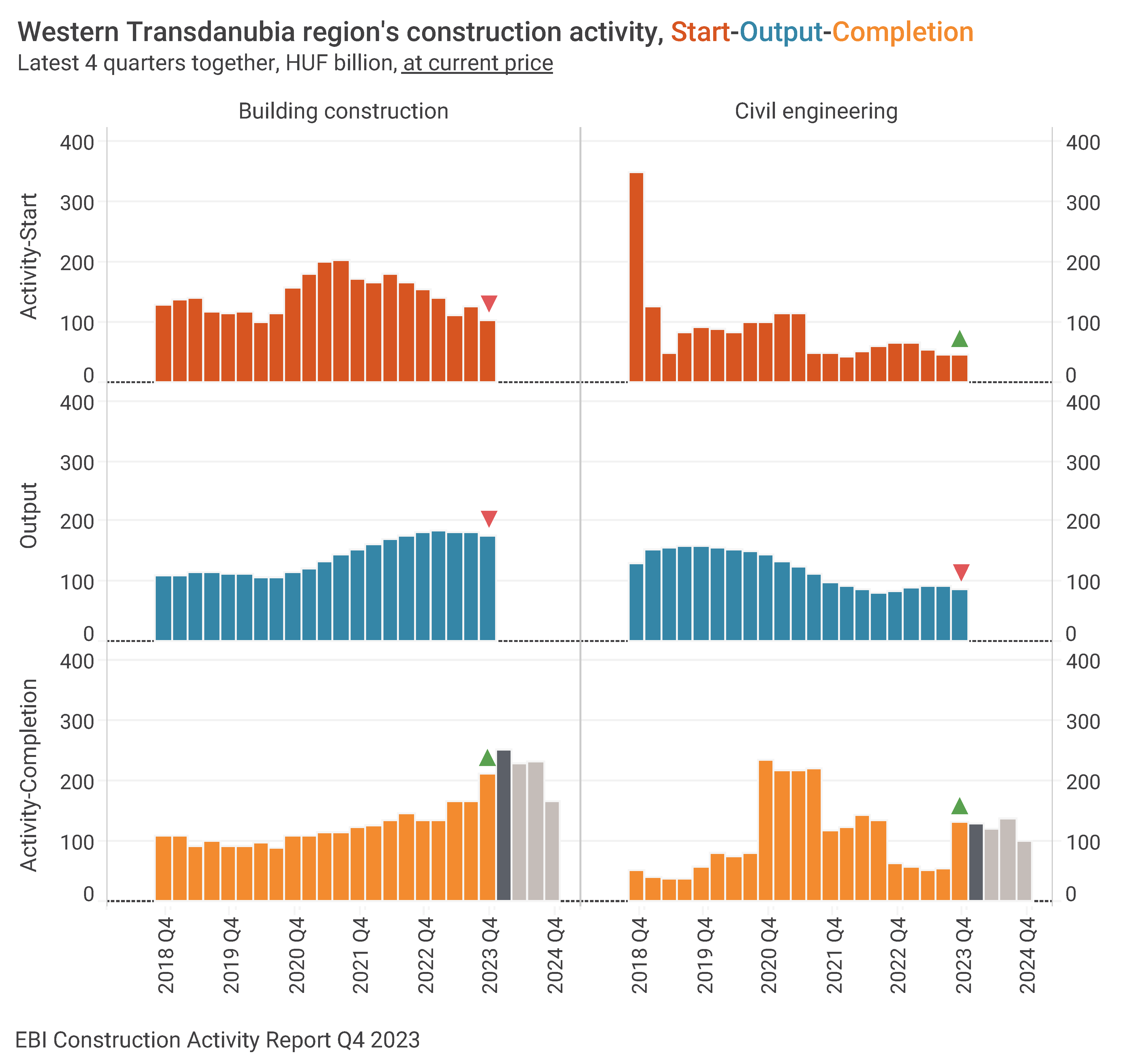
Last year around 6% of started construction works concentrated in the Western Transdanubia region, the same as in 2022. Although due to the declining Activity-Start countrywide this meant a much lower value of started constructions than the year before, the drop was 34%. In 2023 Activity-Start in the region was lower than in previous years (-34% compared to 2021 and almost -44% below the 2020 value). The previous peak in the region was in 2018 when several large-scale projects were launched: M85 highway, M8 highway, and the section of main road 76 between M7 highway and Keszthely, and a stretch of M15 highway between M1 and Rajka.

The value of started building constructions in Western Transdanubia shrank last year; over 2022 there was a 34% drop, while compared to 2021 the decrease was 41%. The projects launched in 2023 included warehouses and factories, for example, the Nestlé Purina pet food production plant and warehouse in Bük or the Velux GP4 production hall in Fertőszentmiklós.

Civil engineering works were also at a low level in 2023 (-32% against 2022, but only an 8% drop compared to 2021). In 2023, only one regional civil engineering project made it to the larger projects; Phase 3 of the Zalaegerszeg vehicle test track. The last time a hike was registered in civil engineering was in 2018 thanks to large road projects.

Recent years have seen a declining Activity-Start in building construction works in Western Transdanubia. At the same time, Activity-Completion has exhibited growth; for instance, 2023 was a record year for the value of completed building construction projects. Projects that reached completion last year comprised several plants of Nestlé Purina, the Water Adventure Park in Győr, Sirius Hotel in Keszthely, and Buildings A1, A2, A3 of VGP Park Győr Béta.

Original article: Tünde Tancsics, ELTINGA – English version: Eszter Falucskai, Buildecon

A closer look at Slovenia’s ambitious public housing plan

Written by Dr Aleš Pustovrh – Bogatin, EECFA Slovenia

Slovenia is currently grappling with a pressing need for affordable rental housing as demand continues to outpace available supply. Thus, the Minister for Solidarity and the Future, Simon Maljevac, has unveiled an ambitious public policy plan aimed at constructing additional housing units. Dr Aleš Pustovrh, EECFA’s Slovenian researcher,  has delved into the key components of the government’s strategy, examining the challenges it faces and the potential impact on the housing landscape in Slovenia.

Neoclassical skyscraper Nebotičnik in Ljublana. Photo: Michal Hlavac on unsplash

Housing landscape in Slovenia: growing disparity between demand and supply

Minister Maljevac highlighted a stark reality that Slovenia lags behind the EU and OECD averages in terms of available dwellings per 1000 inhabitants. Statistical data reveals that there are only 410 dwellings per 1000 inhabitants in Slovenia. This shortage has led to a significant impact on housing prices, with an alarming 77% increase in the average price per square meter between 2015 and 2021.

Between 2015 and 2021 the number of households in Slovenia increased by almost 40,000, while only 23,000 new dwellings were constructed during the same period. This stark disparity has intensified the housing crisis, further driving up prices and making home ownership increasingly unattainable for many Slovenians.

Public housing solution: ambitious plan

Minister Maljevac believes that a crucial part of the solution lies in increasing the availability of public housing for non-profit rents. Currently, there are 23,000 such units managed by 13 local or national housing funds. However, the number of these units has remained stagnant due to minimal public investments in recent years: merely EUR 6 million in 2020 and EUR 4 million in 2021. Simultaneously, public expenditure on subsidies for for-profit rents is on the rise with an estimated annual +20%.

To address the housing crisis, the government has committed to building 5,000 new dwellings by 2026, starting with the construction of 1,000 units in 2024. The National Public Housing Fund (NPHS) plays a pivotal role in this plan. The NPHS capital was raised by EUR 25.5 million in 2023 and the same raise is planned for 2024. The NPHS will use these funds to construct its own residential dwellings and offer favourable loans to local and regional public funds or municipalities for their projects. An additional EUR 100 million in loan financing is also sought.

As the government’s plans are ambitious, there are concerns about their feasibility. The heavy reliance on public funding raises questions, particularly in a time when there are pressures to reduce public expenditure in Slovenia. The government’s dependence on public funding alone may pose a risk to the successful implementation of the plan. To enhance the viability of these plans, the government may need to consider attracting private financing and fostering public-private partnerships. Currently, such partnerships are limited in the Slovenian housing market, but they might become essential to realizing the government’s ambitious goals in the face of budget constraints.

EECFA 2023 Winter Construction Forecast

No clear direction in the Southeast European region of EECFA; 2024 is foreseen to experience a decline, but a comeback is our current scenario for 2025. Expansion is projected to prevail all the way until the end of the forecast horizon in the East European region.

Romania is expected to contribute most negatively to the shrinkage of the SEE region in 2024. The rest of our countries is forecast to perform better. Bulgaria, Croatia and Serbia could end up at higher level in 2025 than what was experienced in 2023. Upswing in Türkiye is envisaged to pull the EE region up and we still believe that shrinkage in Russia is about to come. Not a particularly strong, but recovery is projected in Ukraine.

Construction outlook up to 2025 in Southeast Europe

Bulgaria’s economy is expected to lose momentum in 2023 that will translate to a lower, yet positive growth in 2024. Against this backdrop, construction output is to follow this trend with heterogeneous performance on segment level. While in the forecast period till 2025 civil engineering and non-residential construction will likely contribute with positive growth figures, after several strong years, residential construction is predicted to witness a new normal with negligible annual growth rates from 2024 onwards if any.

Croatia’s construction output will continue to grow, rapidly in 2023 and less robustly in 2024 and 2025. Civil Engineering construction is poised to become the brightest star in the country’s construction firmament with Buildings showing considerable sector to sector variation, but overall not performing as strongly as in the past.

Romania’s construction is expected to shrink in 2023 in real terms. Economic growth is slowing down under sticky inflation and high financing costs. Further slowdown might come in 2024 as multiple elections, political pressure to lower budget deficit, high social spending and the transition to the new EU programming period would make it challenging to focus on public projects. The outlook doesn’t look better on the private investment side with tight labour market and sluggish consumption growth expected for 2024. By 2025, return to growth is postulated as most of these obstacles may dissipate. 

During 2023, Serbia has been performing better than initially expected with the economy picking up in the second half of the year and construction outputs registering another record high. While the construction of buildings is consolidating in a moderate manner, civil engineering surged with a double-digit growth rate. The easing of inflationary pressures is also helping market stabilization, while high interest rates remain a major impediment for growth in short-term. 

Slovenia’s construction industry in late 2023 faces economic challenges exacerbated by unprecedented floods in August, causing EUR 10 billion in damages. Despite workforce shortages leading to increased construction costs and inflation, the sector is expected to see a significant rise in output with civil engineering projects, including flood repairs and infrastructure initiatives, driving growth. However, concerns arise over the potential deceleration in growth in 2024 and 2025, mostly in residential and non-residential construction even as reconstruction efforts in civil engineering gain traction.

What to expect in the Eastern European construction markets of EECFA

In Russia, stable government support, a relatively favourable macroeconomic environment, and the general resilience of the industry to external challenges ensured positive dynamics in construction in 2023, making the forecast more optimistic for this year. The industry’s development strategy prioritizes housing construction as well as transport- and energy-related projects. The positive momentum is not predicted to last long, though, and in the 2024-2025 horizon we might observe contraction in construction market volume, mainly due to the expected decline in the residential market which might outweigh the positive dynamics in other subsectors.

Türkiye’s economy has been impacted by two developments with one being the reconstruction of collapsed buildings and infrastructure in recent earthquakes where most tax revenues went, causing large monthly budget deficits. The other one is increasing interest rates. Although the Central Bank increased the base rate from an 8.5 base point level to 40 in six successive months, it couldn’t curb inflation and there are exchange rate rises along with inflation. The construction sector grew at higher rates than the GDP as the national average on the back of building construction in earthquake-hit provinces. Growing interest rates reversed most of the problems caused by the low-interest rate policy, but it also led to an increase in construction cost and hit the affordability of purchasing homes.

Ukraine’s construction market has been struck by the ongoing war. According to official data alone, almost a million flats, tens of thousands of non-residential buildings, thousands of kilometres of roads, railways, bridges and other infrastructural facilities were either destroyed or damaged. The construction industry partially lost its raw material base and production as most metallurgical enterprises located in the south and east were destroyed or occupied. The main construction segments that can predictably develop even during the war are the restoration of damaged housing and social infrastructure, civil engineering, construction and modernization of industrial production.

Most construction works started in Eastern Hungary

Looking at the last 4 quarters, the largest number of projects was related to the Northern Great Plains region whose share in the national Activity-Start was 30% (after a slight decrease). Budapest came second where 26% of construction works started, so its share grew. And Pest County came third with a 12% share. South Transdanubia had the smallest share in the value of started construction works (only 4% of the national value in the last 4 quarters). Overall, the biggest part of the national Activity-Start was still connected to Eastern Hungary (45%), less than 38% to Central Hungary, while the share of Western Hungary did not reach 17.5%.

Countrywide, Q3 2023 saw the value of started construction works in Hungary slightly drop over Q1-Q2 2023. Between July and September, the Activity-Start indicator of EBI Construction Activity Report accounted for a little less than HUF 600bln. This also means that the first 9 months of this year were quite modest. Activity-Start did not reach HUF 2000bln and fell short of the value of the first 9 months of 2021 and 2022. The difference compared to 2021 was 11%, while compared to 2022 there was a 35% decline. The decrease at constant prices was even greater in the first 3 quarters of 2023: compared to the first 9 months of 2021 almost 40% lower, while compared to the first 9 months of 2022 nearly 46% lower value of construction works started between January and September 2023.

Building construction

In Q3, somewhat more construction works started in building construction than in Q2, but overall, all 3 quarters brought a very similar Activity-Start. In the first 9 months of the year, the value of started building construction works totalled HUF 1400bln, less than in the same period of 2021 and 2022 (the drop compared to the former was 11%, compared to the latter it was almost 18%). At constant prices, the decrease was even bigger: the Activity-Start indicator of EBI Construction Activity Report was 40% and 31% lower between January and September 2023 than in the respective periods of 2021 and 2022. The last time we saw a value of started building construction works lower than this was in 2015.

In case of multi-unit housing construction works, the value of construction starts in Q3 was roughly at the level of Q2, but more modest than in previous years. In case of non-residential construction works there was a minimal increase in Q3 compared to Q2, but the first 9 months still saw a lower Activity-Start than in 2022 and 2021. The decrease at current price was 8% compared to the two years prior, and 15.6% compared to the same period last year. But the decline at constant price was much bigger (37% and 29% respectively). After filtering out the change in prices, the last time we saw lower numbers was in 2016.

The largest building construction projects launched in Q3 this year included several offices such as BudaPart Corso, Central and Harbor office buildings, Zugló City Center Offices 5 and 6, the reconstructions of the Ministry of Agriculture and the Palace of Justice, but also phases 1 to 4 of the Buildings A and B of the Technical Faculty of the University of Debrecen, and phase 1 of the renovation of the MTA (Hungarian Academy of Sciences) Headquarters and Library. Several industrial and warehouse projects entered construction: AN1 logistics hall of HelloParks in Alsónémedi, the production and storage hall of Leier, phase 2 of the half-shaft and cardan shaft manufacturing plant of GKN Automotive, phase 1 of Horváth Rudolf Intertransport Logistics Center, and Velux GP4’s industrial hall.

Civil engineering

After the first two successful quarters this year, Q3 brought one of the lowest Activity-Starts in civil engineering in recent years. Overall, in the first 9 months, the value of started works for the period of 2017-2022, except for 2020, fell short of the Activity-Start at current price for the first 9 months of each year. At constant prices, it barely exceeded the value of works launched in January-September 2015, while in the following period it was considered exceptionally low.

The weak third quarter was mainly owing to the drop in road construction, while some growth was recorded in non-road and railway. In the first 9 months of 2023 road and railway constructions started at much lower than the 2022 record. It exceeded the like-for-like Activity-Start of 2020 and 2021 but did not reach the value of projects started between January and September 2017 and 2019. At constant price, every year after 2015, Activity-Start surpassed 2023 in the first 9 months of the year.

Few civil engineering projects made it to the biggest construction projects. The highest-value one was the reconstruction of the Biatorbágy-Szárliget main railway line followed by several projects related to water and sewerage systems.

Pest county

When looking at the past 4 quarters, Pest county’s share of construction starts was the third highest. It was so despite the fact that in the first 9 months of 2023 there was a decline in the Activity-Start of EBI Construction Activity Report here, and based on recent years, construction works started in the county in the lowest value. In the first 9 months of this year the largest non-residential projects included the construction of CECZ E-commerce Industrial and Logistics Park and that of the logistics halls of HelloParks (Páty PT2 and Alsónémedi AN1).

The decline was attributable to the shrinkage in building construction. In the first 9 months of 2023, in Pest County construction starts were almost 40% lower than in the same period of the previous year and 17.5% lower than in the first 9 months of 2021.

Civil engineering works continued to be at a very low level in the county. Among the biggest such projects that started in the first 9 months of 2023 were the renovation of the previously mentioned Biatorbágy-Szárliget main railway line and several water and sewerage system-related ones.

Multi-unit housing

Multi-unit housing construction works continue to be lower than in previous years, and Q3 brought a slight decrease after the promising Q2 figures. Thus, overall, in the first 9 months of this year, the value of multi-unit home construction starts fell short of 2021-2022, and Activity-Start of EBI Construction Activity Report here dropped back to the 2020 level. Between January and September 2023, the value of started construction works was about 29% lower than in 2022 and 26% lower than in 2021. At constant price, the difference is much bigger (against two years ago almost 50%, while against last year a bit more than 40%). After 2015, 2023 has seen the lowest Activity-Start at constant price for the first 9 months of the year.

On 1 January 2024 a major change will be effective. In cities, the existing CSOK (the family housing allowance program) will cease. Conditions for the CSOK loan will also change: it will remain available to couples planning to have another child, but CSOK+ will provide a much higher preferential loan than previously. The higher loan can be a great help to those planning to buy a new home, but due to tight conditions, the new preferential loan will be unavailable to a massive number of customers who have been eligible until now. Another disadvantage is that so far only those claiming CSOK could benefit from the tax discount and the possibility to reclaim VAT as well.

For the multi-unit housing market, a key factor may still be the return of affordable loans, which can start purchases again, including projects. Loan interest rates decreased, but for the time being, they are still considered very high. The other question in terms of market development is the strategy of investors as they represent a serious group of buyers in the market for new homes (current high yields on government bonds are a good alternative for them compared to the housing market). Hence, no wonder that developers are careful with project launches. And even though larger investors did start some new projects, there were examples of scrapped ones.

In Q3 2023 the value of completed multi-unit buildings exceeded the like-for-like figures for 2021 and 2022. A big number of projects is expected to be completed yet this year, so this year’s value may exceed last year’s completion value if these projects are indeed completed as scheduled despite the delays.

Budapest continued to see the biggest share of multi-unit housing works start. When looking at the previous 4 quarters, the share of Central Hungary was almost two-thirds in Activity-Start. The share of Western Hungary rose over the previous quarter to over 20%, while only less than 14% of multi-unit housing construction works were connected to Eastern Hungary.

Original article: Tünde Tancsics, ELTINGA – English version: Eszter Falucskai, Buildecon

What happens to Ukraine’s construction market amid the war?

Written by Sergii Zapototskyi – UVECON, EECFA Ukraine

The full-scale war in Ukraine has been going on for more than a year and a half. People are dying, cities are being shelled. The real consequences are now difficult to calculate, but even available estimates are huge. And the construction market is facing rising construction costs, shortages of building material and skilled labour.

Izyum, Kharkiv region, City Hospital. Photo by Sergii Zapototskyi

Documented damages

As of 1 September 2023, direct documented damage to Ukraine’s infrastructure due to the full-scale Russian invasion amounted to around USD 151.2 billion (at replacement cost):

  • Housing losses remain the largest share of total direct damage (USD 55.9bln). In total, about 167,200 homes were destroyed or damaged (of which 147,800 private houses, 19,100 apartment buildings) mostly in Donetsk, Kyiv, Lugansk, Kharkov, Nikolaev, Chernigov, Kherson and Zaporozhye regions.
  • Infrastructure and industry, as well as enterprises came second and third in terms of losses (USD 36.6bln and USD 11.4bln, respectively). 18 airports and civilian airfields, at least 344 bridges and bridge crossings, and more than 25,000 km of state and local highways and public roads have been damaged so far. And at least 426 large and medium-sized private and state-owned production facilities were damaged or destroyed because of the war.
  • Education buildings are also hard hit (USD 10.1bln in damage). The number of damaged and destroyed educational facilities already exceeds 3,500 (more than 1,700 secondary, more than 1,000 preschool, and 586 higher education institutions). Most destroyed and damaged buildings are in Donetsk, Kharkov, Kherson, Nikolaev, Zaporozhye and Kyiv regions.
  • Losses also continue to grow in healthcare buildings (USD 2.9bln). In total, 1,223 medical institutions were destroyed or damaged, including 384 hospitals and 352 outpatient clinics.
Izyum, Kharkiv region, multi-storey buildings. Photo by Sergii Zapototskyi

The construction market during the war

With the full-scale invasion, almost all developers suspended work and many of them in the residential and commercial sectors have not yet resumed it yet or some work at a minimum level. According to market analysts, out of 90% of sites that were supposed to resume construction after 24 February 2022, only 50% have done so now. At the same time, barely a third of companies have acceptable construction rates. Construction cost has already grown by 37% since the beginning of 2023, pushing up the average cost per square meter. The main factors behind the decline in construction were physical danger, a major increase in exchange rates and high inflation, which massively reduced the purchasing power of Ukrainians. Serious obstacles also arose with logistics, and due to the suspension of construction work and interruptions in supply, demand for metal structures collapsed. And after Russia destroyed two metallurgical giants, Azovstal and MMKI (Mariupol Metallurgical Plant), the market faced a shortage of rolled metal products. The destruction of some industrial enterprises added to the problems, and at end 2022, the market of metal structures in Ukraine sank by 55%-65%.

Kupyansk, Kharkiv region, factory. Photo by Sergii Zapototskyi

In October-December 2022, construction companies faced a new challenge: they had to adapt to power outage schedules or buy powerful generators to ensure uninterrupted construction. Most developers found it more practical to suspend construction, which also contributed to declining construction volumes. The most serious problem though in many regions were the massive rocket and artillery attacks. Thus, in 2022 the total area of completed housing was 7.1 million sqm, 38% less than in 2021 (11.4 million sqm). Last year, as per Ukrsat, the lion’s share of housing was put into operation in the western regions, mainly due to security (residents wanted to escape from the war).

Now the construction market is facing the following challenges:

  • There is a decrease in demand and an increase in construction costs.
  • Many building material plants were located in the east and many have been destroyed or suspended, thus domestic building material production has slumped.
  • Main logistic corridors and ports are still not working and alternative routes are not yet able to fully cover the deficit. The expected return of the excise tax on fuel will lead to an even greater increase in logistic costs.
  • Ukraine is facing a shortage of skilled labour. There are fewer quality graduates from Ukrainian universities, and students are leaving. Students studying abroad are in no hurry to return to a country at war, so they obtain jobs there. Also, many skilled specialists joined the armed forces, or retrained due to the drop in construction volumes, or went abroad.

When the war ends, a lot will have to be built and restored. Ukraine has lost more than 170 million sqm of housing and it is clear that the market will not be able to cope with such recovery volumes on its own. The level of demand will largely depend on the course of the war (damage caused), the expected liberation of Ukrainian territories, the volume and consistency of international financial assistance (mainly to cover the huge expenses of the state budget), and the general economic situation. And once the urban planning reform (to make the market transparent) is completed, business processes in development, primarily in financing housing construction, may significantly change. Also, in the primary housing market there may be a shift to quality, safety, energy efficiency and functionality. When the war ends, residential complexes and serviced apartments in the live-work-play format may become priority (built according to new ecological, energy-saving, and functional standards with a high degree of safety).

Bulgaria’s RRP revisited: slow progress, downsized and removed projects, concerns over timely implementation

Written by Yasen Georgiev – EPI, EECFA Bulgaria

In our post about a year ago we wrote about the opportunities the RRF could bring to Bulgarian construction. After months of no updates, September and October this year brought news for the future prospects of Bulgaria’s Recovery and Resilience Plan (RRP). In late September 2023 Bulgaria’s government submitted a modified version of the RRP to the European Commission (EC), whereas in early October the country submitted in Brussels its second payment request worth €724mln.

Main government buildings Sofia, Bulgaria. Source: Jack Krier, unsplash.com

The modified version, which still needs to be approved by the EC, comes to meet the respective regulation on EU level that grants allocation for all member states are to be updated in June 2022 based on each country’s post-pandemic recovery performance. Since Bulgaria registered a comparatively better economic outcome in 2020 and 2021 than initially expected, the maximum grant allocation under the RRP was reduced by €580mln (from €6.27bln to €5.69bln).

In order to align the RRP with this downward revision, the government proposed a modification of the plan. It concerns 17 projects included in the original version of the plan, some of them extensive construction works.

Notable downsized projects are those linked to:

  • building national infrastructure for storage of electricity from renewables (decrease by around €400mln to €400mln); 
  • modernisation of hospital facilities (decrease by around €80.5mln to around €100mln);
  • improving the energy efficiency of the building stock (decrease by €43mln to €880mln);
  • modernisation of educational infrastructures: renovation of schools and kindergartens, construction of new ones as well as renovation of student residences (decrease by around €1mln to €290mln).

Three projects were completely dropped out of the updated RRP:

  • the construction of an intermodal transport terminal in Ruse (€23mln);
  • the digital transformation of the Bulgarian Post (€52mln;
  • digitalising of the management, control and efficient use of water (€58mln).

Simultaneously, funding has been revised upward for these projects:

  • the extension of Sofia’s third metro line (increase by around €11.5mln to €122.6mln)
  • construction and/or renovation of youth centres (increase by around €1mln to €33mln).

The second payment, which was initially due by the end of 2022, relates to 61 milestones and 5 targets. Projects under this payment are in such areas as energy-efficient street lighting, smart industry, renovation of buildings, digitalisation of the electricity transmission grid, renewable sources, electricity storage, and the digitalisation of railway transport, among others. Reforms within the scope of the second payment aim at the decarbonisation of the energy sector by boosting the uptake of renewable energy and energy efficiency improvements, providing support for sustainable urban transport, making public procurement more competitive, and many more.

Now the European Commission is assessing the request according to the respective regulation since payments are performance-based and contingent on project implementation and reforms outlined in the RRP.

Against this backdrop, there are growing concerns that Bulgaria is substantially lagging behind in making full use of resources available under the plan. The third payment request (€724mln) should have been submitted by the end of June 2023, which was not the case, since even as of mid-October only 6 out of 46 milestones and targets were implemented. A delay is expected with the submission of the fourth payment request (€612mln) that is due by the end of 2023. It includes commitments for meeting 41 milestones and targets, of which only one was implemented by mid-October.

These delays would not be worrying if the available funding was disbursed under the traditional multi-annual financial framework which allows for budget phasing and transfers between funding periods. However, in case of this funding instrument, all measures must be implemented within a very tight frame: the Regulation establishing the Recovery and Resilience Plans requires all milestones and targets within the national plans to be completed by August 2026.

The delay so far has mainly been due to the lack of working parliament and a political instability over a period of two years. Nowadays, under the condition of a functioning legislative body and a government, which has a supporting majority in it, it remains to be seen how Bulgaria will catch up in channelling these resources in its economy for the sake of the comprehensive and horizontal green and digital transition that all EU countries are currently facing.

Check out the forecast for Bulgaria’s construction sector up to 2025 in the EECFA Forecast Report. Orders and sample report: eecfa.com.

A hidden threat to the Russian housing market: demography

Written by Andrey Vakulenko – MACON, EECFA Russia

Negative demographic trends in Russia are conditioning lower demand on the housing market in the coming decades. Due to the general population decline and aging, the number of most active home buyers will decline in the future. And this should – in the long term – lead to a reduced number of housing transactions.

Currently, the demographic situation in Russia is said to be extremely unfavourable. In July 2023, for example, only a little more than 110 thousand children were born, lower than in any July since 1945. This confirms that the country is experiencing a real ‘demographic hole’, and recovery is unlikely in the next decade.Population size and structure represent one of the main macro-drivers determining housing demand over a long period. Steady population growth leads to an increased number of individual households that over time begin to feel the need for own housing, so in virtually any housing market much demand is generated by young people purchasing their first home. The aging of the population, on the contrary, reduces demand for homes. Demographic factors are structural ones that operate long-term, over the horizon of decades, though. Now the market may show a rise in demand for housing, but if the long-term trend is negative, it will have a restraining effect and limit the potential for buyer activity. Often total population may grow or drop insignificantly, but its age structure can change significantly, determining the prospects for the residential real estate market.

Demographic trends in Russia yesterday, today and tomorrow

Russia’s population has undergone a steady downward trend in recent years. Over the past 30 years, the number of births almost every year has been way less than the number of deaths. The only exception was the period of 2012-2016 when the balance of indicators was minimally positive or near zero. In other years, there was a constant natural population decline. Record fertility rates during the USSR in the 80s have not been repeated to date: after a sharp drop in the 90s during numerous crises, the indicator recovered between 2001 and 2015, but another negative trend followed in 2015-2022 owing to the worsening macroeconomic climate and an almost constant decline in the real income of the population. And the pandemic broke the long-term trend of low population mortality, exacerbating the negative impact of decline in birth rates. Migration growth has also been insufficient in recent years and could not compensate for natural population decline, only slightly smoothing it out. Birth rates in each period determine the population size in a particular age group in the future, therefore, the current age structure of the Russian population is a consequence of past fluctuations in this indicator in different years.

In the future, the Russian population will likely decrease. As per the demographic forecast of the Federal State Statistics Service in Russia (Rosstat) and that of the UN Department of Economic and Social Affairs, population decline is estimated at 2%–5% until 2035. In addition, the age structure of the population will continue to shift towards the elderly. The graph on population structure by age always moves to the right: the rise in fertility in the 80s led to a higher population of people aged 35-49 now, the sharp decline in fertility in the 90s caused a fall in the population aged 20-30, and the recovery in the 2000s led to an increase in the number of under 20 age group. And with the current trend of decreasing birth rates, the elderly will surpass young age groups in the next decades.

What does demography have to do with the housing market?

As population in Russia is anticipated to decline slightly (2%-5% until 2035), this is unlikely to have a major impact on overall housing demand. But the lack of growth expectations is creating negative preconditions for the market in the long run. Also, the next decade should see a demographic shift in Russia: the share of 30-year-olds will plummet against the growth of older age groups. Such shifts directly affect the residential real estate market due to the different behaviour patterns of people of different ages in the housing market. According to a 2022 study by the Bank of Russia, Russians usually live in rentals until they are 30 and first home purchase is most often done after this age. This is also indirectly confirmed by the portrait of a typical mortgage borrower (DOM.RF study), whose average age at the end of 2022 was about 37.8 years. Mortgages in Russia are ‘aging’ under the influence of ongoing demographic changes, as seen in the dynamics of the average age of the borrower and the share of young people in the total number of borrowers.

In general, the main stages of human activity in the residential real estate market are as follows:

  • 20-29 years of age: rental housing. Until 20 young people live with their parents and then separate due to studying or working. Buying a home immediately is accessible to very few, so they rent flats.
  • 30-39 years of age: purchasing a first home. At this age, families are established, children are born. The first home is usually purchased to ensure comfortable living conditions.
  • 40-49 years of age: improving living conditions. After 40 people reach the peak of their career and financial well-being, enabling them to improve living conditions. This can either be an increase in space or change in the home (moving from a flat to a house).
  • 50-64 years of age: optimization of housing. Children grow up and live separately, pushing this age group to optimize housing (moving to a smaller home or to another city/region).
  • 65 years and older: transfer of housing by inheritance.

Considering the predicted age structure of the population, in the coming years Russia will see the largest and most active demand group (first home buyers/those aged 30-39) steadily decline. Population structure will be redistributed towards the age groups of 40 years and older who are considerably less active in the market. This will certainly be negative for housing demand. At the same time, negative trends will to some extent be smoothed out by the following demographic factors:

  • Expected increase – after a long decline – in the number of young people aged 20-29 in 2026-2035. They mainly focus on rentals, but demand for rentals will push them to be more active in home purchases mainly in large cities that are educational and economic centres.
  • The 2020-2021 census showed that the number of households consisting of one person is steadily increasing: their share is now about 42%, almost twice as high as in 2022 (22%). More single people will need more housing units, supporting housing demand.
  • Great need for new and high-quality housing. Residential volume per capita in Russia is about 28 sqm/1 person, way lower than in developed countries, and lower than the target values of state housing programs (min. 30 sqm/person). Low income, coupled with an often outdated and low-quality housing stock, creates need for more frequent improvement in housing conditions.

Having these in mind, the ‘aging’ housing market is not a disaster, it is rather a structural factor that we will need to adapt to. Nonetheless, the gradual contraction of the traditionally most active demand base and the overall downward trend in population will put pressure on the market. An additional challenge for housing developers will be to adapt the product to the needs of older buyers whose number will grow in the near future.