Top trends to track in 2026 in Romanian residential market

Written by Dr. Sebastian Sipos-Gug – Ebuild srl, EECFA Romania

Dr. Sebastian Sipos-Gug, EECFA’s Romanian analyst has looked at the trends that are worth monitoring in the residential market in Romania this year. Among them are the construction costs boomerang, the drop in wages and consumption, considerable interest in multi-family buildings, smaller homes and a greater dependence on mortgage loans.

What we saw in 2025

The construction market faced many challenges in the previous year, alongside the entire national economy. While there was a focus on civil engineering, especially when it comes to EU co-funded projects, the rest of the segments lagged behind.

In early 2025, the removal of fiscal facilities for construction employees led to the decline of their net incomes, and an increase in wage-related expenses for companies. Overall, the effect of this measure was an increase in construction costs.
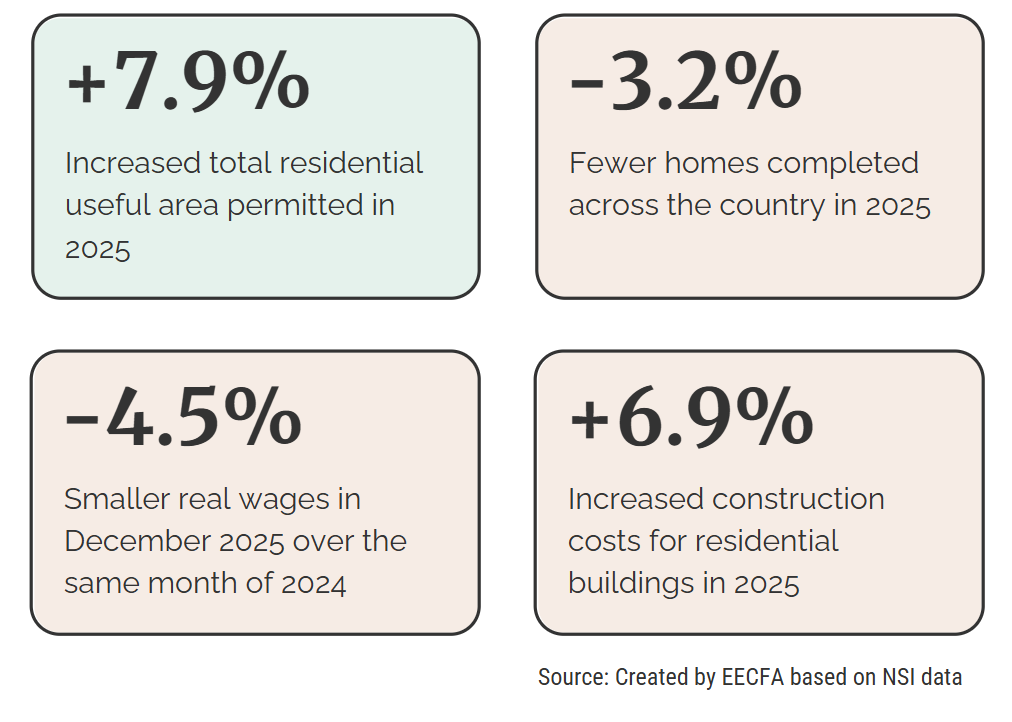
Then came the multiple shocks of the liberalization of energy markets in July, and a VAT increase in August, which pushed inflation upwards significantly, with the CPI reaching 9.88% in September. In a snowball effect, this led to lower real wages and disposable income, which translated into a reduction in private consumption, and, ultimately, means lower demand for residential construction on the short and medium terms.  

The optimism shown in the increased number of permits, and the useful building area in them, compared to 2024, is countered by the decline in the number of completed homes. Thus, while developers might be looking to the future, their actions in the present are lacking, also evidenced by a significant (-21%) annual decline in the value of started construction works in 2025 (source: EBI Construction Activity Report).

What to watch in 2026

Construction costs boomerang. While previously the expectation was that construction costs would gradually decline in 2026, they proved quite resilient to changes in wages, and fuel and construction materials prices remained relatively stable in the past year.  Thus, late 2025 forecasts placed construction costs on a small, descending trend.

The conflict in Iran and its repercussions on oil and gas prices might throw astray these predictions. As of March 2026, oil prices were approaching 2022 levels, and, if they are not reversed rapidly, might have a similar impact on world-wide inflation, energy prices and, eventually, construction costs. A reversal, however, seems rather unlikely at the moment as the damage to energy infrastructure could take years to undo.

To make matters worse, in the past few years home prices grew slower than construction costs, reducing potential profit margins for developers. Added to the decline in real wages, it remains quite unlikely that there will be room for prices to increase alongside construction costs, again similar to 2022, further eating into builders’ financial return potential.
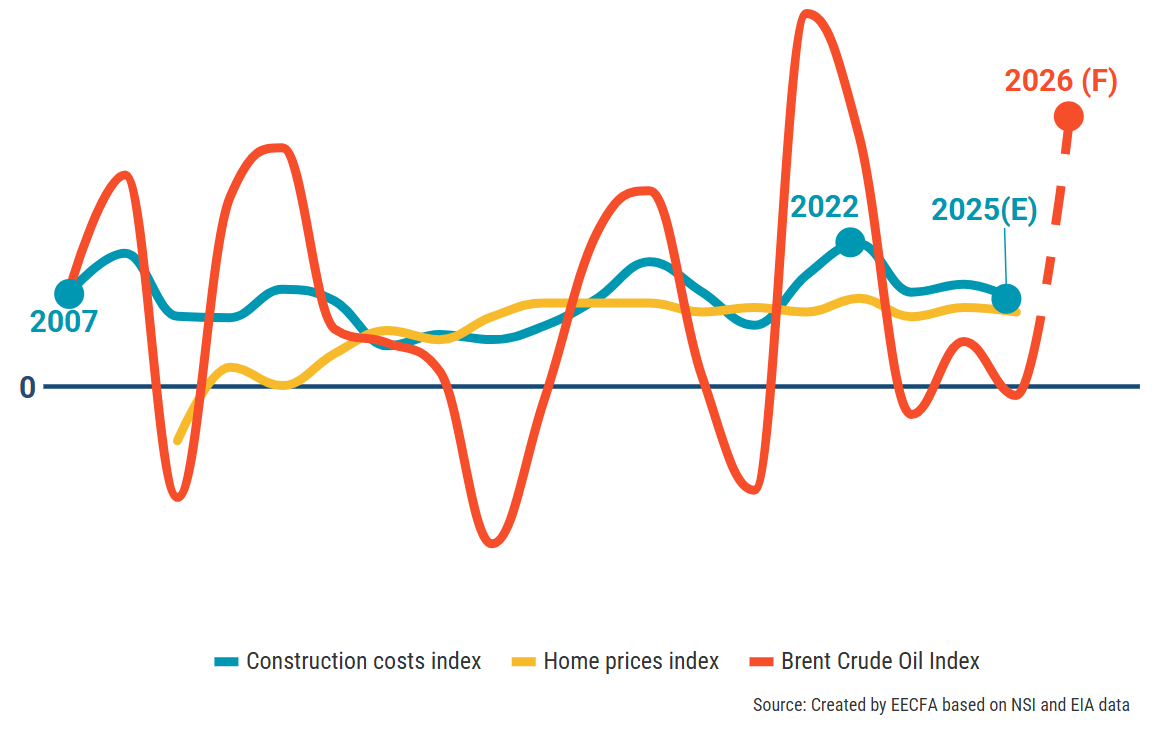
Decline in wages and consumption. Wage growth for 2026 was already forecasted to remain low, underperforming inflation (source NFC – National Forecasting Commission Autumn 2025 Report). Add to that the further shocks now expected from increased energy costs (due to oil and gas prices rising considering the conflict in Iran) and food costs further rising due to increased fertilizer prices, the downwards pressure on real wages is likely to be worse than forecasted, with a slower recovery.

Real wage decline will make it harder to purchase and build new homes, with a negative impact on demand for residential construction. But it could provide a boost to renovation activity, especially when it comes to energy efficiency, as switching homes becomes harder.

High interest in multi-unit residential buildings. Looking at building permits trends for the past decade, single-home buildings have remained relatively stable, while the majority of growth was due to multi-unit buildings. Under price pressure, on the backdrop of restricted wage growth and a contractionary macro-economic outlook, it remains most likely that for the near future we’ll continue to see more interest in the latter. Another connected issue is that of internal mobility, with migration from rural to urban areas in search for education and economic opportunities, increasing demand for denser residential construction.

Smaller homes. While the mean area in permits remained relatively stable between 2017 and 2025, there is a historical precedent in economic downturns leading to smaller homes being built so as to increase accessibility. Since the economic outlook for the year seems to have worsened, this could be the case again in 2026.


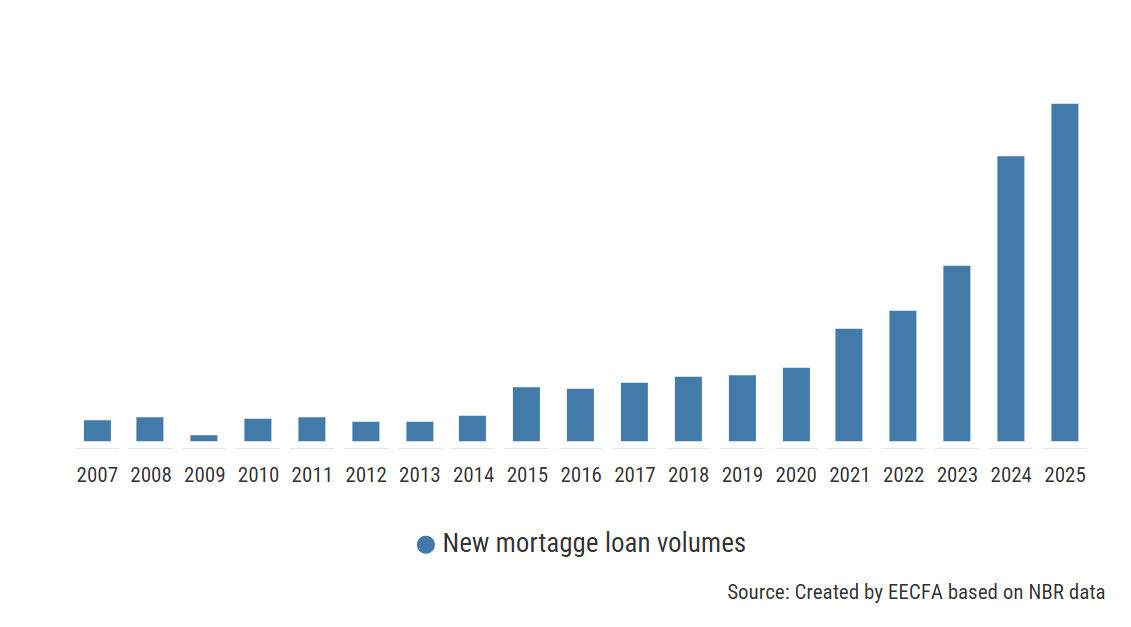
Increased reliance on mortgage loans. Despite the highest interest rates seen in a decade, the volume of new mortgage loans increased dramatically in 2024 and 2025. While some of this could be blamed on higher home prices, there remains a major portion that cannot be explained by price or transaction dynamics. Thus, it is quite likely that it reflects a reduced ability to buy homes without applying for a loan. This is also evidenced by the fact that the share of the population currently housed in a dwelling that was purchased with a mortgage loan grew steadily from a low of 0.5% in 2007, to 1.5% in 2024 (source: Eurostat). This could have been further boosted by the expected drop in interest rates as inflation seemed to be heading in the right direction. However, as of March 2026, this seems less likely, as the conflict in Iran would lead to another energy-led inflation event. Nonetheless, with real wages on the decline, mortgage loans will continue to be relied on for boosting home affordability.
Q4 2025: Weak Construction Activity-Start in Hungary

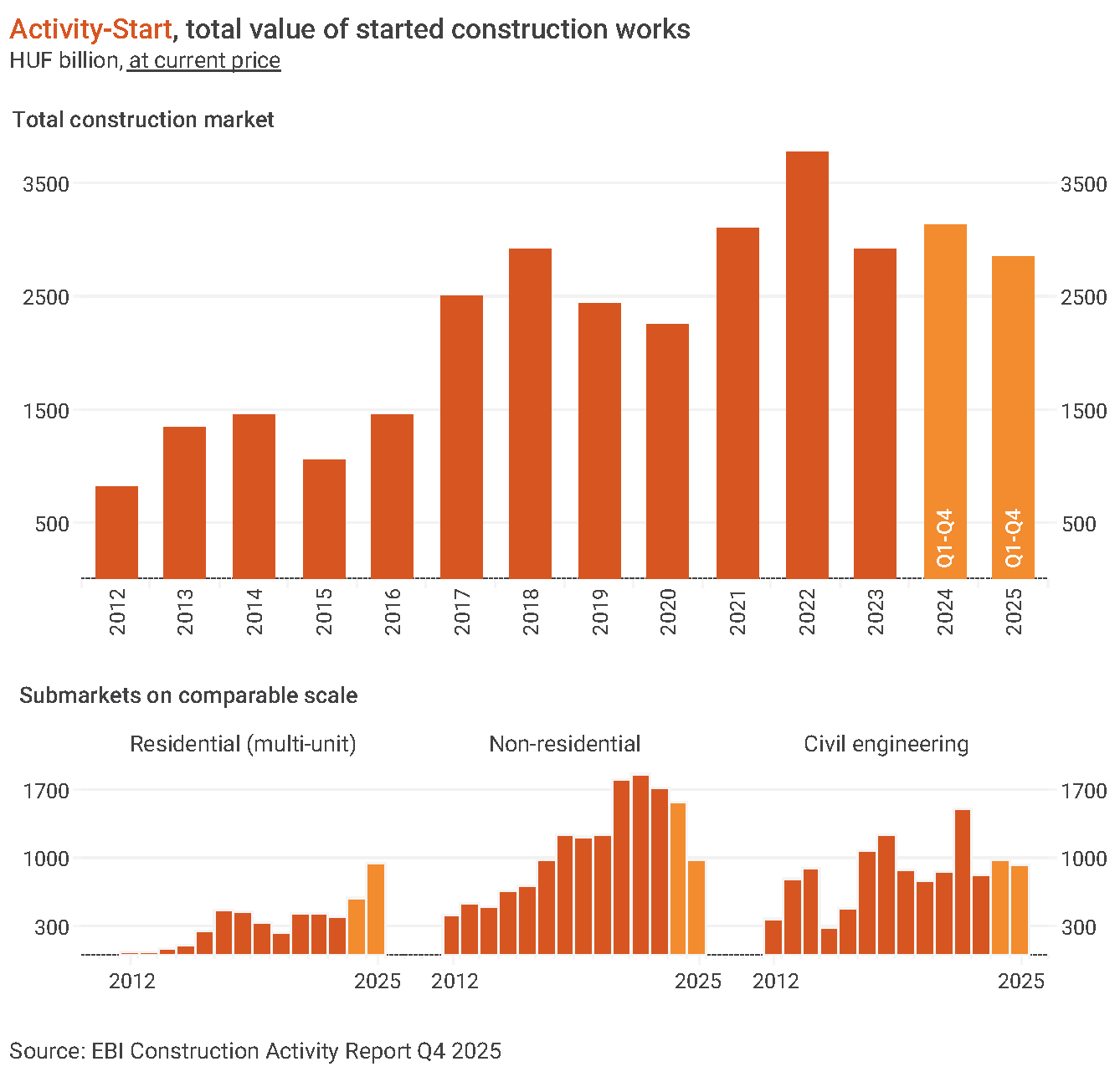
The latest EBI Construction Activity Report has found that although the expansion of M1 motorway caused a considerable surge in the value of started construction projects in Q3 2025, Q4 brought very low Activity-Start. Even at current price, such a low number of construction projects did not start in a quarter in the past 9 years. However, thanks to the high numbers in Q3, annual Activity-Start only slightly sank against 2024. In total, projects worth nearly HUF 2,900 billion entered construction phase in 2025.

Declining Activity-Start in building construction in Q4 2025

In Q4 2025, Activity-Start in building construction decreased significantly compared to previous quarters. However, due to the higher first quarter value, the full-year decline remained 10% compared to 2024, while the decrease was 8% over 2023.

Overall, construction works started in the segment last year were worth slightly less than HUF 2,000 billion, the lowest level between 2021 and 2025. Due to the significant increase in multi-unit residential construction in 2025 and the few construction starts in non-residential buildings, multi-unit residential construction accounted for almost half of building construction Activity-Start, which has not been the case since the first half of the 2000s.

Non-residential construction was characterized by a decline in Q4, and the value of started construction works was roughly at the same level as in Q2, which was also modest. For the year as a whole, non-residential Activity-Start was around HUF 1,000 billion, the lowest value in the period between 2018 and 2025. It also shows a 37.5% decline compared to 2024 at current price, and a 43% drop over 2023.

The largest non-residential projects entering construction phase in Q4 2025 included the construction of several logistics centres, such as CATL warehouse in Debrecen, Porsche Parts Center logistics-warehouse centre in Budaörs, and Building C of VGP Park Budapest Aerozone. Several hotel projects began, too, including the construction of Mama Shelter Hotel and Ruby Hotel in Budapest, and Danubius Hotel Annabella ***Superior in Balatonfüred.

M1 highway expansion boosting civil engineering Activity-Start in 2025

Following Q3 2025, which registered high Activity-Start due to the expansion of M1 motorway (M0-Concó rest area), Q4 2025 saw a very low value of started civil engineering works in Hungary. Few projects started not only in value, but also in number.

Thanks to the motorway project, annual figures tell a nicer story with projects starting in the value of nearly HUF 1,000 billion in 2025. It did not differ much from 2024, although the figures then were also boosted by the start of one large project, the construction of the Mohács Danube Bridge and related road network. Overall, in 2024-2025, apart from these two large projects, the value of civil engineering projects entering construction phase would have been very moderate. In Q4 2025 not a single project made it to the list of biggest started ones, indicating the reduction in civil engineering in that quarter.

Budapest continues to lead Activity-Start

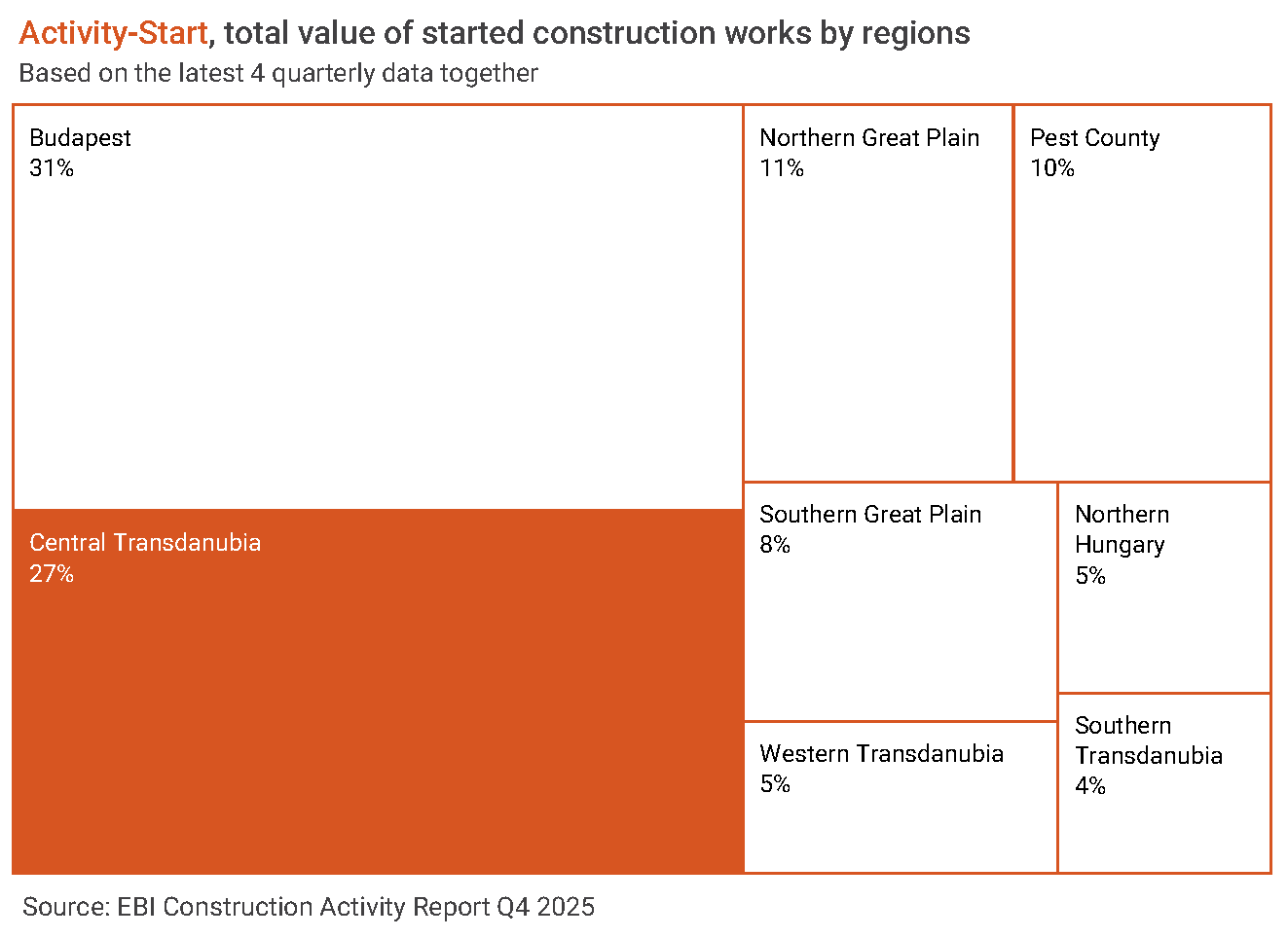
Budapest had the highest share, 31%, within total Activity-Start in the last four quarters. Central Transdanubia also had a high proportion, more than 27%, primarily due to the M1 highway expansion. Together, more than 40% of works started in Central Hungary, 36.4% were related to Western Transdanubia, while the share of Eastern Hungary was 23%.

Sluggish multi-unit residential developer activity in Q4 2025

Q4 2025 saw another decrease in the value of started multi-unit residential constructions, with the cost value of started works falling below the level of Q2-Q3 2024, the second lowest value in the past two years.

However, 2025 overall was still a record year thanks to the high activity in the first 3 quarters of the year. Works worth nearly HUF 1,000 billion started, exceeding the Activity-Start of the previous year by 60% even at current price. At constant price, it was roughly equivalent to the record holder years of 2017-2018.

2026 may also register strong multi-unit residential construction as last year’s preliminary data shows surge in building permits. Further boost may come from the Otthon Start Program which was launched in September 2025 (subsidy helping first-time homebuyers secure up to HUF 50 million in mortgage financing with a fixed 3% interest rate and a maximum 25-year term) and the Capital Program, which was also started last year. In connection with the former, the construction of several thousand units has been announced in priority projects, and applications for several thousand more may be given green light. Since sales deadlines must also be met in priority projects, their start is expected soon with many construction works beginning this year.

The weaker project start in recent years was also visible in the Activity-Completion indicator in 2025. Multi-unit homes worth a total of HUF 370 billion were completed last year, roughly 8% below the 2024 value.

Regionally, in the past 4 quarters, most multi-unit residential Activity-Start was related to Budapest with 68% of works starting here in 2025. Central Hungary, including the capital city, accounted for 70%. 16% of works started in Western Hungary and 14% in Eastern Hungary.

Moderate wholesale and retail Activity-Start in Q4 2025

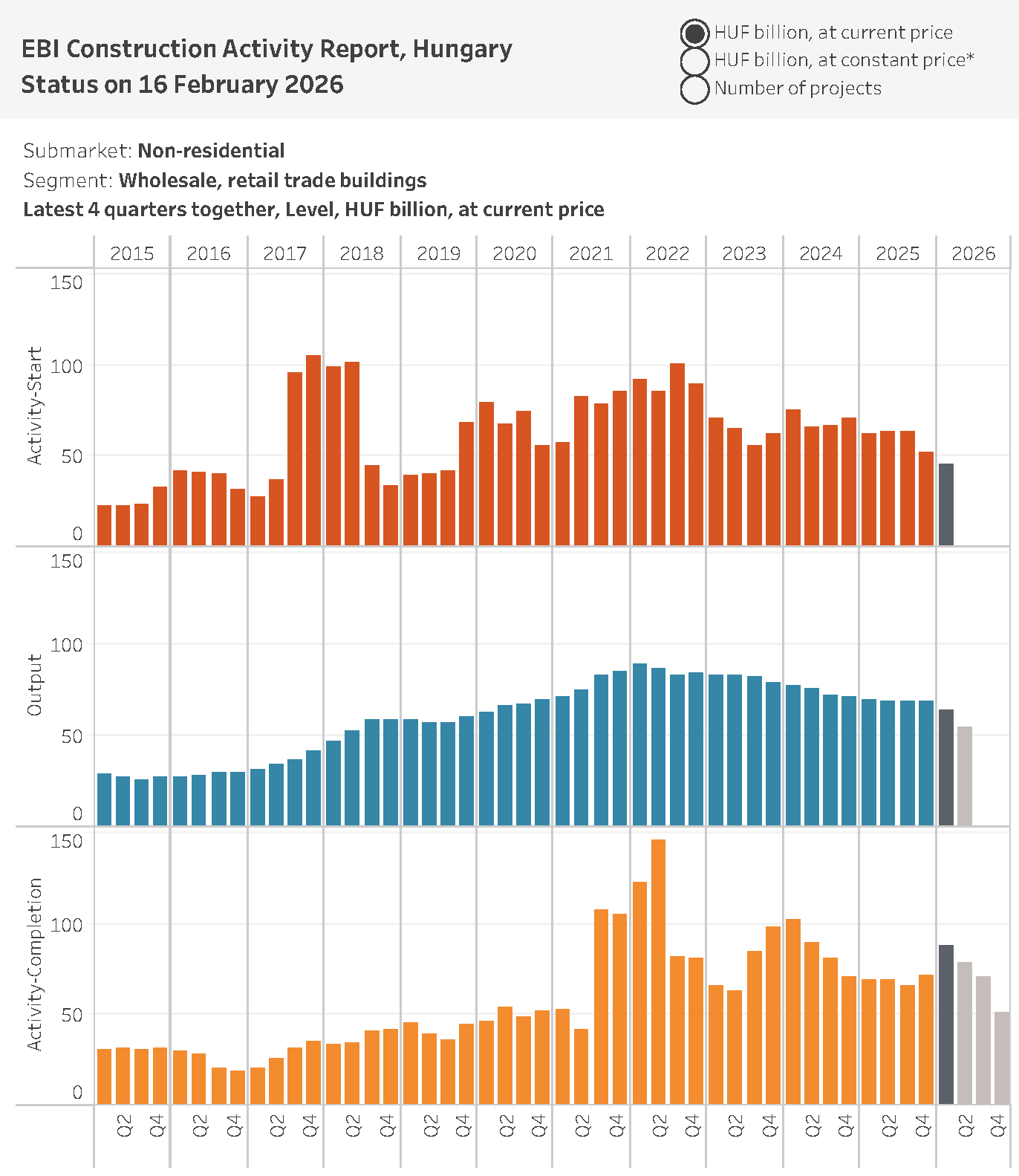
The last time an outstanding Activity-Start was registered in wholesale and retail was in 2017 and 2021-2022. In 2017 the start of construction of Etele Plaza contributed with the highest value, while in 2022 two big project starts played a major role in higher numbers (ActiCity Event Center in Veszprém and Phase II of Zenit Corso shopping centre in Zugló).

2025 brought a rather modest Activity-Start in wholesale and retail, works started by a 27% lower value than in 2024. The decline compared to 2023 was also 16%, roughly at the level of 2020, and the shrinkage compared to the peak years (2017 and 2021-2022) was 39-50%. Despite the drop, larger projects began last year, such as OBI DIY store and Drive-in in Kistarcsa and Stop Shop in Salgótarján.

In 2025, a total of HUF 71 billion worth of wholesale and retail properties were completed, the same as in 2024, for example, the shopping court in Táncsics Mihály Street in Komárom, Phase I of Time Out Market in Budapest, Mömax home improvement store in Székesfehérvár, and Spar store and Dera Park shopping park in Szentendre.

Original article: Tünde Tancsics (ELTINGA); English version: Eszter Falucskai (Buildecon)