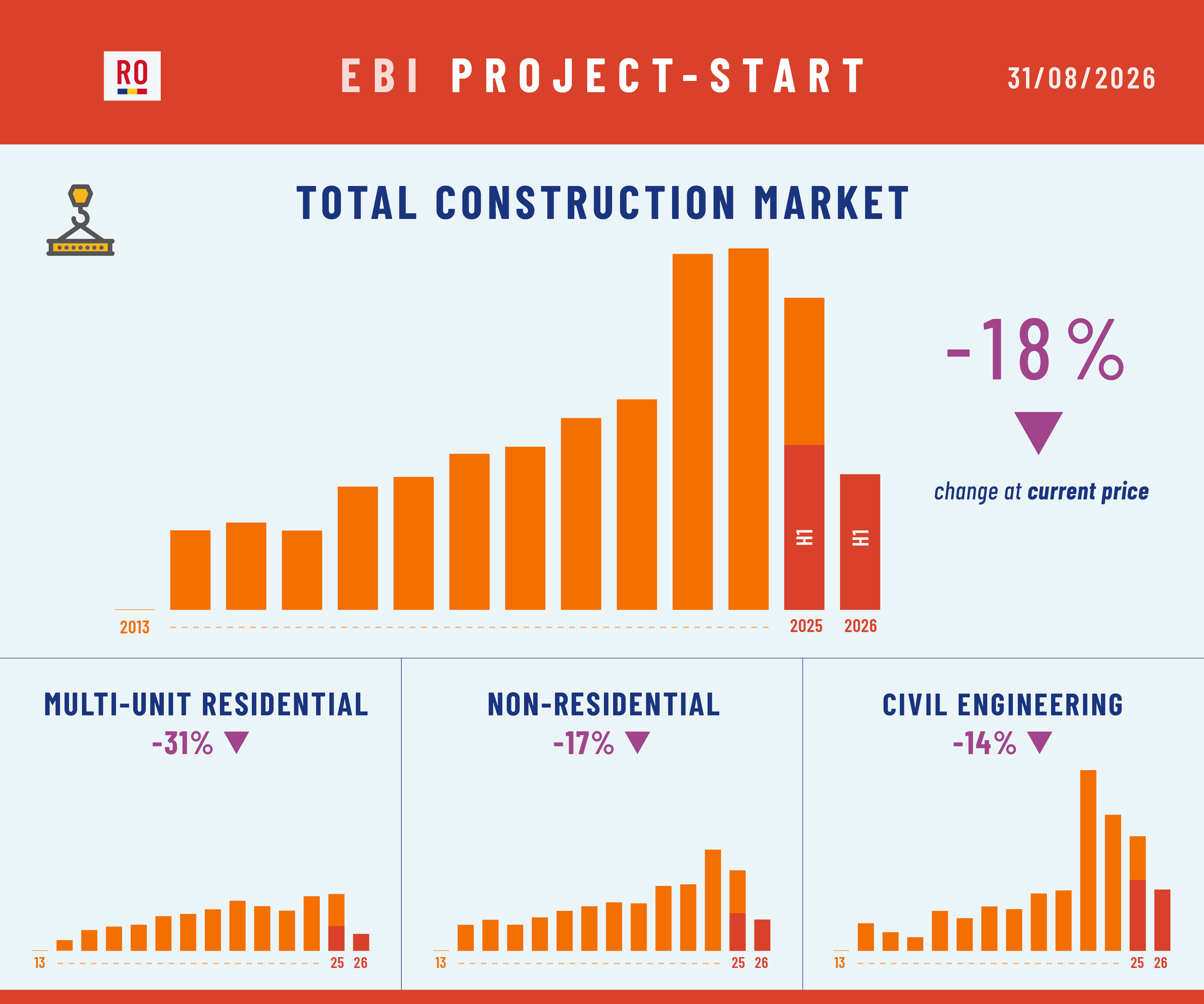
The value of newly started construction projects in Romania was much lower in the first half of 2026, according to the latest EBI Construction Activity Report Romania, with Project-Start in decline across almost every submarket. “Q1 was relatively strong, but not enough to change the overall downward trend. A combination of economic slowdown, persistent inflation, elevated interest rates, and reduced public spending continues to constrain the market” – says Dr. Sebastian Sipos-Gug.
The total value of commenced multi-unit residential projects experienced the largest drop (-31% compared to H1 2025) as developers face more difficult financing terms and cooling market demand. Home prices are rising more slowly than inflation or construction costs, which also makes residential projects less appealing for speculative development. The ransomware attack on the land registry database also hindered new construction, since it froze property transactions, mortgage contracts, land surveys and construction authorizations for weeks. As the administration will have to handle the backlog created during the shutdown in addition to new requests, the situation is unlikely to improve for the remainder of the year.
Project-Start also fell in case of non-residential construction, though at a more moderate pace (-17% year-on-year). Performance within the submarket was uneven: publicly funded buildings, particularly in healthcare and education, were behind much of the decline as government investment comes under strain from austerity measures and the focus on ongoing NRRP-funded projects. The private sector is showing signs of strong resilience, as evidenced by the detailed breakdown in the report (for instance, the remodeling of mall Palas Iasi started in Q2 2026, at an estimated value of EUR 80mln), and could help the submarket weather this period of poor performance.
The infrastructure submarket fared the best of all three, but it still declined significantly (-14% year-on-year) since new projects took a backseat in favor of completing existing works, with the administration focused on increasing absorption before the August 2026 NRRP deadline. The ongoing government crisis has further complicated both the launch of new projects and the financing of those already underway, but a ramp up of the 2021-2027 EU funding programs could help sustain the submarket by the end of the year. For instance, in H1 2026 construction started on the renovation of one of the oldest railroad connections in the country: Bucharest North – Jilava – Giurgiu North – Giurgiu North Border (55 km), with EUR 423mln co-funded from the CEF 2021-2027 budget.
EBI Construction Activity Report Romania analyses the construction industry on a quarterly basis, including the volume of newly started construction works and the value of projects completed in each quarter in aggregate and by segment as well. It is prepared by Eltinga, Buildecon (creation of indicators and development of algorithms for aggregation) and iBuild (project research and project database). We have renamed our indicators for the sake of easier understanding; from now on we refer to the total value of started/completed construction works as Project-Start/Completion.To get the report, please contact us.
EECFA’s 2026 Summer construction forecast up to 2028 was released on 22 June. Sample report can be viewed at eecfa.com. To obtain the new reports, please contact us
Southeast European construction markets up to 2028
Bulgaria stepped into this year as the 21st member state of the eurozone in the middle of an evolving political turbulence that inevitably impacted the construction sector, most notably, projects that rely on public funding. Nevertheless, according to Yasen Georgiev at Economic Policy Institute (EPI), EECFA’s Bulgarian member institute, Bulgaria’s total construction output is anticipated to increase by approximately 2% on average in the forecast period of 2026-2028. He also notes that “Last year Bulgaria’s construction sector excelled with a strong performance, largely thanks to the residential and non-residential submarkets which fared better than previously predicted. In 2026-2028, however, the country’s total construction output could see a heterogeneous performance.”
Michael Glazer (SEE Regional Advisors) and Tatjana Halapija (Nada Projekt), EECFA’s members for Croatia, point to funding from the EU’s Military Mobility Package (MMP) as a promising source of finance for a wide variety of Croatian construction projects. Transportation ones, both straightforwardly military and dual use, are obvious contenders, so the availability of MMP money should lift output in those civil engineering segments. MMP will likely boost some non-residential segments, too, since it can finance, e.g., factories and logistics centers (perhaps even flight schools?) that have a military or dual-use purpose. This will help sustain total construction output despite rapidly declining levels of finance under the EU’s post-2022-earthquake rebuilding programs and RRF. In non-residential generally, while some developments will affect all segments, specific factors will ensure that output growth varies greatly from segment to segment. The picture for energy construction is also confused, with solid, well-known technologies competing with much-hyped, as-yet-unproven, “hi-tech” alternatives. Residential is buffeted by the conflicting influences of rising prices, declining GDP growth and interventions by the central bank and the government.
Dr. Sebastian Sipos-Gug, EECFA’s Romanian researcher at Ebuild, notes that Romania’s construction market is still in a tight spot. “Growth potential is limited with global and national factors conspiring against it. Recent economic forecasts are more pessimistic; 2026 might see a stagnant GDP, declining real wages and the highest inflation in the EU. This is coupled with the looming specter of national deficit causing high taxation and austerity measures: lower public spending, and wage and hiring freezes for public employees. Not to mention that construction costs, which started evening out in 2025 after the 2022 shock, are now again on the rise due to climbing energy prices and labor costs. The saving grace of construction is the EU programs funding infrastructure projects. Yet, with the NRRP running out in mid-2026, and other programs having an inconsistent performance, the boost they can provide is limited. Adding to all this is a political crisis that could lead to a government change at a critical moment (the end of NRRP absorption, projects phased into other funding sources). But the silver lining: most of these issues should be transitory. By 2028 Romania’s construction might return to growth on the back of improved economic indicators, inflation levels within the target range, a more efficient energy sector, and hopefully, a more stable political situation.”
“Serbia’s overall construction output is still consolidating in 2026 led by the correction in civil engineering, while buildings continue to grow in this forecast” – according to Dejan Krajinović, EECFA’s Serbian researcher at Beobuild. He adds that the performance in the residential submarket remains stable and is predicted to continue to grow with moderate growth rates. Non-residential, on the other hand, is booming, driven by massive investments related to the EXPO 2027, with another year of double-digit growth expected in 2026. Main segments benefiting from ongoing developments are office, commercial and hotel, but health-related construction is also breaking records in 2026. The consolidation in civil engineering is anticipated to end in 2027, with new growth on the horizon in 2028 and onwards. The large-scale infrastructure projects in the pipeline should launch a next big growth cycle in overall outputs. However, the war in the Middle East is already pushing construction costs up and the economic uncertainty and fragmentation are still risks that continue to linger in the coming period.”
“Slovenia’s construction sector’s output was holding steady at just under €6bn in 2024 and 2025 but is set to edge higher in the forecast period, supported mainly by public spending” – says Dr. Aleš Pustovrh at Bogatin, EECFA Slovenia. “Growth is increasingly uneven: residential construction remains constrained by limited supply and rising costs despite strong demand, while private non-residential segments such as offices, retail and industry face cautious investors and only modest expansion. By contrast, publicly financed segments, notably education, health and civil engineering renovation, are providing stability, with infrastructure upgrades, railway investment and energy-transition projects sustaining activity. Transport and utility constructions are shifting from large expansions to maintenance and modernisation, and investment in electricity networks and pipelines is set to rise further due to the energy transition. Overall, the sector is moving into a more stable but slower phase where public policy and infrastructure spending play a decisive role in keeping output on track – as long as public financing remains available.”
Eastern European construction markets up to 2028
According to Andrey Vakulenko at Macon, EECFA’s Russian research institute, the downward trend in Russia’s construction market, which began in 2025, is likely to continue and intensify in 2026–2027. The main reason behind is the combination of a decelerating economy and a prolonged period of high interest rates, which negatively impacts demand, limits the availability of financing and restrains investment activity. Residential construction is experiencing the strongest pressure as the market struggles to find a new balance amid reduced mortgage availability, declining demand and decrease in new construction. Most non-residential segments may also show negative dynamics in the coming years impacted by the slowdown in consumption volumes and business activity, weak household income growth and changes in the direction and scope of government funding in certain segments. Civil engineering will likely stay the most resilient subsector due to the implementation of major transport and energy projects. The planned acceleration of infrastructure construction, the expected growth in the residential submarket and the easing of monetary policy are the conditions for the construction market to return to a growth trajectory in 2028.
“In Türkiye, state involvement in housing development has grown in recent years” – say Prof. Ali Türel and Prof. Leyla Alkan Gökler, EECFA’s Turkish researchers. “Policies to curb inflation have depressed households’ disposable income, creating a serious housing affordability issue for both ownership and renting as home prices and rents have spiked. As moderate-to lower-income households have found it increasingly difficult to accumulate sufficient equity for home purchases, the government has intervened. It launched a large number of residential projects for dwellings that can be bought on affordable terms by households not owning a house in Türkiye. Dwellings will be built by the Housing Development Administration (HDA), the key state actor in housing production in Türkiye. Since HDA has also been involved in rebuilding the about 550,000 dwellings damaged in the February 2023 quake, the share of housing built by the public sector has greatly risen in recent years, while the share of the private sector has been declining from its former share of about 90%. Our latest forecast indicates that total construction output in Türkiye may reach nearly 8 trillion TL (nearly EUR 180 billion) in 2028, at 2025 prices.”
“Ukraine’s construction market exhibited high resilience in 2025 despite the ongoing war and challenging security conditions. While it is recovering and it nominally returned to pre-war levels last year, it was still 40% below the 2021 output at comparable prices.” – notes Professor Sergii Zapototskyi at Uvecon, EECFA Ukraine. “Key growth drivers were commercial, industrial, warehouse, and logistics developments, an uptick in residential construction in relatively safe regions, and large-scale projects aimed to restore public and transport infrastructure. In the coming years, the construction market is expected to continue to grow, supported by post-war reconstruction needs, government housing support programs, and an increase in international funding for Ukraine’s recovery. The greatest growth potential will remain in residential, commercial, as well as industrial and warehousing construction. At the same time, the future performance of the market will largely depend on the security situation, the availability of investment resources, the ability to address labour shortages, and the effectiveness of government reconstruction policies.”
Written by Dr. Sebastian Sipos-Gug – Ebuild srl, EECFA Romania
Dr. Sebastian Sipos-Gug, EECFA’s Romanian analyst has looked at the trends that are worth monitoring in the residential market in Romania this year. Among them are the construction costs boomerang, the drop in wages and consumption, considerable interest in multi-family buildings, smaller homes and a greater dependence on mortgage loans.
What we saw in 2025
The construction market faced many challenges in the previous year, alongside the entire national economy. While there was a focus on civil engineering, especially when it comes to EU co-funded projects, the rest of the segments lagged behind.
In early 2025, the removal of fiscal facilities for construction employees led to the decline of their net incomes, and an increase in wage-related expenses for companies. Overall, the effect of this measure was an increase in construction costs.
Then came the multiple shocks of the liberalization of energy markets in July, and a VAT increase in August, which pushed inflation upwards significantly, with the CPI reaching 9.88% in September. In a snowball effect, this led to lower real wages and disposable income, which translated into a reduction in private consumption, and, ultimately, means lower demand for residential construction on the short and medium terms.
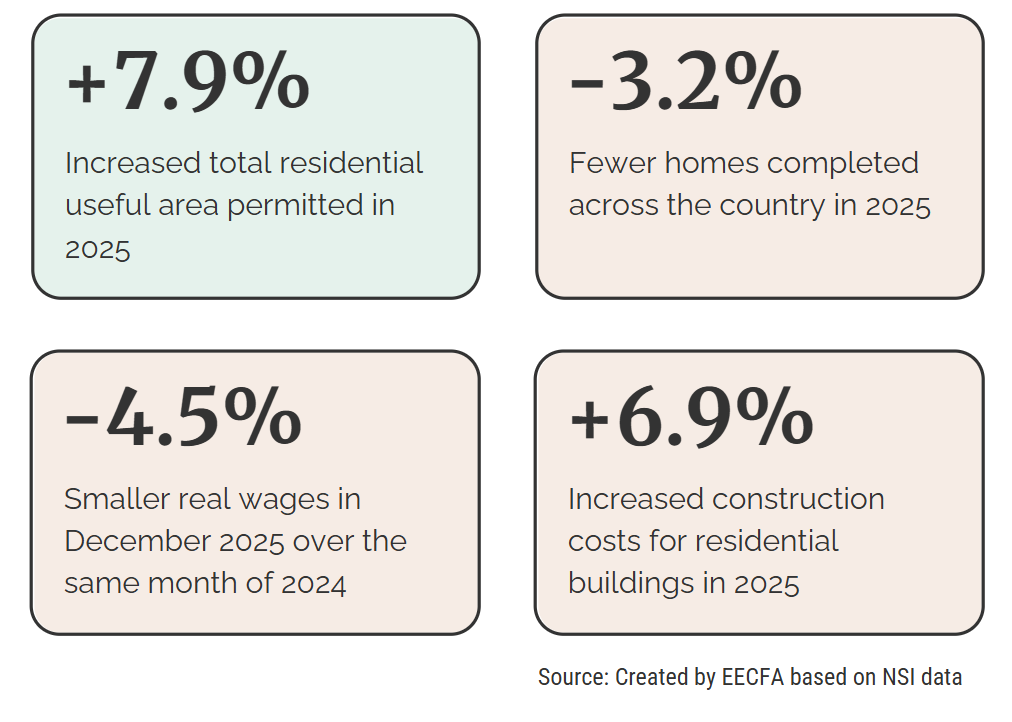
The optimism shown in the increased number of permits, and the useful building area in them, compared to 2024, is countered by the decline in the number of completed homes. Thus, while developers might be looking to the future, their actions in the present are lacking, also evidenced by a significant (-21%) annual decline in the value of started construction works in 2025 (source: EBI Construction Activity Report).
What to watch in 2026
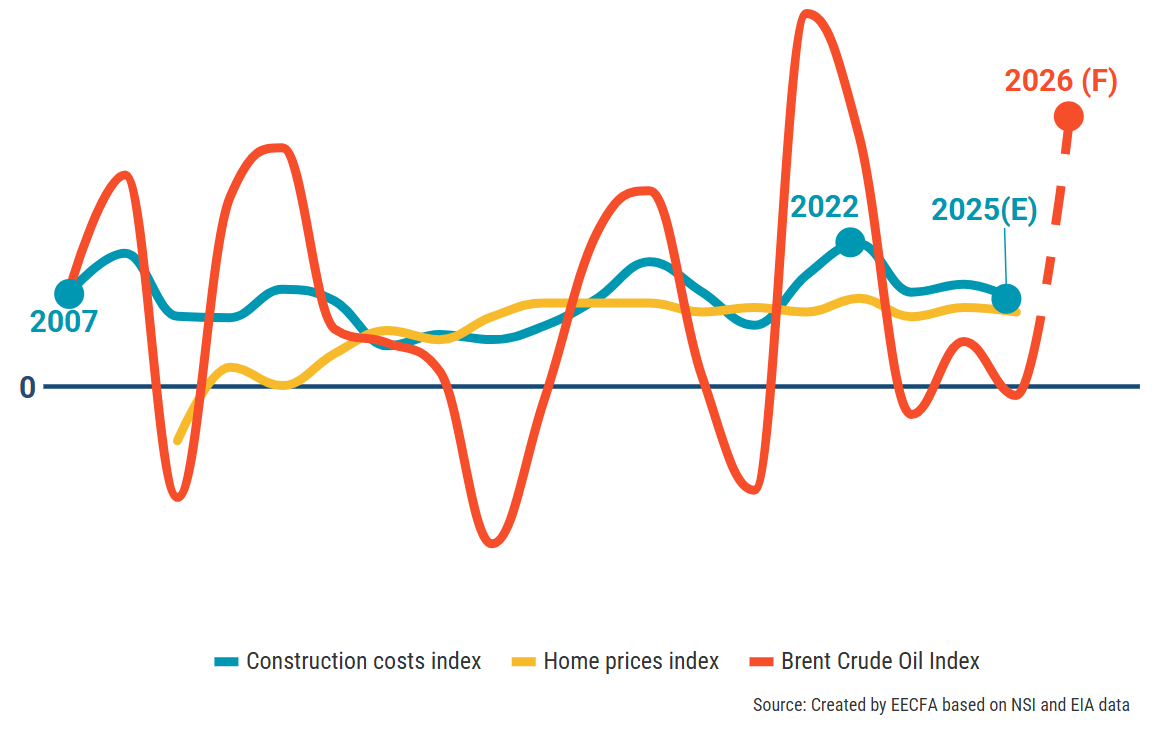
Construction costs boomerang. While previously the expectation was that construction costs would gradually decline in 2026, they proved quite resilient to changes in wages, and fuel and construction materials prices remained relatively stable in the past year. Thus, late 2025 forecasts placed construction costs on a small, descending trend.
The conflict in Iran and its repercussions on oil and gas prices might throw astray these predictions. As of March 2026, oil prices were approaching 2022 levels, and, if they are not reversed rapidly, might have a similar impact on world-wide inflation, energy prices and, eventually, construction costs. A reversal, however, seems rather unlikely at the moment as the damage to energy infrastructure could take years to undo.
To make matters worse, in the past few years home prices grew slower than construction costs, reducing potential profit margins for developers. Added to the decline in real wages, it remains quite unlikely that there will be room for prices to increase alongside construction costs, again similar to 2022, further eating into builders’ financial return potential.
Decline in wages and consumption. Wage growth for 2026 was already forecasted to remain low, underperforming inflation (source NFC – National Forecasting Commission Autumn 2025 Report). Add to that the further shocks now expected from increased energy costs (due to oil and gas prices rising considering the conflict in Iran) and food costs further rising due to increased fertilizer prices, the downwards pressure on real wages is likely to be worse than forecasted, with a slower recovery.
Real wage decline will make it harder to purchase and build new homes, with a negative impact on demand for residential construction. But it could provide a boost to renovation activity, especially when it comes to energy efficiency, as switching homes becomes harder.
High interest in multi-unit residential buildings. Looking at building permits trends for the past decade, single-home buildings have remained relatively stable, while the majority of growth was due to multi-unit buildings. Under price pressure, on the backdrop of restricted wage growth and a contractionary macro-economic outlook, it remains most likely that for the near future we’ll continue to see more interest in the latter. Another connected issue is that of internal mobility, with migration from rural to urban areas in search for education and economic opportunities, increasing demand for denser residential construction.
Smaller homes. While the mean area in permits remained relatively stable between 2017 and 2025, there is a historical precedent in economic downturns leading to smaller homes being built so as to increase accessibility. Since the economic outlook for the year seems to have worsened, this could be the case again in 2026.
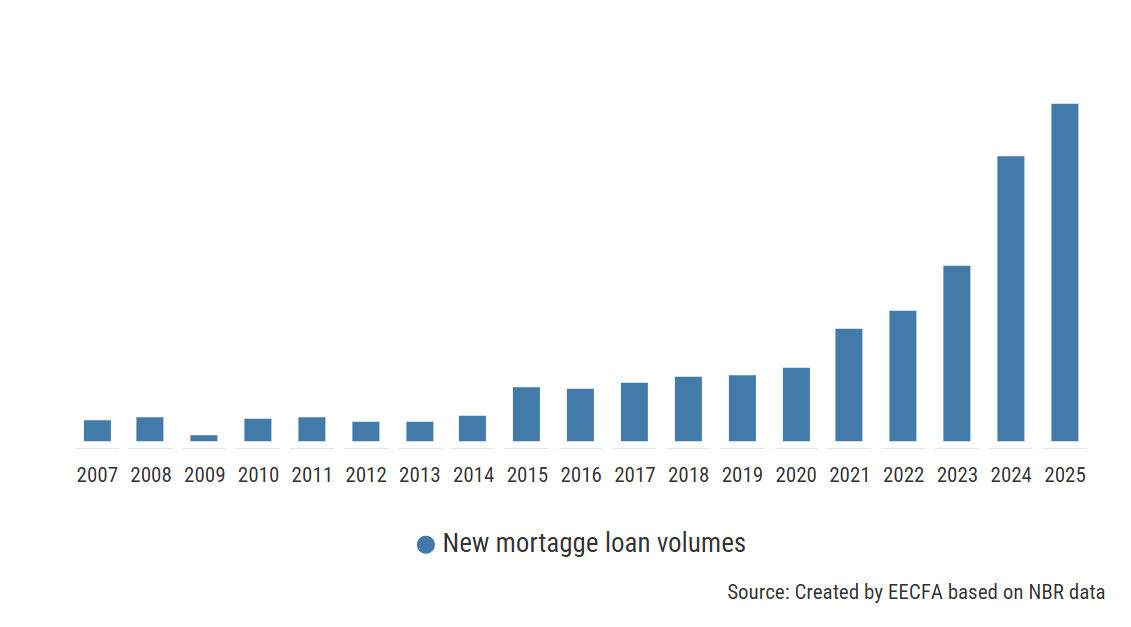
Increased reliance on mortgage loans. Despite the highest interest rates seen in a decade, the volume of new mortgage loans increased dramatically in 2024 and 2025. While some of this could be blamed on higher home prices, there remains a major portion that cannot be explained by price or transaction dynamics. Thus, it is quite likely that it reflects a reduced ability to buy homes without applying for a loan. This is also evidenced by the fact that the share of the population currently housed in a dwelling that was purchased with a mortgage loan grew steadily from a low of 0.5% in 2007, to 1.5% in 2024 (source: Eurostat). This could have been further boosted by the expected drop in interest rates as inflation seemed to be heading in the right direction. However, as of March 2026, this seems less likely, as the conflict in Iran would lead to another energy-led inflation event. Nonetheless, with real wages on the decline, mortgage loans will continue to be relied on for boosting home affordability.
Residential, non-residential and civil engineering forecasts up to 2027 can be found in the EECFA Romania Construction Forecast Report. Sample report and orders: https://eecfa.com/
Written by Dr. Sebastian Sipos-Gug – Ebuild srl, EECFA Romania
Reading the recent blog post regarding permit and completion data one can see that the trend for residential permits in Romania seems to have taken a downturn since 2021, and this naturally raises the questions: What has happened? Has the market peaked or is it just a temporary setback?
The supply-side story
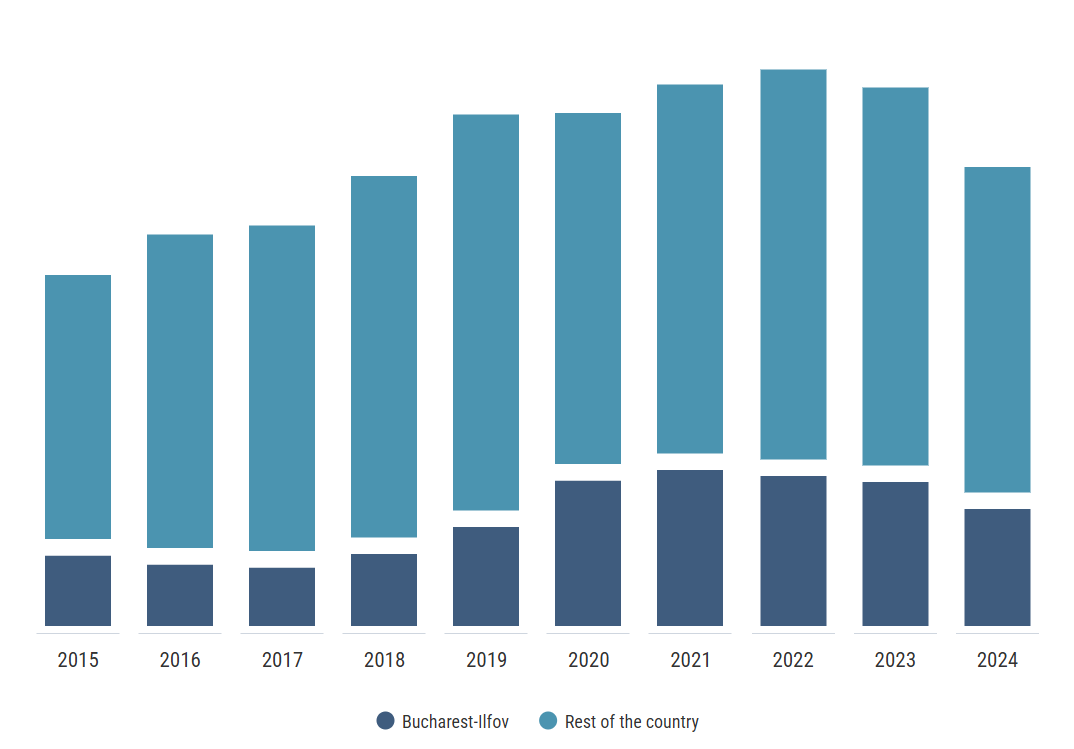
In order to attempt answering these questions, Dr. Sebastian Sipos-Gug, EECFA’s researcher on Romania, started by looking at permit data for a longer period and split by regions. The slowdown in 2023 and 2024 was present in most regions, but none of them was hit as hard as Bucharest where the useful area in residential permits nearly halved in 2024 compared to the peak of 2022. Thus, whatever effect led to the drop in permits, it disproportionately affected Bucharest. While it remains by far the most active region, the drop is oversized when adjusted for its share of the market.
In case of Bucharest, a non-trivial amount of this effect could be explained by the gridlock in the urban planning area, with permits for all types of construction hindered by the cancellation in 2022 of the existing zoning plans which have yet to be replaced by newer versions. This makes it more difficult to gain permits for new developments, and could be, at least partly responsible, for the observed shrinkage in residential permits in the last two years.
Figure 1: Useful area in residential permits, 2015-2024, Bucharest-Ilfov chart presented outside the map due to relative market size (Source: own calculations based on NSI data)
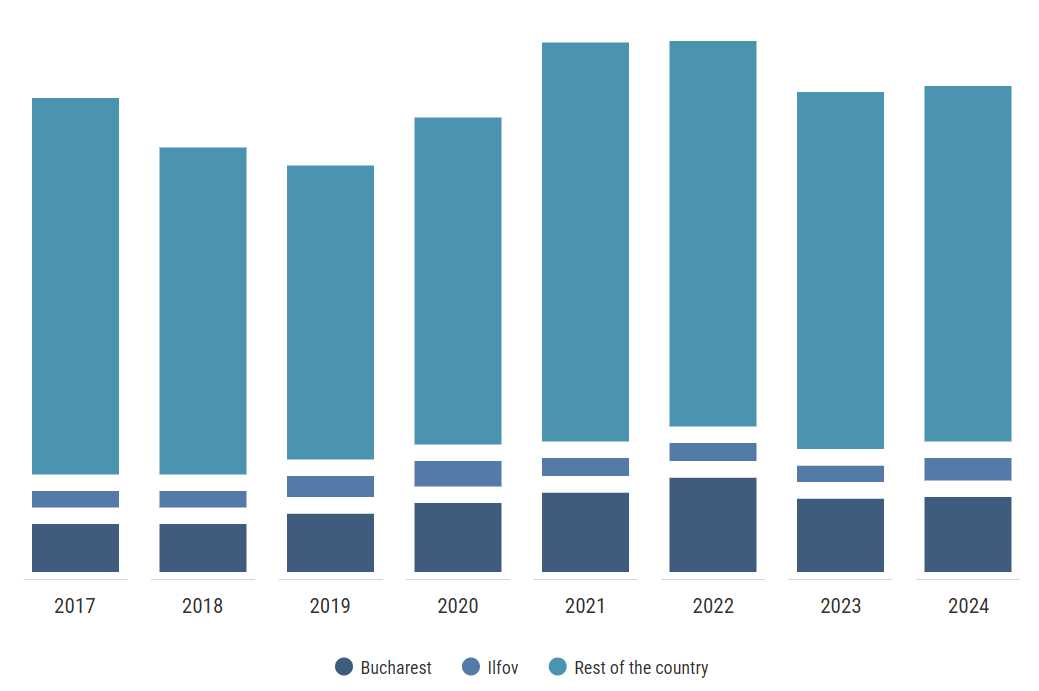
The next logical step seemed to be looking at other indicators such as completions and seeing what happened there. Indeed, they have also been on the decline with the number of completed homes country-wide in 2024 being comparable to that of 2018. Again, Bucharest-Ilfov saw a much larger drop in 2024 over the 2021 figures, standing at –33% compared to –12% in the rest of the country.
Figure 2: Home completions between 2015-2024 (Source: own calculations based on NSI data)
The decline is quite apparent in the supply of new housing overall, but that the situation is much more dire in Bucharest.
The demand-side story
Could the decrease in supply be a response to lower demand? After all, if developers have difficulties selling stock, they are unlikely to start new projects.
Looking at the number of transactions, they indeed declined overall in 2024 compared to the peak of 2021, but the effect was much smaller with just around 10% fewer properties being sold in the whole country, while in the Bucharest-Ilfov region there was barely any change (-0.3%).
At the same time, prices of homes continued growing, but this time Bucharest (+20%) lagged behind the country (+27%), meaning that the price gap between the capital and the rest of the country is slowly closing.
Figure 3: Number of real estate transactions between 2017 and 2024 (Source: own calculations based on ANCPI data)
However, when comparing the growth in home prices to that of the rise in construction costs, the situation looks more dire. As of 2024, residential construction costs grew 41% over the 2021 level, far outpacing the increase in prices. This was partly due to increased materials costs (+32%), but also due to much higher labor costs (+60%) for construction workers. Since in January 2025 tax breaks for construction workers were eliminated and the minimum wage for them grew, it’s unlikely for the situation to improve in the short term, potentially discouraging developers from new investments until prices reach a place where they offset the costs and offer similar margins as before.
What does this mean for housing affordability?
This topic was touched upon last year, in another blogpost, with the conclusion that it is useful to look at affordability from two standpoints: cash buyers and mortgage takers, since increased interest rates can negate the effects of wage growth.
Taking a regional split into account this time, it’s noticeable, and perhaps slightly surprising that homes are more affordable in Bucharest as the wage gap between it and the country average is higher than the residential prices gap.
This took a turn, however, in 2024 as home affordability in Bucharest started to drop, while the national average remained more or less the same. If the previously mentioned issues that limit permitting are not resolved, we can expect this trend to continue in the future as well since a limited supply will mean higher prices.
Another factor that could limit future supply, at a national level, is developer funding. It used to be the case that developers would focus on presales and use very high downpayments in the project phase (up to 90% in some cases) to fund the construction work, without requiring a bank loan.
Since a high-profile scandal regarding a large developer brought this issue into the limelight, confidence in this type of arrangement has declined and buyers are less likely to accept paying high downpayments before construction has even started. Concurrently, there is a bill underway aiming to limit downpayments for unfinished buildings to 10%. Should developers resort to banking loans for their projects, it would make the market more stable but more expensive for them, leading to either lower margins, or higher prices.
Figure 4: Home affordability for cash buyers: sqm in an average 2-room apartment one could afford with average monthly net wage (Source: own calculations based on data from NSI and imobiliare.ro)
When it comes to home affordability for those using a mortgage loan, things are not looking better than they did last year. Inflation has proved to be stickier than expected, and the Central Bank is lowering reference interest rates slowly, meaning mortgages will continue to be relatively expensive in the near future.
While the higher wages in the capital again prove to be an advantage, making homes slightly more affordable than for the average Romanian, this indicator was also on the decline in 2024 for Bucharest, and stable for the rest, shrinking the gap between the two.
Figure 5: Home affordability for mortgage buyers: size of the home (in sqm) one could afford to buy with a mortgage loan, assuming a 25% downpayment, a 30-year term and a debt-to-income ratio of 40% of the average monthly net wage (Source: own calculations based on data from NBR, NSI and imobiliare.ro).
In the context of high energy costs, in 2021 construction costs increased. Since then, the situation has not improved dramatically, and it’s unlikely to change in the near future as inflation and high wage growth will keep an upwards pressure on them in 2025 as well.
Bucharest is doubly feeling the pain when it comes to new residential development. Adding to high construction costs, there are issues with urban zoning and permits approvals. The supply constraints mean higher prices, leading to slightly declining home affordability, especially for those relying on mortgages.
Figure 6: Construction costs for residential buildings (Source: own calculations based on data from NSI)
Forecast for the Romanian residential market is available in the EECFA Forecast Report. EECFA conducts research on the construction markets of 8 Eastern-European countries, including Romania. Contact us for orders and sample report