Housing market in Russia: Demand potential shaping future market dynamics

While in the EECFA Forecast Report Russia we estimate/forecast residential output, this article is looking at another angle of predicting housing market developments: demand potential in the Russian housing market (the number of households able to buy housing) as the main indicator of further market dynamics. Positive macroeconomic indicators in Russia currently are suggesting growth in real incomes and an increase in the population’s solvency, which in the near-term future is set to raise the number of households able to buy housing. This growth in demand potential will have a positive impact on residential output, yet, this is not something that will happen overnight: the Russian housing market is predicted to continue to slump for the time being. Nevertheless, the predicted growth in demand potential will play a major role in halting this drop, leading to an expansion in the housing market in 2019.

Written by Andrey Vakulenko – MACON Realty Group, EECFA Russia
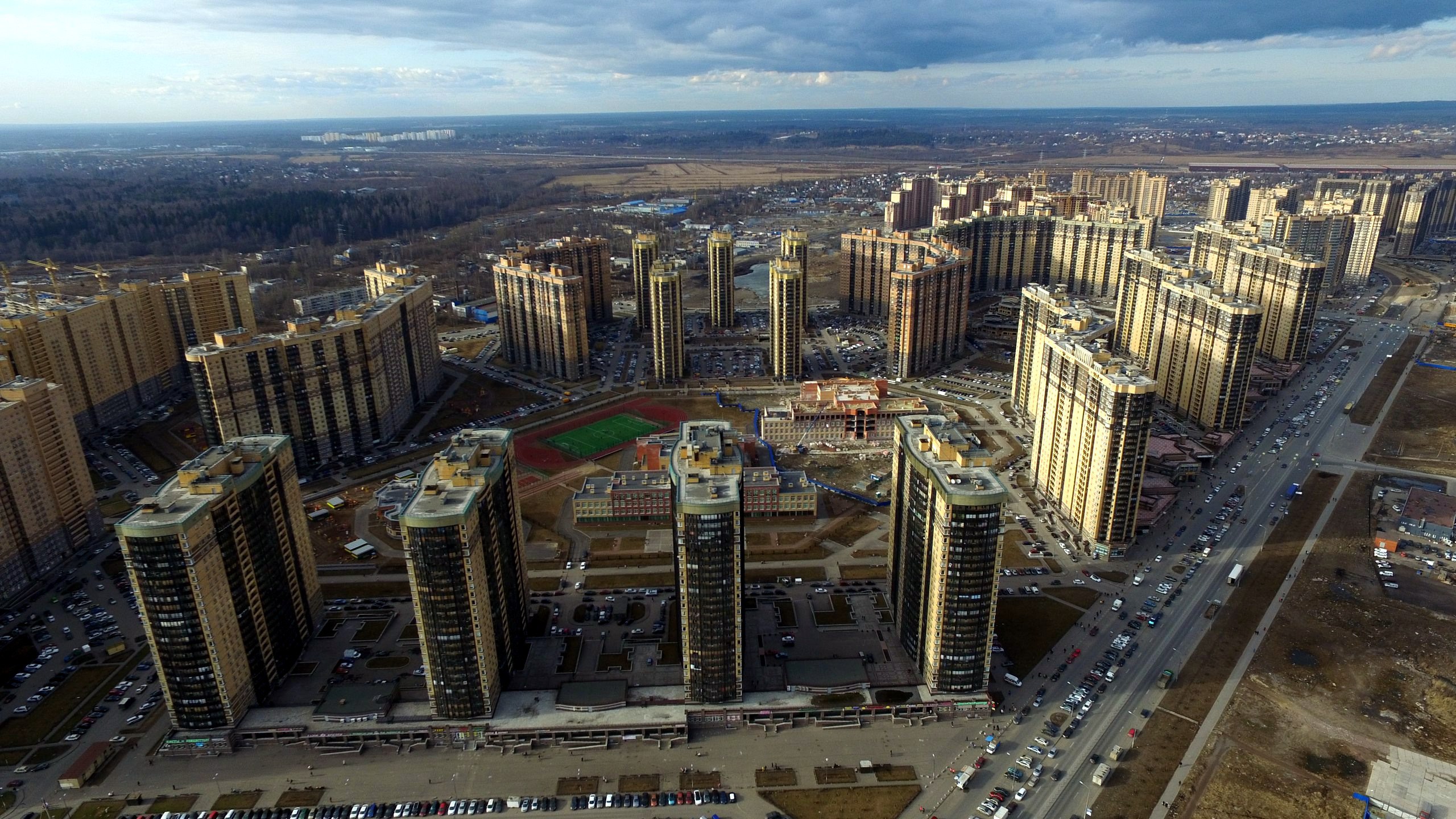
‘North Valley’ Residential Complex in St. Petersburg – Source: http://www.severdol.ru

Having the largest share in total construction both in value and volume terms, the housing market is the engine of the whole Russian construction market. Any change – decline or growth – in the housing subsector may have a decisive effect on the Russian construction industry as a whole; as it was the case, in particular, during the crisis of the Russian economy in 2015-2016. In this period, the housing sector enjoyed an unprecedented level of state support (more details in the current/previous EECFA reports), which prevented the entire construction industry from collapsing.

The state of the housing market primarily depends on the ability of the population to purchase housing. Other market factors, such as the volume of supply in the market, the level of competition or the cost of housing are secondary. It is the ability of citizens to buy housing that ultimately determines the total volume of effective demand, which in turn regulates development activity and price trends in the local housing market. At the same time, the indicators of the population’s need for housing are also secondary in terms of the dynamics of the market situation; they are of an abstract nature and cannot be used to predict the situation in the market. The need for housing is a conditional market potential, which, without the ability to buy housing is never realized. The ability of the population to purchase housing is the real market potential, which – in most cases – is realized in transactions. The level of housing provision (need) affects only the nature of demand: investment purchase, purchase of a first home, improvement of housing conditions, among others. Continue reading Housing market in Russia: Demand potential shaping future market dynamics

EECFA 2017 Summer Construction Forecast and Revision

We have released our summer construction forecast on 16 June 2017 on Bulgaria, Croatia, Romania, Russia, Serbia, Slovenia, Turkey and Ukraine. This post intends to summarize the most important projections for these construction markets for the years 2017-2019. These are our main findings; for a deeper understanding, please consult our reports. You can contact us on eecfa.com.

Outlook for the EECFA regions

The highly optimistic outlook for South East Europe is maintained by EECFA. Leaving behind the transitory 2016, when the absorption of funds available in the new EU programming period (2014-2020) was still at a low level, the upcoming years are characterized by a bigger expansion of the construction market than that of GDP. Building construction is predicted to well outperform the total market, with a yearly average rate of 9% over the horizon. The small growth in the region’s total civil engineering market is attributed to the negative expectations in Romania.

Sideway moves, no further market expansion on the horizon are what we consider the most probable scenario for the 3 East European markets together. Turkey and Russia, being far the two biggest markets we cover in EECFA, is expected to show some similarities. In both countries our forecasts are moderately optimistic in the civil engineering market. While in the building construction market the outlook is clearly negative for Russia and neutral for Turkey. In Ukraine, the recovery experienced in 2016 is predicted to be sustained until 2019. Both building construction and civil engineering could expand further with a relatively good pace. Continue reading EECFA 2017 Summer Construction Forecast and Revision

EECFA 2016 Winter Forecast

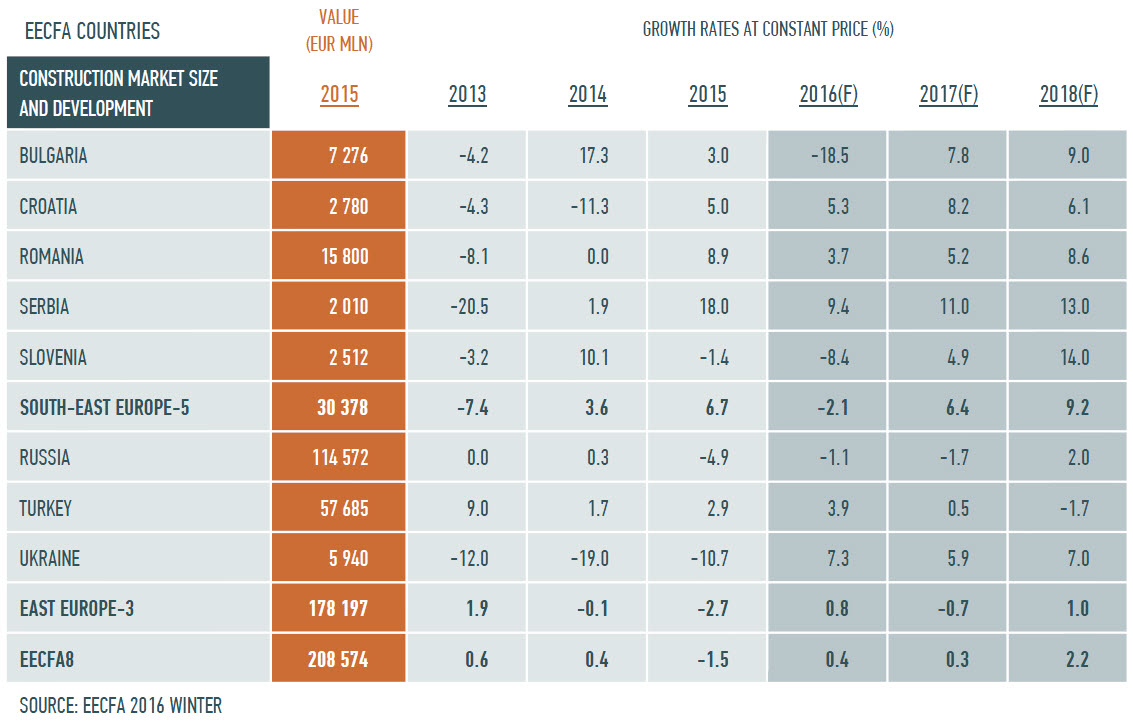
EECFA has released its winter construction forecast reports on 2 December 2016. In this post you will find the concise summary on our expectations for the 8 construction markets we are dealing with: Bulgaria, Croatia, Romania, Russia, Serbia, Slovenia, Turkey and Ukraine. You can also find us and our reports on eecfa.com.

eecfa_pressgraph


Regional outlook

South-East Europe is very optimistic. After the transitory 2016, when shrinkage in the civil engineering market in the EU countries of the region dragged down the region’s total performance, high growth is expected to characterize the total construction market in the upcoming years. Each EECFA country of the region predicts an expansion beyond 5% for 2017 and a further increase for 2018. Building construction, coming back from low levels, is predicted to expand faster than civil engineering in 2017.

Eastern Europe is at a standstill as a whole. In Russia, we expect a prolonged decline. The total construction market is not predicted to expand before 2018, and we believe that the growth of civil engineering sub-market can only alleviate the loss awaited in building construction in 2017. In Turkey, our stories for the upcoming years is rather similar to that of Russia, slight optimism in civil engineering, slight pessimism in building construction leads to a total market which is not predicted to grow until 2018. In Ukraine, all-round recovery is forecasted. From the very low levels, we expect relatively high growth rates for 2017 and 2018.

eecfa-_presstable

Continue reading EECFA 2016 Winter Forecast