Rusty

With the latest governmental decision, the number of projects in designated rust belt action areas reached 81 in Hungary. Estimated 40 thousand dwellings1 are being built or will be built on these sites. The sole purpose of this post is to follow these projects and to see how they will or will not help the recovery of the new residential construction sub-market in Hungary.

Status on 28 January 2026.
The upswing has not been too intensive lately, but many XXL projects have moved closer to under construction status.

Completed: 3 620 dwellings
Under construction: 10 484 dwellings
Before construction: 26 149 dwellings

Brief background

Rust belt action areas (let me shorten them to rusty) are practically brownfield areas with special benefits. The owner of the site or the developer should initiate the process (with specific development plans) and there is a Committee to examine if the proposed site is entitled for the rusty status. Based on the opinion of the Committee, the final decision is made by the government. The decisions (about the exact sites) are announced in a decree and the special benefits coming with it are:

  • priority investment status, meaning e.g. faster permitting procedures2,
  • newly built homes can be sold at 5% VAT without limitation in time3,
  • this 5% can be reclaimed by the buyers4.

By the current regulations, it means a min. 5% and a max. 27% price advantage over competitors developing on non-rusty area until 2030 (depending on when the permit was obtained) and a 27% price advantage from 2031 on.

Our focus

What we do is to turn the mentioned decree into information we need for forecasting. With the help of Eltinga Building Permit Monitor database and the iBuild project information database, actual projects are identified from the lot numbers specified in the decree. Among all the general project specifics, the number of dwellings (where it is known), are attached to these projects.

The map shows the stages of the housing projects that were given rusty status. Bluish dots are those before construction, neon yellow dots are those under construction and the dot disappears once the project is completed.

OK, it is very convenient to see projects on a map, but our focus is more on the chart under the map where the yellow is the number of homes under construction.

What we are curious about is if and when the right end of the yellow curve shows a strong upturn.

In other words, we are curious whether the regulation ignites a recovery or not. As of now, it is more common that the yellow line has increased because projects having started in the past were given the rusty status. (So they were just re-qualified, it did not mean new project starts.) In parallel, it is less common that projects start after they were given the status. Just two extreme examples for these: Unipark Buda has been under construction since 2019 and it got the rusty status at the end of 2023, while Láng quarter was given the rusty status in 2021 and it is still before construction.

The charts will be updated quarterly, so check back if you are also curious.

Another way we like to look at it is a list. Here we do not separate the projects to phases (like on the map) and it gives a quick understanding on how each rusty project moves ahead from 1 February 2024 on.

Data sources

The data mostly come from Eltinga Building Permit Monitor (in Hungarian: Építési Engedély Figyelő). This is a very detailed database on before construction multi-unit housing projects in Budapest. It is aiming primarily at developers who would like to understand the competition. For further information on this, please turn to Mr Zoltán Sápi, Eltinga, sapiz@eltinga.hu. Besides, we use the iBuild project information database.


  1. This is an estimation based on the median size of those rusty projects where the number of homes were announced ↩︎
  2. 619/2021. (XI. 8.) Korm. rendelet
    a rozsdaövezeti akcióterületek kijelöléséről és egyes akcióterületeken megvalósuló beruházásokra irányadó sajátos követelményekről
    ↩︎
  3. 2021/8. Adózási kérdés – A rozsdaövezeti lakások értékesítésének adómértéke ↩︎
  4. Rozsdaövezeti adó-visszatérítési támogatás ↩︎

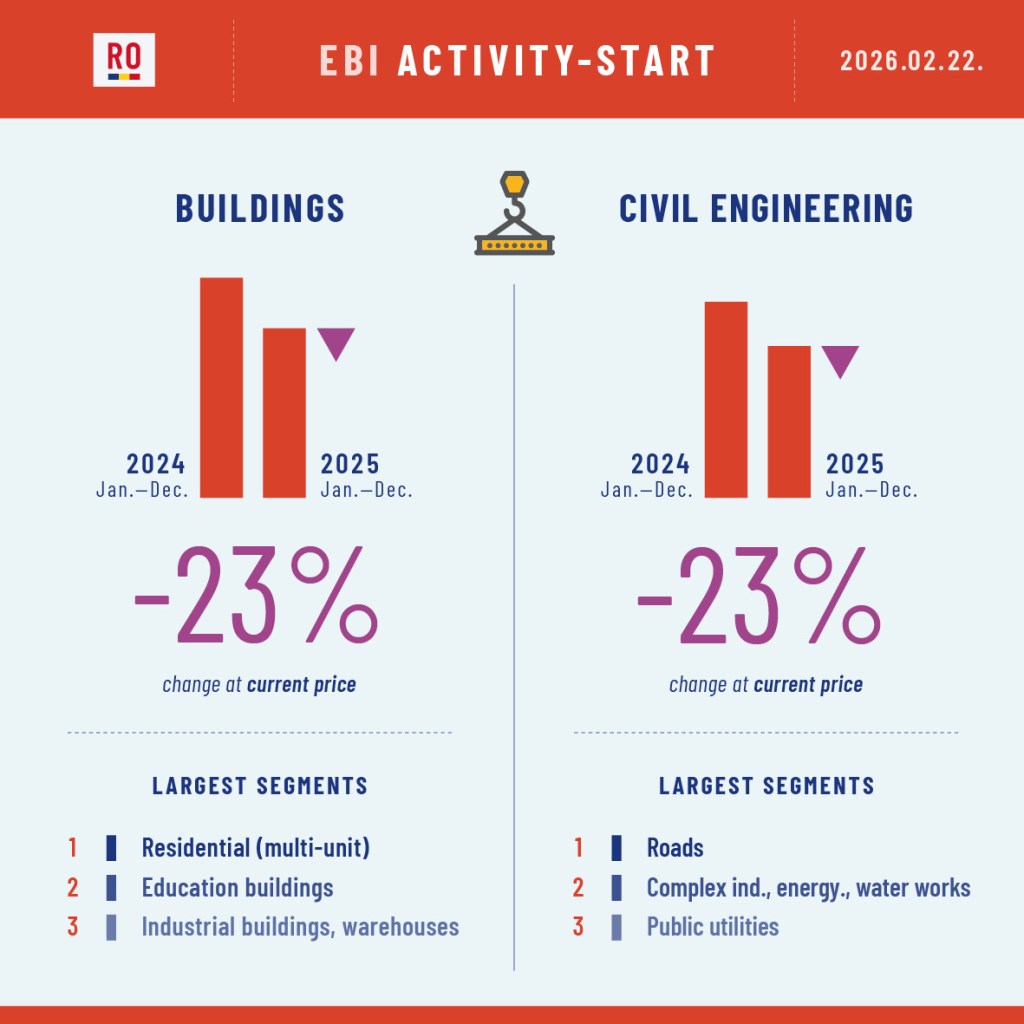
EBI Romania – started construction works – 10 January 2025

There was no construction start indicator in Romania, so we have created an estimation for it.

This poster is a summary of our monthly findings. It shows how the total value of started construction works have changed over the same period last year. Besides, it presents which segments have the biggest start value in the current year. We call this indicator Activity-Start. And they are computed every month for 18 construction segments by aggregating data of construction projects. The projects are from the iBuild database and ELTINGA and Buildecon found the way of creating indicators out of them.

If you need short-term foresight, you will like it.

Brief comment from Janos Gaspar, head of Buildecon:

Activity-Start of building construction dropped massively in 2025. Both the residential and the non-residential submarkets are in red, but residential looks less bad. These are not the final results, though, as Q4 figures are still ‘very’ preliminary. There was a drop in civil engineering, too. With more than 6-billion-euro worth of started works, however, 2025 is still considered to be a very good year. It is just that it was not as exceptionally great as 2023 and 2024.

Every month this poster will be available here on our blog. If your interest is deeper, we have the EBI data visualization (with indicators for all the 18 segments of the construction market), updated monthly and we have the EBI Construction Activity Report Romania (with data and explanations), published quarterly in English and in Romanian. All these are packed into a yearly subscription. For the specifics, please contact us.

EBI Hungary – megkezdett kivitelezési munkák – 2026. január 7-i állapot

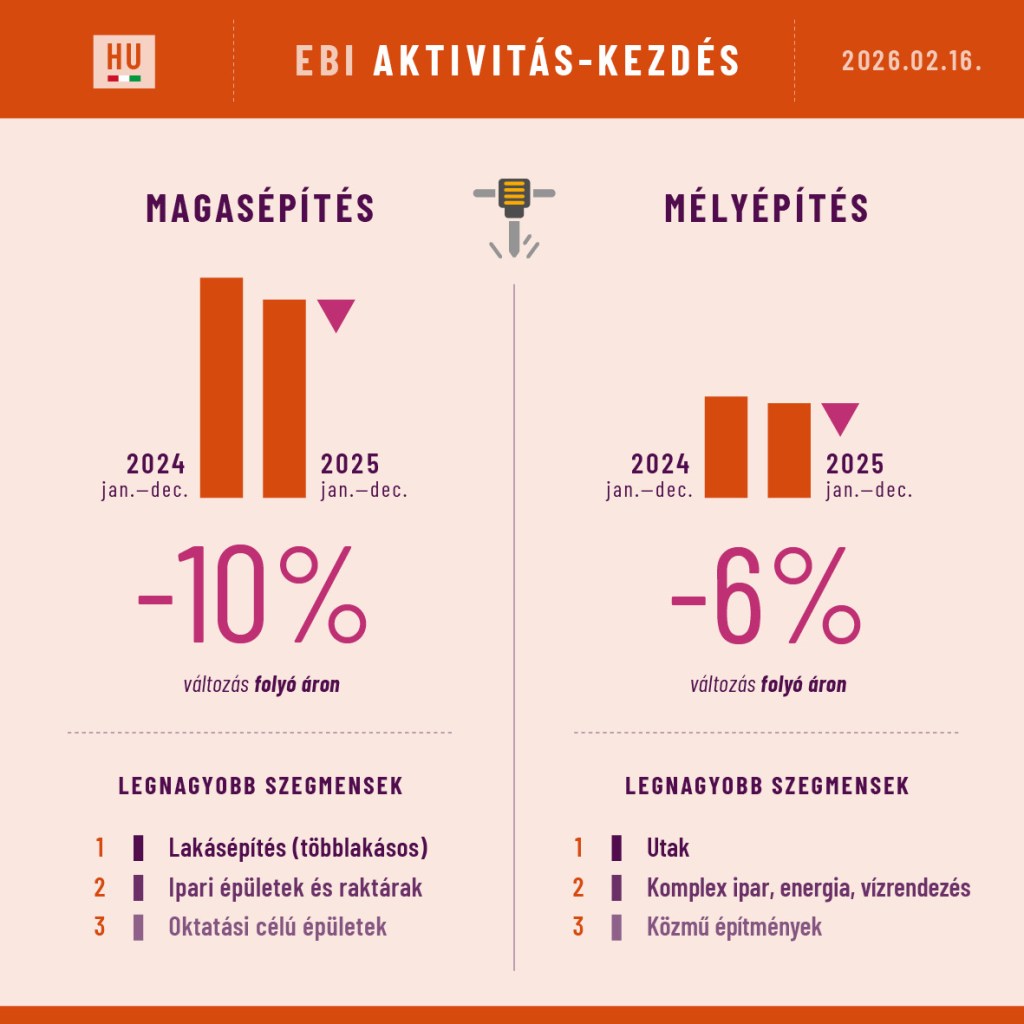
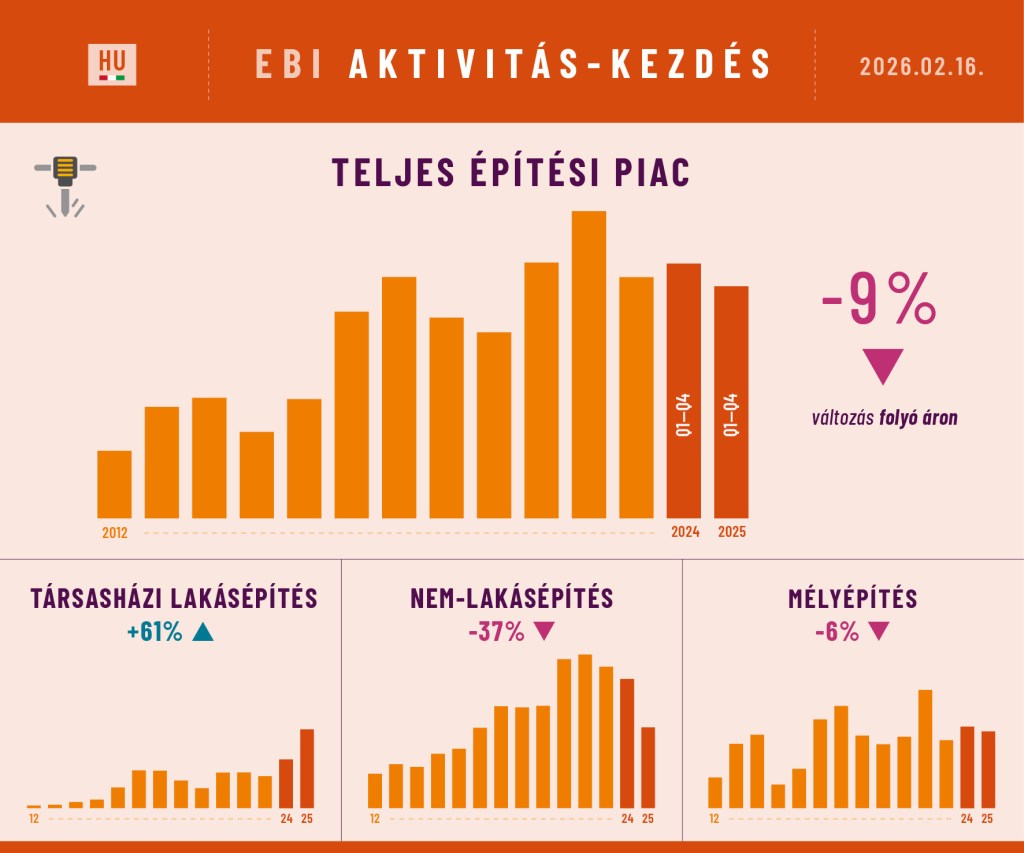
Az év vége nagyon gyenge lett a társasházi lakásépítés részpiacon, de 2025 egészében még így is megduplázódott az Aktivitás-Kezdés 2024-hez képest. Ezzel szemben a megkezdett nem-lakáscélú projektek értéke hatalmasat esett a tavalyi évben. Ezen a részpiacon nagyon tartós a visszaesés, három éve folyamatosan csökkenést mérünk. A mélyépítés 2025-ös Aktivitás-Kezdése lényegében megegyezik a tavaly előtti (és az előtti) év alacsony szintjével.

A poszter a két nagy építési részpiac Aktivitás-Kezdés indikátorának időszak/időszak változását mutatja, valamint a szegmenseket amelyekben a legnagyobb értékben indultak kivitelezések. Ezt a posztert minden hónapban kitesszük ide a blogunkra. A teljes építési piacot részletesen bemutató EBI Építésaktivitási Adatvizualizációt (összesen 18 szegmens adataival) is havonta frissítjük, és negyedévente az EBI Építésaktivitási Jelentésben is elmondjuk, hogy mit látunk a piacon. Ha érdeklik a részletek akkor a contact oldalon írjon nekünk.

The end of the year was very weak in the multi-unit residential submarket, but Activity Start in 2025 (as a whole) still doubled compared to 2024. In contrast, the value of started non-residential projects fell dramatically last year. The decline in this submarket is very persistent; it has been going on for three years. The Activity Start of civil engineering in 2025 stayed at the same low level as in the year before (and in the year before that).

The poster (above) shows the period/period changes of the Activity-Start indicator in the 2 main submarkets and the segments with the largest value of started works. This poster is published every month here in the blog. The EBI Construction Activity Data visualization with the details on the whole construction market (with altogether 18 segments) is also updated monthly and the EBI Construction Activity Report, summarizing what’s happening in the market, is published in each quarter. If your interest in construction markets is deeper, please contact us for the details.

EECFA 2025 Winter Construction Forecast

EECFA released its 2025 Winter construction forecast on 12 December. Check out a sample report and place your order on eecfa.com. For discount, please contact us.

Southeast European construction markets

Bulgaria’s total construction output is forecasted to increase by 3% on average for 2026-2027” – says Yasen Georgiev at Economic Policy Institute (EPI), EECFA’s Bulgarian research institute. He adds that this is to follow estimates for a similar performance of almost 3% in 2025. The sectoral background, however, shows, a nuanced picture – cooling of residential construction, positive news from non-residential and a robust performance of civil engineering. The latter will benefit from investments which will be backed by the absorption of EU funds through the Recovery and Resilience Plan (RRP) and classical operational programmes, both with implementation deadlines in 2026 and 2027. At the same time, Bulgaria’s economy is to expand by 2.4% on average in 2026-2027 – a period continuously shaped also by the Euro adoption on 1 January 2026.

Michael Glazer (SEE Regional Advisors) and Tatjana Halapija (Nada Projekt), EECFA’s Croatian members, think that declining dwelling sales in Croatia have, paradoxically, failed to stop the growth in the value of Croatian residential output, because increases in the price per square meter of those dwellings that do get sold have more than compensated for the lower number of square meters bought. “But how long this can continue is unclear” – they add. “The policies that the Croatian government is implementing in order to ease the country’s housing crisis are confusing the residential picture still more, since a number of those policies have contradictory effects on output. As to non-residential building construction, output growth during the period covered by the current forecast will depend greatly on the sector, with some likely to continue to benefit from catch-up growth and EU support for a bit longer and others moving toward a steady state or even a decline. In civil engineering, EU funds continue to play the dominant role in financing construction of all sorts. Sports facility construction is experiencing a boom, but given the speed with which such projects are completed, the effect on output will be relatively brief. Renewable energy construction should be growing rapidly, but regulators’ hostility toward the sector are holding it back.”

Romania’s economy is entering a challenging period as the recently implemented measures to reduce the national account deficit begin to take effect” – reports Dr. Sebastian Sipos-Gug, EECFA’s Romanian researcher at Ebuild. “While most forecasters do not anticipate a recession, economic growth is expected to remain subdued over the next two years. Inflation is the highest in the EU, boosted in 2025 by increases in sales taxes. As a result, consumer prices are rising at a pace that is forecasted to outstrip wage growth, leading to a decline in real incomes in both 2025 and 2026. Government spending is also facing cuts, thus both private and public consumption are predicted to decline, with a chilling effect on most construction activity types. There is also the challenge of the massive level of public investment required by civil engineering projects that have started since 2023, which will be difficult to sustain under the austerity and the mounting pressure of losing even more EU funding. On the brighter side, both the economy at large and the labour market are expected to be quite resilient. By 2027, assuming the deficit reaches manageable levels, the effects of contractionary policies should fade out, inflation could ease, and interest rates could come down. This means that demand for construction would rebound and with it, construction activity.”

Dejan Krajinović, EECFA’s Serbian researcher (Beobuild) says that “Serbia’s overall construction output sank into a negative territory in 2025, primarily owing to the weaker performance in civil engineering. This year recorded growth in building construction, but the substantial consolidation in civil engineering dragged totals in red. The completion of major road, railway and energy projects contributed mostly, but delayed construction starts played a role as well. Residential construction is stable and is on historical levels, while non-residential construction is booming led by the hosting of the EXPO 2027 in Belgrade. Investments into commercial, hotel and office buildings are all spurred by the event, with the purposely built EXPO 2027 complex consisting of numerous venues being the single largest investment in non-residential. Improving financial conditions and sustained demand still support relatively high construction activity, but a lot of global political and economic uncertainties are dimming future prospects.”

Dr. Aleš Pustovrh at Bogatin, EECFA Slovenia, says that Slovenia’s construction sector is holding steady at EUR 6bn, though growth has cooled. Residential buildings remain the anchor, with output expected to show only a slight dip in 2025, helped by strong employment, rising wages and cheaper mortgages. Property transactions rebounded in early 2025, reversing last year’s slump, while prices continue to climb amid land shortages and slow permitting. Public housing programmes are ambitious, but private developers are concentrating on Ljubljana and coastal towns. Non-residential construction is mixed: offices are recovering slowly, retail stays subdued, but industrial and warehousing thrive on export demand and automation while health and education remain at very high levels. Civil engineering and public works lean on EU-backed projects and are anticipated to reach historically high levels by 2026. 

Eastern European construction markets

Andrey Vakulenko at Macon, EECFA’s Russian research institute notes that “the high key rate and the overall economic slowdown are constraining the Russian construction industry with negative trends expected for the current year and over the next two years. An easing of monetary policy, which has already begun, could help normalize the situation, but a positive effect is not expected until 2027. The main drag on construction output will likely be the residential subsector where high rates and revised government demand support principles are reducing activity among both buyers and developers. Negative trends will also likely persist in most non-residential segments due to declining growth rates of budget financing, a general decrease in business activity and a slowdown in consumption. The overall descending dynamics in the construction market may somewhat be mitigated by stable growth in civil engineering driven by export projects in energy and transport, but this growth is not predicted to be enough to keep the construction market in a positive zone”.

Prof. Ali Türel, EECFA’s Turkish researcher, reports that “the major effect of inflation-curb policies in Türkiye is the decline in disposable income and in the purchasing power of wage earners and pensioners. The moderate to lower-income population is unlikely to save enough equity for buying a home when rents have also become unaffordable for many. Ironically, housing sales have been increasing at a much higher rate than the growth of households. This can be attributed to the typical trend in Türkiye, where, during inflation, people expect a higher real return on their financial assets from real estate investments compared to alternative investment options. The reconstruction of earthquake-damaged buildings and infrastructure also contributed to the high rate of growth in building starts and completions from Q2 2025 onward, leading to the highest rates of change in the construction sector’s contribution to GDP compared to other sectors. Our latest forecast indicates that total construction output in Türkiye may reach 6.4 trillion TL in 2027 (EUR 180 billion), all at 2024 prices.”

According to Prof. Sergii Zapototskyi of Uvecon, EECFA Ukraine, despite the war and high risks, Ukraine’s construction industry remains one of the key drivers of economic recovery in 2025. The RDNA4 (the latest Rapid Damage and Needs Assessment Report) estimates Ukraine’s reconstruction needs for the next decade to be USD 486-524 billion, creating long-term demand for residential, non-residential and civil engineering construction works. Major challenges persist, including the uncertainty regarding the duration of the war, especially in frontline regions, labour shortages, bureaucratic barriers in the urban planning legislation, and logistical constraints due to the relocation of production facilities, and often, shortages in building materials. At the same time, the industry is demonstrating resilience: developers are diversifying supply chains, stabilizing procurement schedules, and increasing activity in the Central and Western regions. Demand for housing, intensive infrastructure restoration, and international investment from the EBRD, EIB, and other partners continue to support positive dynamics. The sector’s development prospects for 2026-2027 will largely depend on the security situation and the effectiveness of state recovery programs.

M1 motorway boosting Activity-Start in Hungarian construction

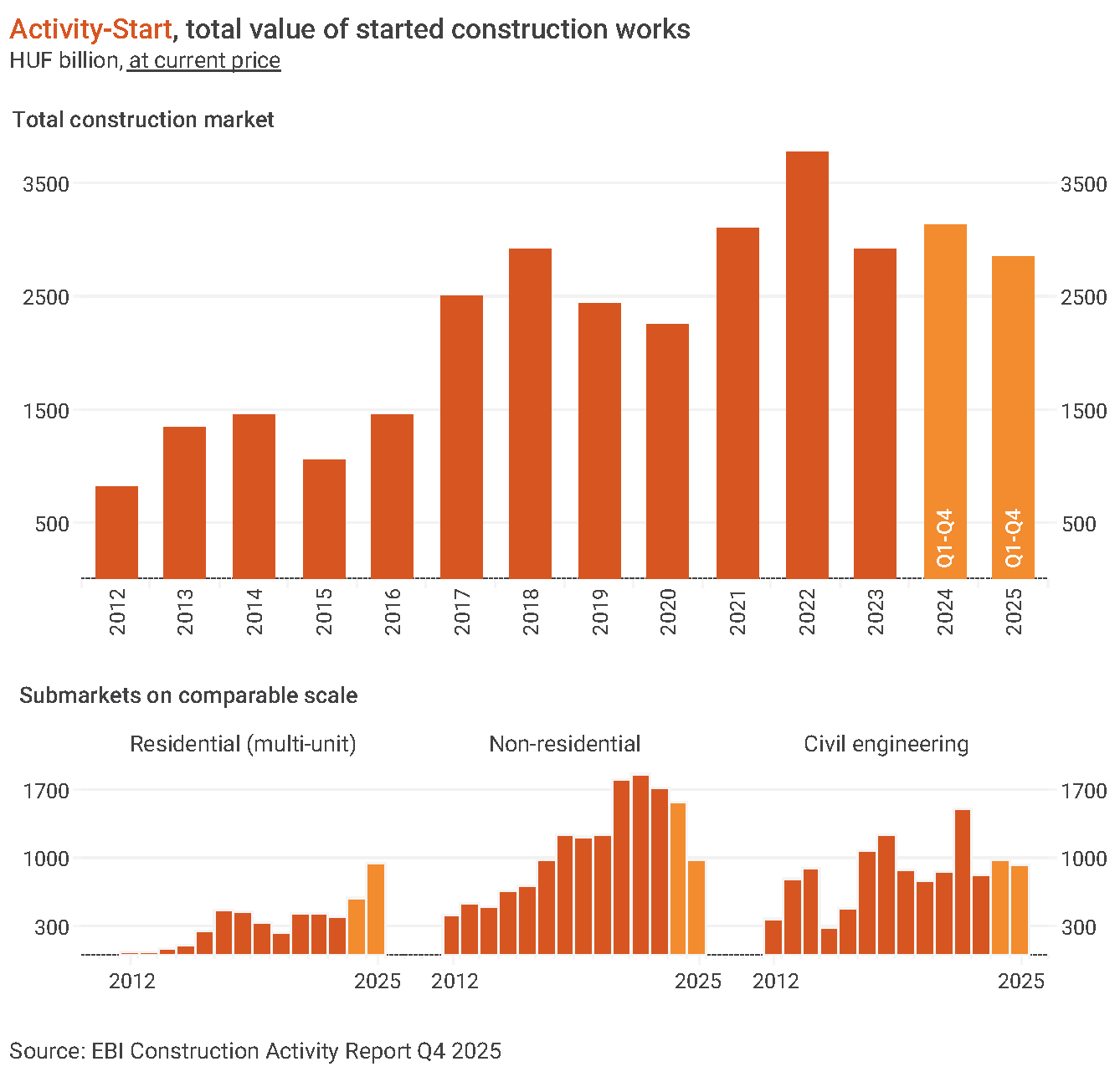
The latest EBI Construction Activity Report Hungary has found that it was mainly due to the ongoing M1 motorway expansion that the value of started construction projects rose significantly in the third quarter of this year. The value of projects entering construction in July-September 2025 exceeded HUF 1,000 billion at current price – the second highest level in the past ten years. Without this motorway expansion, accounting for around 60% of Activity-Start, the figures would have been much more modest, though.

Building Construction Activity-Start

In Q3 2025 the value of started building construction projects was HUF 400 billion, around the same value as between April and June. Thanks to the outstanding figures between January and March, the value of building construction projects entering construction phase exceeded HUF 1,500 billion, only 4 points short of the same period in 2023 and 2024. At constant price, Activity-Start between January and September of this year was the lowest in the past 9 years.

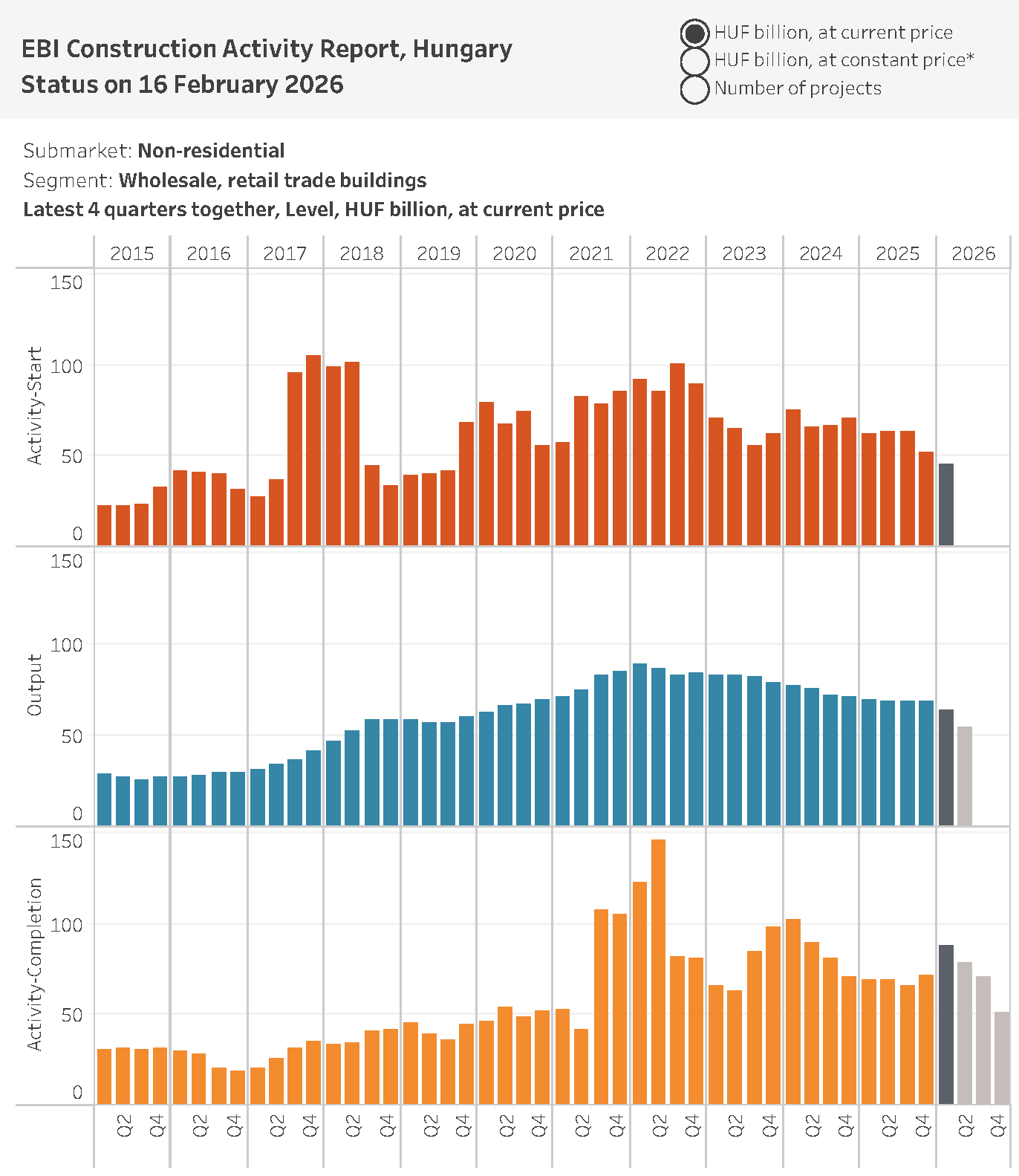
Activity-Start of EBI Construction Activity Report in multi-unit housing construction, although greatly sank, stayed at a high level, with the total value of projects started in Q3 2025 exceeding HUF 170 billion. The situation was the opposite in non-residential construction. The segment recovered somewhat between July and September from the previous quarter’s low point, but projects still entered construction at a low value: Activity-Start was around HUF 230 billion. Since 2017 non-residential construction projects haven’t started at a lower value than in the first 9 months of this year.

The largest non-residential projects entering construction in Q3 2025 included MCC’s talent centre in Miskolc, BYD’s electric bus assembly plant in Komárom, Panattoni Logistics Park Building A in Mosonmagyaróvár, IGPark automotive parts manufacturing hall in Nyíregyháza, Phase 2 of Weerts Ebes logistics centre, and MVM Neuron headquarters office building in the 3rd district of Budapest.

Civil engineering Activity-Start

Civil Engineering Activity-Start of EBI Construction Activity Report registered a surge in Q3 2025 due to M1 motorway expansion (M0-Concó rest area). Outside road construction, the value of construction projects started in other civil engineering segments was moderate. While total Civil Engineering Activity-Start exceeded HUF 760 billion, the value of non-road and railway projects started was only around HUF 50 billion in Q3. In addition to the two phases of M1 motorway expansion, only Phase 7 of the closure of the Gyöngyösoroszi ore mine could make it to the list of the biggest started civil engineering projects.

Budapest on top among regions

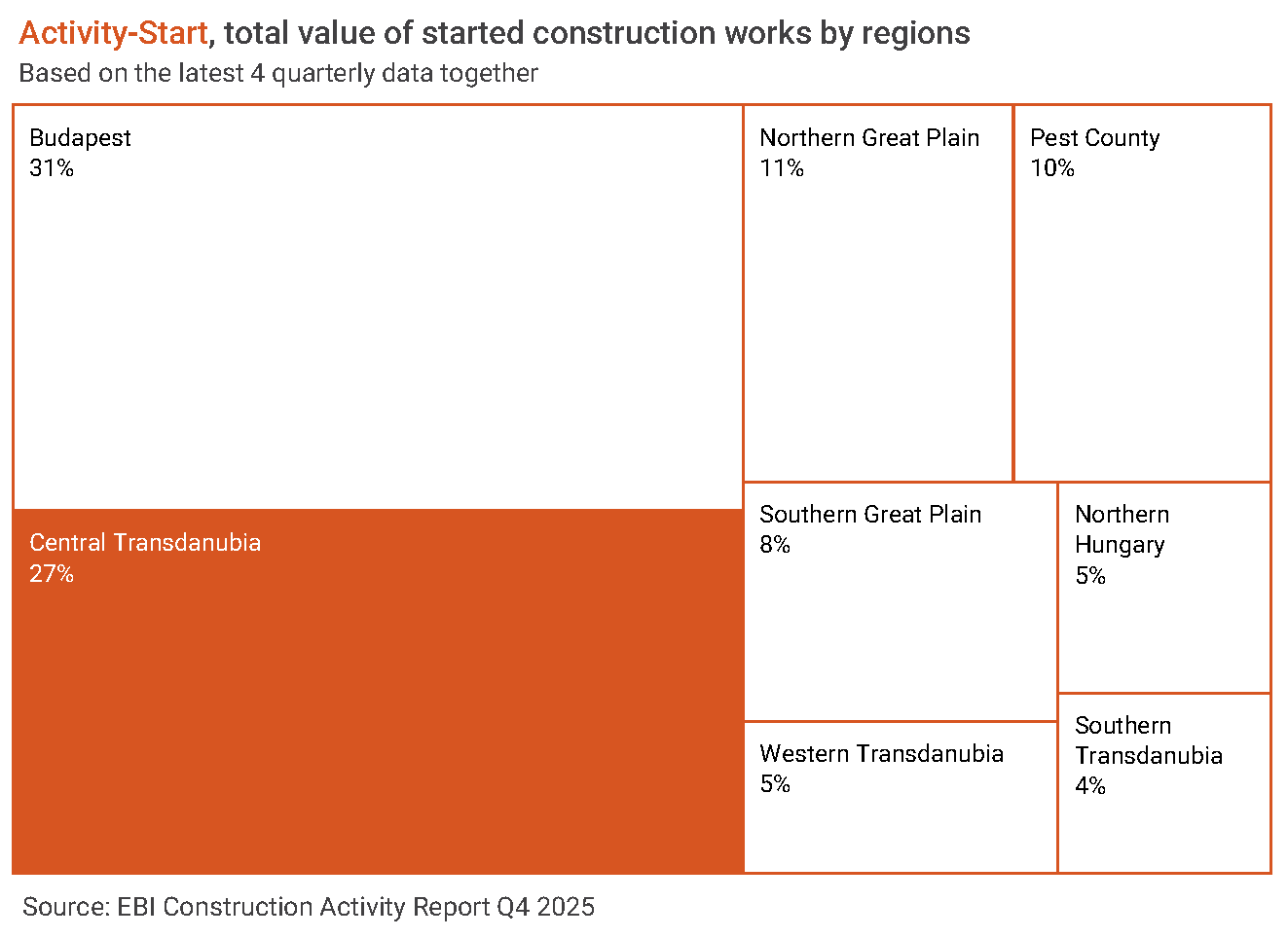
In the past four quarters, the highest value of construction projects in Hungary started in Budapest and its share in total Activity-Start was 28%. Central Transdanubia also had a large share of 23%. 39% of projects started in Western Hungary, 38% in Central Hungary, while Eastern Hungary’s share was 23%.

Still high multi-unit housing Activity-Start

Although Q3 2025 was the second consecutive year to see a significant drop in the value of started multi-unit housing construction works, Activity-Start stayed high, far exceeding the average of recent years. At current price, multi-unit housing construction works started at an over HUF 170 billion, the fourth highest value after the first two quarters of 2025 and the last quarter of 2024. Overall, the successful first 9 months of this year brought a huge jump in multi-unit housing Activity-Start at current price, but it was also outstanding at constant price, only surpassed by the same period in 2017 in the last 10 years.

Multi-unit housing construction is likely to remain strong. There was a high number of building permits issued in the first three quarters of this year, meaning plenty of projects to get started. In Q3 2025 permitting was boosted by the preferential loan program dubbed Otthon Start available since September which could continue to have a positive impact on the number of homes under construction.

In Q3 this year, multi-unit homes worth around HUF 80 billion were completed at current price, while in the first 9 months, multi-unit housing Activity-Completion was well over HUF 200 billion, only slightly lower than in the same period in 2023-2024.

Looking at the past 4 quarters, Budapest continued to have a major share in multi-unit constructions entering construction (73%). Central Hungary had a 76%, while Western Hungary and Eastern Hungary had a share of 12% each.

Still weak Activity-Start in industrial buildings and warehouses

Industrial buildings and warehouses thrived between 2022 and 2024 when construction works worth between HUF 700 billion and 1,000 billion started annually. For example, construction started on several BMW plants around Debrecen, on Mercedes-Benz projects in Kecskemét, and on several battery factories. This year has seen a decline so far and the value of projects started during three months in Q2-Q3 2025 has been the lowest since 2021. Overall, in the first 9 months of 2025, Activity-Start in industrial buildings and warehouses was around HUF 400 billion, 37% lower than in the same period of 2024, and 29%-39% lower than the 2022-2023 values. Trends are similar at constant price: the period of 2021-2023 was exceptionally good for industrial buildings and warehouses, while there was a strong decline in 2025. In the last 10 years, Activity-Start at constant price in the first 9 months has not been so low as now.

The biggest projects started between January and September 2025 were CTP’s logistics halls in Biatorbágy and Vecsés, HelloParks’ logistics hall in Fót and BYD’s projects in Szeged and Komárom. Construction of Phase 1 of Halms automotive parts manufacturing plant in Miskolc and Panattoni Logistics Park Building A in Mosonmagyaróvár also started.

Activity-Completion was relatively high in all three quarters of 2025 as several projects that started in 2022-2024 reached completion. The value of projects completed since the beginning of 2025 neared HUF 700 billion. For example, this year saw the completion of CATL warehouse and metalworking plant in Debrecen and its surroundings, two BMW factories, and the hangar complex of the Helicopter Base in Szolnok. And Activity-Completion may also remain high in the last quarter of this year.

Original article: Tünde Tancsics (ELTINGA); English version: Eszter Falucskai (Buildecon)

Q2 2025: drop in construction start in Hungary

On a quarterly level, the value of started construction projects in the second quarter of this year has been the second lowest since 2020 and the Activity-Start of EBI Construction Activity Report Hungary at current price did not reach HUF 470 billion. In the first half of the year, projects entering construction phase were worth around HUF 1,200 billion, far below the previous years and close to H1 2020 when the pandemic hit.

Building construction performed poorly in Q2 2025

In Q2 2025 the value of building construction starts fell below HUF 400 billion, barely reaching half of the Activity-Start of Q1. After 2020 it was only in Q3 2024 when the value of construction starts was at a similarly low level. The decline in building construction was even more pronounced at constant price: Activity-Start of EBI Construction Activity Report at constant price was last lower in Q1 2015 than in Q2 this year.

Such a poor performance in building construction occurred despite the extremely successful quarter in multi-unit housing construction. The Activity-Start for non-residential construction fell to a critically low level not seen since Q1 2015, below HUF 120 billion. At constant price, the decline is even more drastic, the value in Q2 2025 was less than half of the previous negative record.

The largest building construction projects during Q2 2025 were mostly multi-unit housing ones. Only one non-residential project made it to the list of the biggest projects, Phase 1 of Halms automotive parts manufacturing plant in Miskolc.

Better Civil Engineering Activity-Start, but still at a low level

Q2 2025 saw an improvement over Q1 in Civil Engineering Activity-Start of EBI Construction Activity Report, but projects started only at a value of around HUF 100 billion. In the road and railway construction segment, there was an increase in Q2 2025 against Q1 with projects entering construction phase on HUF 50 billion, a level not considered high.

The biggest civil engineering projects launched in Q2 2025 include the railway infrastructure of the Ivancsa industrial-innovation development area, the XIV/A water shaft in Tatabánya, and the development of the drinking water networks in Ács, Bábolna and Koppánymonostor.

The capital city has the highest share in total Activity-Start

Looking at construction projects launched in the past four quarters, Budapest had the highest value with a share of 34% in total Activity-Start. It still exceeds the 20%-30% typical of the period between 2021 and 2023.

In the previously leading Northern Great Plain, 16% of projects started. The share of Southern Transdanubia was 15%, and that of the Southern Great Plain was 11%. The lowest values ​​were registered in Northern Hungary and Western Transdanubia during the period, with a share of 4% each. In Central Transdanubia and the Pest region, a respective 8% of projects were launched.

Favourable trend continuing in multi-unit housing construction

Q2 2025 far exceeded the average of recent years in terms of the value of construction starts: multi-unit housing constructions started at HUF 250 billion at current price. This is an absolute record, the second highest value after Q1 2025 registered since 2014. Activity-Start of EBI Construction Activity Report in the segment exceeded HUF 200 billion for the third consecutive quarter, way more than the previous highest HUF 144 billion until H1 2024. The expansion was also significant compared to previous years, even when calculated at constant price.

The momentum fuelled so far by maturing government bonds and interest payments may continue this autumn with the launch of the Home Start Program (providing first-time home buyers with a fixed-rate loan of up to HUF 50 million at a 3% interest rate). Also, this autumn, projects financed by the Housing Capital Program this year (a government initiative to help the supply side) may also appear among sold homes. As a result of these, a pick-up in both demand and supply is expected for the rest of the year. In Budapest, the projects of the Housing Capital Program may be the source of a further high level of Activity-Start. In the countryside, more multi-unit housing projects may start due to the livelier demand thanks to the launch of the Home Start Program. In the capital city, the number of available new homes is already at one of the highest levels in recent years because of the previous significant construction starts. This, in addition to the new supply, may make developers more cautious with project launches as the end of the year approaches.

The value of completed multi-unit homes in Q2 2025 was around HUF 90 billion, a slight increase compared to Q1. Overall, Activity-Completion of multi-unit housing constructions slightly dropped in the first half of the year compared to the previous year, remaining roughly at the 2023 level.

Looking at the past four quarters, Budapest has had a massive share in multi-unit housing constructions entering construction phase (75%), while none of the other regions reached 10%. In Central Hungary 77% of such projects started and in Western Hungary 14%, while only 9% of the Activity-Start was registered in Eastern Hungary.

Hotels in focus: the year started off sluggishly for projects, but growth is visible

Hotel construction works boomed in 2019-2020 most, but projects also commenced in 2021 and 2023 at relatively high values. 2024 saw a slight decline, and this year also started rather sluggishly. The second quarter brought some expansion, though; between April and June 2025, the total value of construction starts in the segment was over HUF 20 billion, a major improvement compared to the previous, very weak quarter, and roughly the same as the median for the period between 2023 and 2025. At constant price, we also see that Activity-Start of EBI Construction Activity Report in Q2 2025 does not differ much from previous quarters but is far behind the high values between the end of 2019 and the beginning of 2021. The largest started hotel projects in H1 2025 included Phase 1 of Staybridge Suites Hotel in Budapest and the MCC Talent Development Center project in Miskolc.

Several hotel projects that were launched in previous years have now reached completion. In Q2 2025, Activity-Completion in the segment set a record, approaching HUF 90 billion at current price and exceeding HUF 160 billion at constant price. For example, the 4-star hotel next to the Balaton Park Circuit racetrack and Le Primore Hotel in Hévíz have been completed.

Also, many hotel projects are currently underway which are due for delivery next year, such as the renovation of the Grandhotel Galya in the countryside, and a number of hotels under construction or under renovation in Budapest: Sofitel Budapest Chain Bridge, hotel in Kígyó street, VP36 Boutique Hotel, Paulay Opera Hotel, Hotel Paulay (Puro), Moxy Budapest Downtown by Marriott, and Hilton Garden Inn. Hotel Gellért in the capital city is also undergoing renovation and may be completed in 2027. Klotild Palace St. Regis Hotel and K36 Hotel and Student Hostel are also nearing completion and could open this year.

Original article: Tünde Tancsics (ELTINGA); English version: Eszter Falucskai (Buildecon)

EECFA 2025 Summer Construction Forecast

EECFA released its 2025 Summer construction forecast on 23 June. See a sample report and place your order on eecfa.com. To get discounts, you may contact us.

Southeast European construction markets up to 2027

According to Yasen Georgiev at Economic Policy Institute (EPI), EECFA’s Bulgarian research institute, total construction output in Bulgaria is anticipated to grow by 3% on average for 2025-2027 with a stronger growth in the middle of the period when the absorption of operational programmes and the implementation of the Recovery and Resilience Plan are to gain momentum. According to the sectoral breakdown, residential construction is expected to be the subsector with the weakest performance, while non-residential construction and particularly civil engineering are predicted to see stronger growth figures. Against this backdrop, the country’s economy is set to register a slower-than-expected growth in 2025 and 2026. In parallel, it is awaited to benefit from the effects from the full Schengen area membership effective from the beginning of 2025 and from the euro adoption expected on 1 January 2026.

Michael Glazer (SEE Regional Advisors) and Tatjana Halapija (Nada Projekt), EECFA’s Croatian members think that Croatia’s construction as a whole continues vibrant due to the combination of continuing transitioning-economy catch-up growth and large inflows of EU money. Both are beginning to diminish, however, and that will affect all construction segments, some more strongly and more quickly than others. In building construction several sectors have seen the end or are close to seeing the end of catch-up growth. Others, particularly those that benefit most from EU finance, are still going strong. Civil engineering continues to profit greatly from EU funding, and because of the poor initial condition of Croatia’s infrastructure after independence, much catch-up construction remains to be done. Certain government policies will have a great influence on specific building and civil engineering sectors. Those policies include the housing policies embodied in Croatia’s new National Housing Policy Plan until 2030, the new tax on real estate and the country’s renewable energy permitting and electrical grid hook-up fee rules.

Romania’s macroeconomic outlook remains positive, but more reserved as the political instability and fiscal uncertainty have done little to improve growth opportunities’ – says Dr. Sebastian Sipos-Gug, EECFA’s Romanian researcher at Ebuild. At the same time, he adds, the country has the largest government deficit in the EU, which will dampen public investment capabilities. All these will make it harder to finance public works and could negatively impact civil engineering. This is doubly worrying as this subsector countered the decline in other construction segments in 2024, and thus the outlook for total construction remains negative in 2025 and 2026 in real terms. Not all is gloom and doom, however. As inflation and interest rates come down, and employment indicators remain strong, private consumption could boost demand for residential and non-residential construction.

‘In 2025 Serbia’s construction is making new gains in building construction, while civil engineering has entered a period of consolidation after the strong expansion during 2023 and 2024′ – believes Dejan Krajinović, EECFA’s Serbian researcher at Beobuild. Building construction is supported by both public and private investments, boosted by the hosting of the EXPO 2027 in Belgrade. Non-residential construction is the main beneficiary of this event, particularly commercial, office and hotel segments, while residential construction is also keeping historically high volumes. Some delays are seen in civil engineering, but the overall performance is still strong with a long list of planned projects in all major subsegments. Domestic demand is still relatively strong, but economic growth and the level of investments are being muffled this year by uncertainties in the global markets, particularly the weak EU economy, international trade issues and the ongoing wars in Ukraine and the Middle East.

‘Total construction output in Slovenia is expected to decrease from the historic high of EUR 5,5 billion reached in 2023. In both 2024 and 2025, it could contract but remain above EUR 5 billion annually’ – as per the opinion of Dr. Aleš Pustovrh at Bogatin, EECFA’s Slovenian member institute. He predicts the sector to return to growth in 2026 and 2027, mostly on the back of a healthy growth in residential construction buoyed by decreasing mortgage rates. On the other hand, civil engineering is prognosticated to shrink significantly in 2024 and 2025 due to some large projects nearing completion, like the new railroad connecting Port Koper. Both non-residential and civil engineering depend to a large degree on public financing that was widely available in the post-Covid period but will become much less available in 2025-2027. Especially if the overall economic activity continues to slow down. This deceleration and more foreign labourers have also caused lower construction cost growth, but other challenges persist such as the additional bureaucratic burdens (changed permitting process, increase in tax, ongoing discussion on changes to short-term rental legislation, among others) and many external risks in the global economic and political environment. 

Eastern European construction markets up to 2027

‘In the forecast horizon, the construction sector of Russia will be under pressure from a range of macroeconomic factors, the main one being the high key rate, which will negatively affect the pace and volume of construction projects’ – according to Andrey Vakulenko at MACON, EECFA’s Russian research institute. The tight monetary policy and the reduced availability of mortgages will likely slow down housing construction, on the one hand. On the other, the high cost of project financing, the general cooling of the economy as well as reduced consumption and business activity will likely shrink the volume of investment in non-residential construction. However, these trends can partly be offset by high volumes of government financing of priority infrastructure and energy projects, which can support civil engineering and ensure near-zero growth in total construction market in 2025-2027.

Prof. Ali Türel, EECFA’s Turkish researcher says that Türkiye has been trying to control high inflation by raising the base rate and managing exchange rate increases through market instruments by the Central Bank and maintaining wage growth at zero or negative rates. This created financing difficulties for industries and businesses, reduced demand for basic consumer goods, and led to affordability problems for mortgage credits. Big declines in building starts and completions in Q1 2025 may also be related to these measures. Yet, the Central Bank’s inflation target for 2025 remains high at 24%. Positive real changes in housing prices relative to building construction costs encourage house building, while their negative real change compared to inflation may be the leading factor in the increase of home sales through equity financing when mortgage credits are not affordable for most households. Rebuilding the quake-damaged 870 thousand units requires about EUR 100 billion and these expenditures have been the primary factor of the large national deficits in recent years.

‘This year, in spite of the continuing war and the economic instability in the country, Ukraine’s construction industry shows signs of recovery and growth on the back of successful programs financing both the construction of new facilities and the reconstruction and restoration of infrastructure in eastern and southern regions’ – according to Prof. Sergii Zapototskyi at Uvecon, EECFA Ukraine. The World Bank estimates that reconstruction would require USD 486 billion. On the negative side for the sector are bureaucratic barriers in the urban planning legislation, shortage of workers caused by mobilization, shortage and high cost of building materials, and logistical difficulties. On the positive side for the sector is demand for housing and the need to restore damaged infrastructure. The near-term future of the industry depends on the level of security, the effectiveness of restoration programs and the volume of international investments.

Q1 2025 sees weak Activity-Start in Hungarian construction

2025 started off weak in Hungarian construction despite the much higher Activity-Start at the end of 2024 fuelled by launched major projects then. In Q1 2025 the value of started construction works greatly dropped compared to both the previous quarter and the same period of the previous year. The Activity-Start of EBI Construction Activity Report at current price was around HUF 570 billion in Q1 2025; the second lowest quarterly value since July 2020. At constant price, and if adjusted with price changes, it has been the second worst three-month Activity-Start since 2015.

Value of started building construction works fuelled by multi-unit residential projects

Building construction has slightly improved compared to the previous two weaker quarters: the value of started works was well over HUF 500 billion, 18% up from Q4 2024. The improvement, which was also evident at constant price compared to H2 2024, was attributable to the surge in multi-unit residential works. At the same time, Non-Residential Activity-Start continued to see the low levels of the last two quarters of 2024. In the first three months of this year, non-residential construction works of slightly more than HUF 240 billion started, the lowest quarterly figure since 2017. At constant price, no building construction works have started in such a low quarterly value in the past 10 years.

Among biggest building projects launched in Q1 2025 were mainly logistics buildings: CTP logistics halls in Vecsés (Phase 2) and Biatorbágy, and HelloParks logistics hall in Fót. Construction also began on Phase 2 of Building A of H2Offices in Budapest, and the Hungerit poultry processing plant in Szentes.

Critically low value of started civil engineering projects

Civil Engineering Activity-Start was extremely low in Q1 2025 with started construction works worth only HUF 31 billion. This has by no means been the lowest value recorded in the subsector since 2014, both at current and constant prices. Activity-Start in road and railways and in non-road and non-railways amounted to around HUF 16 billion, respectively. Sadly, not a single civil engineering project made it into the largest projects entering construction phase in the quarter.

Regional comparison: Budapest on the lead

According to EBI Construction Activity Report, Budapest had the highest value of construction projects started in Hungary in the last four quarters. And although its share in total Activity-Start slightly dropped, it still stood at 32%, exceeding the 20%-30% typical in the period between 2021 and 2023.

In Northern Great Plain, the region that previously was on the lead, 14% of projects started in Q1 2025. The share of Southern Transdanubia was 16%, while that of Southern Great Plain 11%. Western Transdanubia and Northern Hungary registered the lowest value at 5%, respectively. In Central Transdanubia, 7% of projects started, whereas in the Pest region, 10%.

Multi-unit residential projects shooting up

The latest EBI Construction Activity Report Hungary has found that 2025 started off greatly in the multi-unit residential segment as in the first three months the value of construction starts was almost HUF 300 billion at current price. It has been a record since 2014 and exceeds the previous quarter’s highest value (HUF 209 billion). Even at constant price, the growth in Activity-Start is a 39% rise over the previous quarter.

This increased activity comes as no surprise: the last quarter of last year already witnessed recovery with developers responding to growing demand and preparing for increased interest at the beginning of this year.

The market has confirmed these expectations, and as per ELTINGA’s Housing Market Report, the latest two quarters saw a record in Budapest in the number of sold new multi-unit dwellings. Although a major part of demand came from investors, the question is how long this can last. Developers might become more cautious with project starts towards the end of the year as demand might decrease following interest payments and maturing government bonds.

When it comes to completions, the value of completed multi-unit residential projects in Q1 2025 was around HUF 76 billion, a drop compared to both the previous quarter and the same period last year. At constant price, Activity-Completion in Q1 2025 has been the third worst value since 2019.

Regionally, looking at the past four quarters, Budapest accounted for 70% of multi-unit projects entering construction, while Central Hungary recorded slightly more than 72% of the value of such projects. Eastern Hungary had a 13%, while Western Hungary had a 16% share in Activity-Start.

Better Q1 2025 in industrial buildings and warehouses than in the construction industry as a whole

In Q1 2025 the total value of construction starts of industrial buildings and warehouseswithover HUF 150 billion was slightly higher than in the previous two quarters. True, if we look at the period between 2022 and H1 2024, it was the second lowest value. Last year, in addition to automotive industry projects, several food industry projects started such as Pick’s plant in Szeged, Master Good-Sága plant in Sárvár, or Félegyházi Bakery plant and warehouse in Kiskunfélegyháza.

In the first quarter of this year, as previously mentioned, the largest projects entering construction phase included several logistics projects such as CTP’s logistics halls in Biatorbágy and Vecsés, and HelloParks’ project in Fót. Besides, the construction of several plants began: Unilever’s deodorant factory in Nyírbátor, Phase 2 of Scheider Electric’s Duna Smart Power Systems smart factory in Dunavecse, or Kométa’s packaging plant in Kaposvár.

As for completions in the segment, industrial buildings and warehouses were completed at a value of HUF 250 billion in the first quarter of this year – the third highest value since 2014. Biggest completed industrial projects include CATL warehouse and metalworking plant in Debrecen and HelloParks AN1 logistics hall in Alsónémedi. And we expect to see further major completions this year.

Original article: Tünde Tancsics (ELTINGA); English version: Eszter Falucskai (Buildecon)

Bucharest’s drop in residential permit and completion

Written by Dr. Sebastian Sipos-Gug – Ebuild srl, EECFA Romania

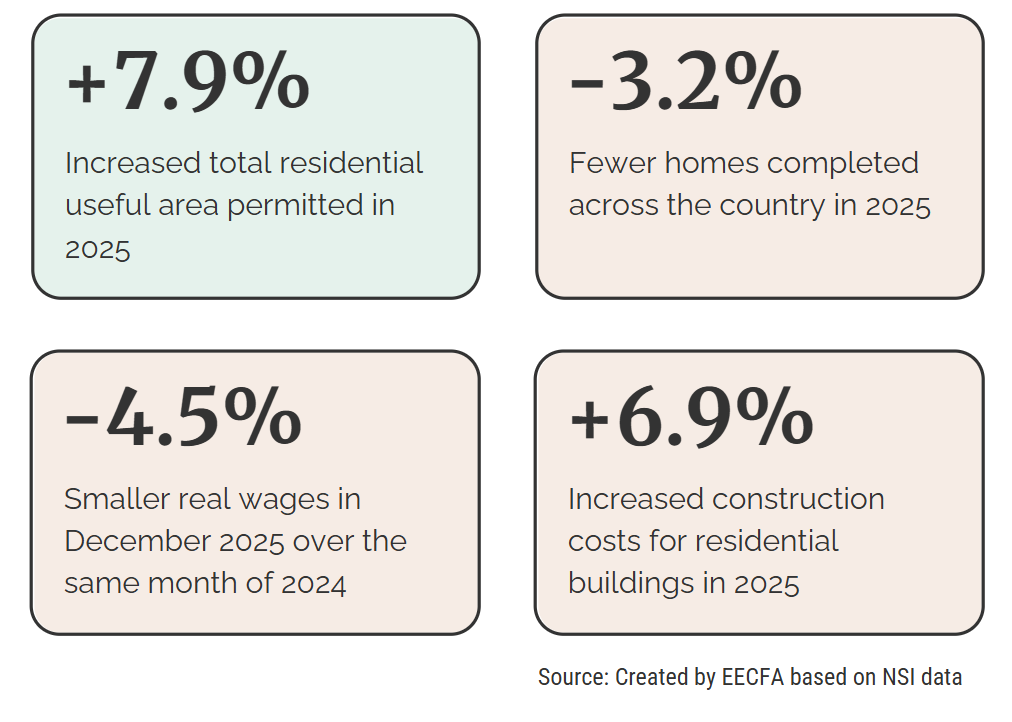
Reading the recent blog post regarding permit and completion data one can see that the trend for residential permits in Romania seems to have taken a downturn since 2021, and this naturally raises the questions: What has happened? Has the market peaked or is it just a temporary setback?

The supply-side story

In order to attempt answering these questions, Dr. Sebastian Sipos-Gug, EECFA’s researcher on Romania, started by looking at permit data for a longer period and split by regions. The slowdown in 2023 and 2024 was present in most regions, but none of them was hit as hard as Bucharest where the useful area in residential permits nearly halved in 2024 compared to the peak of 2022. Thus, whatever effect led to the drop in permits, it disproportionately affected Bucharest.  While it remains by far the most active region, the drop is oversized when adjusted for its share of the market.

In case of Bucharest, a non-trivial amount of this effect could be explained by the gridlock in the urban planning area, with permits for all types of construction hindered by the cancellation in 2022 of the existing zoning plans which have yet to be replaced by newer versions. This makes it more difficult to gain permits for new developments, and could be, at least partly responsible, for the observed shrinkage in residential permits in the last two years.  

Figure 1: Useful area in residential permits, 2015-2024, Bucharest-Ilfov chart presented outside the map due to relative market size (Source: own calculations based on NSI data)

The next logical step seemed to be looking at other indicators such as completions and seeing what happened there. Indeed, they have also been on the decline with the number of completed homes country-wide in 2024 being comparable to that of 2018. Again, Bucharest-Ilfov saw a much larger drop in 2024 over the 2021 figures, standing at –33% compared to –12% in the rest of the country. 

Figure 2: Home completions between 2015-2024 (Source: own calculations based on NSI data)

The decline is quite apparent in the supply of new housing overall, but that the situation is much more dire in Bucharest.

The demand-side story

Could the decrease in supply be a response to lower demand? After all, if developers have difficulties selling stock, they are unlikely to start new projects.

Looking at the number of transactions, they indeed declined overall in 2024 compared to the peak of 2021, but the effect was much smaller with just around 10% fewer properties being sold in the whole country, while in the Bucharest-Ilfov region there was barely any change (-0.3%).

At the same time, prices of homes continued growing, but this time Bucharest (+20%) lagged behind the country (+27%), meaning that the price gap between the capital and the rest of the country is slowly closing.

Figure 3: Number of real estate transactions between 2017 and 2024 (Source: own calculations based on ANCPI data)

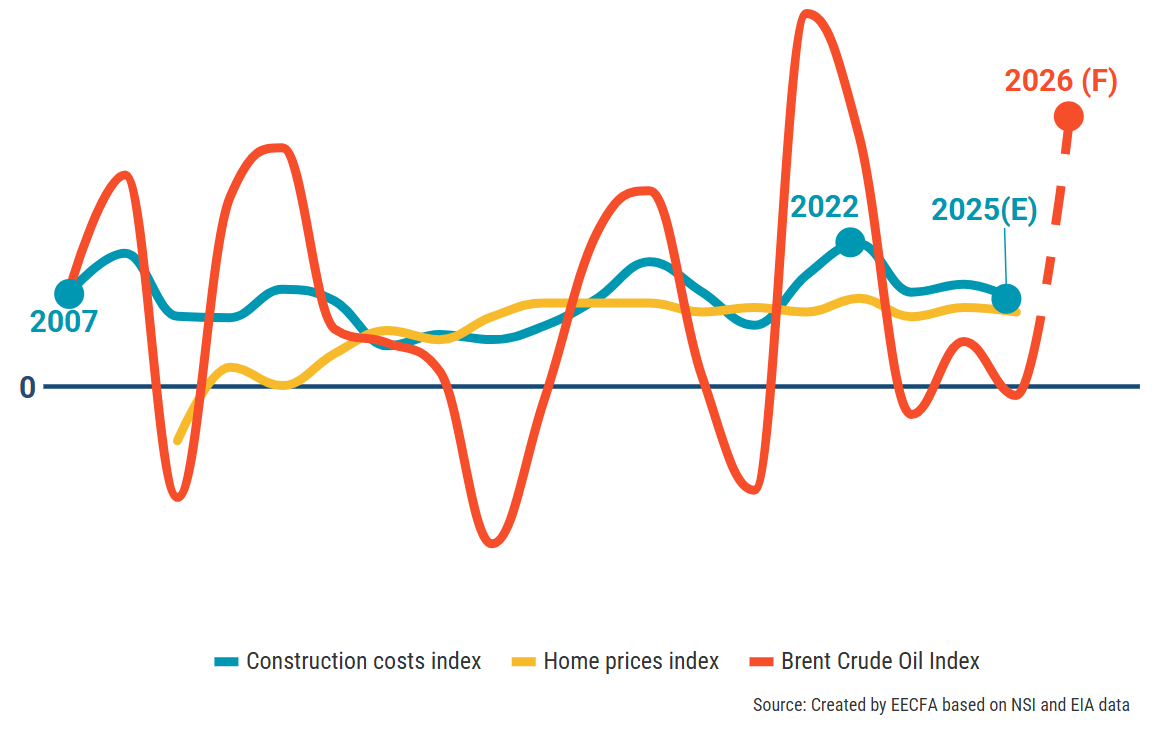
However, when comparing the growth in home prices to that of the rise in construction costs, the situation looks more dire. As of 2024, residential construction costs grew 41% over the 2021 level, far outpacing the increase in prices. This was partly due to increased materials costs (+32%), but also due to much higher labor costs (+60%) for construction workers. Since in January 2025 tax breaks for construction workers were eliminated and the minimum wage for them grew, it’s unlikely for the situation to improve in the short term, potentially discouraging developers from new investments until prices reach a place where they offset the costs and offer similar margins as before.

What does this mean for housing affordability?

This topic was touched upon last year, in another blogpost, with the conclusion that it is useful to look at affordability from two standpoints: cash buyers and mortgage takers, since increased interest rates can negate the effects of wage growth.

Taking a regional split into account this time, it’s noticeable, and perhaps slightly surprising that homes are more affordable in Bucharest as the wage gap between it and the country average is higher than the residential prices gap.

This took a turn, however, in 2024 as home affordability in Bucharest started to drop, while the national average remained more or less the same. If the previously mentioned issues that limit permitting are not resolved, we can expect this trend to continue in the future as well since a limited supply will mean higher prices.

Another factor that could limit future supply, at a national level, is developer funding. It used to be the case that developers would focus on presales and use very high downpayments in the project phase (up to 90% in some cases) to fund the construction work, without requiring a bank loan.

Since a high-profile scandal regarding a large developer brought this issue into the limelight, confidence in this type of arrangement has declined and buyers are less likely to accept paying high downpayments before construction has even started. Concurrently, there is a bill underway aiming to limit downpayments for unfinished buildings to 10%. Should developers resort to banking loans for their projects, it would make the market more stable but more expensive for them, leading to either lower margins, or higher prices.

Figure 4: Home affordability for cash buyers: sqm in an average 2-room apartment one could afford with average monthly net wage (Source: own calculations based on data from NSI and imobiliare.ro)

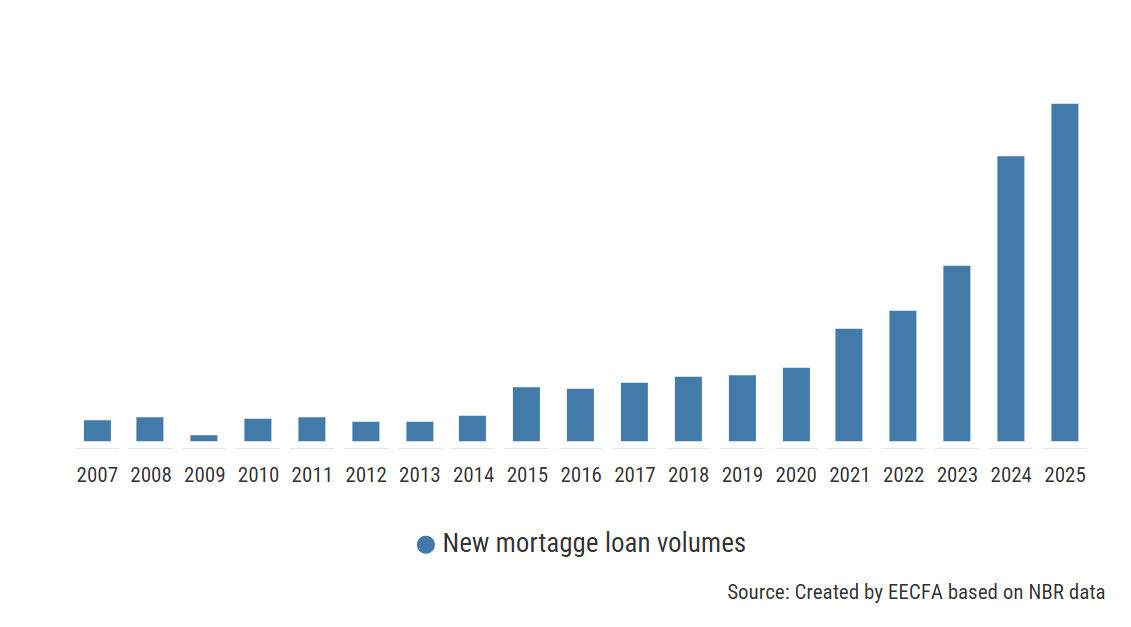
When it comes to home affordability for those using a mortgage loan, things are not looking better than they did last year. Inflation has proved to be stickier than expected, and the Central Bank is lowering reference interest rates slowly, meaning mortgages will continue to be relatively expensive in the near future.

While the higher wages in the capital again prove to be an advantage, making homes slightly more affordable than for the average Romanian, this indicator was also on the decline in 2024 for Bucharest, and stable for the rest, shrinking the gap between the two.

Figure 5: Home affordability for mortgage buyers: size of the home (in sqm) one could afford to buy with a mortgage loan, assuming a 25% downpayment, a 30-year term and a debt-to-income ratio of 40% of the average monthly net wage (Source: own calculations based on data from NBR, NSI and imobiliare.ro).

In the context of high energy costs, in 2021 construction costs increased. Since then, the situation has not improved dramatically, and it’s unlikely to change in the near future as inflation and high wage growth will keep an upwards pressure on them in 2025 as well.

Bucharest is doubly feeling the pain when it comes to new residential development. Adding to high construction costs, there are issues with urban zoning and permits approvals. The supply constraints mean higher prices, leading to slightly declining home affordability, especially for those relying on mortgages.

Figure 6: Construction costs for residential buildings (Source: own calculations based on data from NSI)

EECFA 2024 Winter Construction Forecast

EECFA released its 2024 Winter construction forecast on 16 December. Check out a sample report and purchase any of the 8 reports or the package of 8 reports at eecfa.com. For discounts, contact us.

Southeast European construction markets

Total construction output in Bulgaria is forecasted to grow by an average of 3.3% in 2024-2026, which is slightly above real GDP growth projections for the same period. The subsector breakdown shows that residential construction is expected to lose momentum, but this is likely to be compensated by a more dynamic performance of non-residential construction and civil engineering. In parallel, general economic activity in Bulgaria in the forecast period is to be influenced by the effects from the full membership in the Schengen area from 2025 onward and the prospects for the country to introduce the euro on 1 January 2026.

Croatian building construction presents a varied picture across subsectors, with anticipated output growth ranging from significantly positive to somewhat negative. Civil engineering is more uniformly positive, but certain sectors show the effects of the completion and commencement of large projects. Both building and civil engineering output growth will be strongly influenced by new government laws and regulations, the consequences of which, while likely to be large, are difficult to predict for both the short and medium terms. These include the new National Housing Policy Plan until 2030, the new tax on real estate and measures to balance the playing field between different types of tourism accommodations.

Despite the rise in investment, Romania will likely continue to see a stifled growth in construction in real terms due to costs remaining high. Stubborn inflation and the slightly disappointing macroeconomic performance combined with increased wages and still high interest rates create a less appealing environment for investors in building construction. On the bright side, high income and importsare indicative of strong demand for consumption and could translate to demand for construction. While infrastructure did well, the current political turmoil and uncertainty could hobble performance going forwards. Even assuming deficit remains high but stable, as the EC expects, it would continue to raise public debt and make financing further projects more politically difficult. As some downside factors could improve by then, construction growth is forecasted to return to positive in 2026.

Serbia’s construction is likely to have closed another strong year led by civil engineering, but non-residential also entered a new growth cycle with positive outlook boosted by public investments and the hosting of the EXPO 2027 in Belgrade. The construction of commercial, office and hotel buildings are all set to grow in the coming period, followed by education and health. Residential construction is already on historically high levels with a relatively stable performance. In civil engineering, road and railway construction continues unabated, breaking new record volumes on the way, but other segments also have an impressive project pipeline. The economy is set to expand by 4% in 2024 and 2025 on the back of strong consumption and high investment, so construction outputs may sustain formidable levels up to 2026.

Slovenia’s construction sector is expected to maintain post-pandemic levels with annual output consistently exceeding EUR 5 billion up to 2026 against the EUR 3 billion pre-pandemic. Public financing has been a key driver with national budget expenditure up from EUR 10 billion in 2019 to over EUR 15 billion in 2024, though there will be spending limits in 2025-2026. Civil engineering in the forecast period will be supported by major infrastructure projects. Residential construction is set to drop slightly first in 2024 before rebounding by 2026 driven by lower mortgage rates. Non-residential construction is forecast to grow steadily but remain dependant on the availability of public financing. Other challenges remain such as labour shortages, permit backlogs and high costs, but construction cost growth is set to stabilize at under 3% annually.

Eastern European construction markets

In 2024, the Russian construction industry fared better than previously expected driven by the high pace of project implementation and the massive budget support in civil engineering and non-residential construction. It could even offset the negative impacts of the decline in housing construction caused by the end of the mass preferential mortgage program. However, this positive momentum is expected to gradually fade owing to the tight monetary policy of the Central Bank and several other internal and external factors that are slowing down the economy in general and the construction industry in particular. In 2025-2026, the record budget expenditures planned within the framework of new national projects and other measures of state financing will likely maintain construction market volumes in Russia in the positive territory, but with minimal growth.

In Türkiye, increased interest rates and the Central Bank’s policy to reduce the depreciation of the national currency to curb inflation has not yet produced the intended outcomes. And high interest rates are blamed for shrinking industrial output and decelerated trade growth. The interest rate and the Central Bank’s policies had two major effects on the construction sector: big negative real rates of change in construction costs and housing prices. Housing sales are growing as real prices drop and rely on equity financing since mortgage loans have become unaffordable at high interest rates. Building permits in most segments decreased in Q3 2024, while completions had a positive trend. The government’s legal obligation to rebuild the earthquake-damaged 350 thousand buildings with 870 thousand independent units has been the main factor in huge budget deficits that impede the Government from providing sufficient funds for civil engineering projects.

As a consequence of the war ongoing for over 1000 days, Ukraine’s construction market is facing economic difficulties, limited resources, huge losses in buildings, hike in building material prices, lack of skilled workers and limited access to financing, topped with the unpredictability of government decisions and the instability of property rights. The destroyed homes of more than 1.5 million families create a huge demand. Non-residential construction also focuses on the restoration of destroyed buildings and the construction of new ones in safer central and western regions. Civil engineering is also boosted by the renovation of bridges, roads, railways, pipelines, communication and power lines. The ‘Unified portfolio of public investment projects’ recently approved by the government includes 750 big reconstruction projects on roughly UAH 2.36 trillion, while the state budget also has UAH 256.1 billion for public projects in 2025. First, the EUR 50 billion under the EU’s Ukraine Facility are to be used. Financing is also planned through international financial organizations and foreign governments. The priority is energy, transport, utility and public buildings such as schools.