Good news from Türkiye: permit data for rebuilt earthquake-damaged housing included in statistics

Written by Prof. Ali Türel, EECFA Türkiye

Rebuilding permits, previously excluded from TurkStat’s statistics, were published on 22 August this year. The addition of statistics on rebuilding damaged housing in earthquake-hit regions raised building permits and completions in Q2 2025.

Video by TOKI (Housing Development Administration): Construction projects implemented by TOKI in the earthquake zone in Türkiye.

This May and June saw high construction production in Türkiye

The Calendar Adjusted Index of Construction Production increased by a respective 20,4% and 24,9% in May 2025 and June 2025 compared to the same months of 2024, after declining in the previous three months. Building construction went up by slightly higher rates, 23,5% and 16,9%, while civil engineering grew less, by 9,9% and 16,7% in May and June 2025.

Construction also had high shares in the Turkish GDP. The Seasonal and Calendar-Adjusted Gross Domestic Product in the chain-linked volume index for construction in Q1 2025 expanded by 7.4% annually, while the national average GDP growth was 2,7%. The rise in construction within GDP began after the destructive earthquakes in February 2023. The rebuilding of approximately 870,000 independent units, including 650,000 dwelling units and infrastructure, started in the following months, and the growth rate of construction in GDP increased to 7,2% in 2023 and 9,3% in 2024.

In Q2 2025 we may expect a higher growth rate for construction than in the previous quarter since the completion of 250 thousand dwelling units has been reported until June 2025. Also, a total of 453 thousand urban and rural housing and workplaces will be handed over to legal beneficiaries by the end of 2025 (Source: Anatolian News Agency).

However, building start and completion statistics did not show the same trend in Q1 2025; the total floor area of construction and occupancy permits fell by 20% and 24,9%, respectively, compared to Q1 2024.

Rebuilding statistics in earthquake-hit regions added on 22 August 2025

Q2 2025 saw a sharp reversal of this trend with the addition of rebuilding statistics of damaged housing in earthquake-hit regions. We have been following the process of inclusion of the rebuilding statistics into TurkStat’s published statistics, and we are happy to see that it was published on 22 August 2025.

The delay of including rebuilding statistics can be linked to the effects of law 7471 which aims to speed up rebuilding damaged structures in earthquake-hit regions. The responsibility of the Ministry of Environment, Urbanization, and Climate Change in rebuilding damaged housing caused by natural disasters is further supported by this law. The Housing Development Administration (known as TOKI in Turkish), affiliated with that Ministry, handles the implementation and financing of rebuilding projects. The Ministry’s local branches have been issuing construction and occupancy permits in earthquake-affected regions as outlined in the same law. TurkStat collects and publishes building permit statistics issued by municipalities and transmitted online to them. Since the local branches of the Ministry were not part of this network, rebuilding permits were not included in TurkStat’s previously published statistics. The table is based on the revised statistics and there may still be further revisions in future publications if there is missing data in current rebuilding statistics.

Building permit
floor area,mln m2
Building permit
annual change,%
Occupancy permit
floor area,mln m2
Occupancy permit
annual change,%
2023197,5616,7118,80-15,6
2024180,27-8,7138,2116,4
Q1 202535,24-20,031, 25-24,9
Q2 202554,3661,827,2030,2
Rebuilding permits in earthquake-hit regions. TurkStat has revised the data by including permits of all authorized administrations to issue building certificates.

Less building construction activity without rebuilding works can be related to the high-interest rate policy to curb inflation, currently at a 43% level. Both producers and credit users have problems in production and purchasing produced goods without relying on bank credits. Lowering inflation and interest rates would lead to the stimulation of building construction.     

Türkiye’s quake reconstruction efforts taking their toll on the economy

Written by Prof. Ali Türel, EECFA Türkiye

One and a half years after the devastating quakes that shook Türkiye, rebuilding is slow, and the public money spent on the reconstruction of damaged buildings and infrastructure are causing massive budget defi­cits in Türkiye’s economy. It is topped with high inflation, increased interest rates, growing unemployment and a stagnant minimum wage. With the current pace of construction, it seems that the reconstruction of 870 thousand units will take two to three additional years.

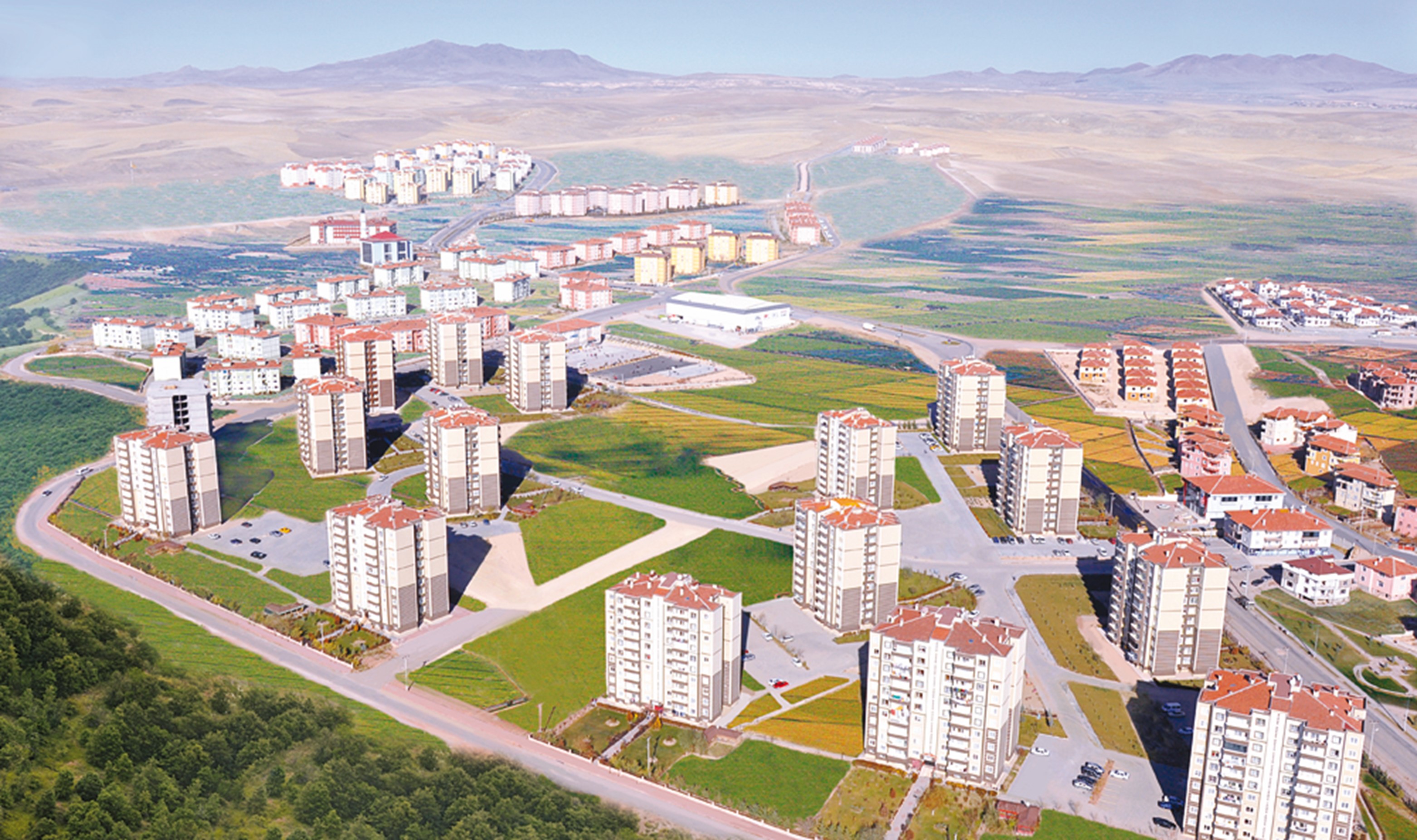
Owner-occupied social housing project of the Housing Development Administration (TOKI) that is in charge of rebuilding in earthquake-hit regions. Photo with the permission of TOKI

What happens in Türkiye’s economy

Türkiye’s economy continues to have a bad time due to high inflation despite conventional economic policies put into effect after the re-election of President Recep Tayyip Erdoğan last May. In the following 10 months the Central Bank of Türkiye (CBT) increased the base rate from 8,5 points to 50 points and since then it has remained at that level. Bank interest rates followed suit, causing affordability problems for mortgage and consumer loans.

In July 2024, monthly and yearly rises of Consumer Price Index were 3,23% and 61,78%, and in Domestic Producer Price Index 1,94% and 41,37, respectively. The latest inflation forecast of the CBT at the end of the year is between 38% and 42%. Policies to curb inflation began to show their negative effects on the economy as Calendar Adjusted Production Index of Total Industry fell by 4,7% and Manufacturing by 6,9% in June 2024 from June 2023. Seasonal and Calendar Adjusted Index also dropped in June 2024 from the previous month by a respective 2,1% and 3,1%. Unemployment grew by 7,2% in June 2024 and rose to 9,2% as 234 thousand people lost their jobs within one month. GDP is also predicted to decline in Q3 and Q4.    

Wage increases are curtailed within the scope of the economic program to keep inflation under control. The minimum wage did not rise for the whole second half of 2024, despite Consumer Price Index rose by 24,73% in the first 6 months. Income levels of pensioners, most notably of those in the lowest income segment, have been a much-complained issue in recent months. This is also aggravated by the low retirement age that was further reduced by a law enacted in 2023. The high number of retired people to total employment necessitates increasing transfers from the national budget to the Social Security Institution.  

How reconstruction efforts stand 1,5 years after the quakes

Rebuilding damaged housing, workplaces (industrial, commercial and other uses), and infrastructure following the earthquakes on 6 February 2023 requires massive investments from the national budget. Big budget deficits under these circumstances lead to increases in the public sector’s borrowing requirements. Civil engineering projects are worst affected by the financial strain on the national budget owing to the state’s legal obligations in rebuilding structures damaged by natural disasters.

The reconstruction of buildings and infrastructure is estimated at EUR 100 billion. As an alternative to the direct provision, the government introduced a financial assistance: 1.500.000 TL (44177 Euro) loan with a 50% grant to people either building an own house or buying one.

According to Murat Kurum, the recently reappointed Minister of Environment, Urbanisation, and Climate Change (the organization responsible for rebuilding collapsed and pulled down or heavily damaged buildings):

  • in the first 3 months of 2024, the construction of 76 thousand dwelling units was completed and transferred to their owners
  • the target for 2024 is to complete 200 thousand dwelling units by the end of the year
  • monthly expected completion is 25-30 thousand dwelling units

It implies that rebuilding 870 thousand independent units (650 thousand housing, 170 thousand workplaces) may continue for 2 to 3 more years.

Building and housing developments as of Summer 2024

In Q2 2024, construction permits for buildings in total floor area nosedived by 30,9% from Q2 2023 and the yearly change was a 32,9% rise in Q1 2024. In housing permits the yearly fall in the number of units in Q2 2024 was 28,9% (against the 34,3% growth in the previous quarter).

Occupancy permits for buildings in Q2 2024 sank by 14,4% in total floor area, and 23,5% in the number of dwelling units from Q2 2023. Like starts, the yearly rates were 45,5% and 38,9% growth in Q1 2024, respectively. Thus, it can be said that policies to curb inflation also create negative effects in building production.

Housing Price Index grew by 38,7% at current price yearly in July 2024, showing a 14,3% drop in real terms. The rise in housing prices was much less than construction cost in the previous month; Construction Cost Index increased yearly by 66,12% in June 2024 when Consumer Price Index rose by 71,60% and Domestic Producer Price Index by 50,09%. June 2024 was the first month over many years that the yearly rise in Construction Cost Index was less than Consumer Price Index. The rise in labour cost, 105,50%, is pushing total construction costs upward, and material prices, with a 51,55% rise, downward. Curbing minimum wage increases until the end of 2024 may be expected to lead to a lower rate of change in the construction cost in the following months.

In July 2024 housing transactions comprised 127,088 thousand (+16% like-for-like). Between January and July 2024, the number of dwelling units sold was 672,162 thousand, only 0,5% less than in the same 7 months of 2023. The main difference was in mortgage sales (only 9% of total sales in July 2024), and 9,4% in January-July 2024, dropping by 20.9% and 53,8% from the same months last year. Such great falls in mortgage sales are related to decreased affordability for mortgage loan repayments of commercial banks between 3,05 and 4,20 monthly interest rates for 10-year term mortgages. Subsidized mortgage loans by state-owned banks at 0.69-0.99% monthly rates to people who are not homeowners did not greatly affect the share of mortgaged transactions. 

Forecast up to 2026 for the Turkish construction market is available in the EECFA Forecast Report Türkiye 2024 Summer. To order it or to request a sample report, please contact us.
Rebuilding post-earthquake Türkiye

Written by Prof. Ali Türel, EECFA Türkiye

Türkiye’s high inflation so far has continued to rise in the course of this year, given May’s election-fuelled wage increases and the state transfers to rebuild facilities in the aftermath of the February quakes. The new administration is exercising a conventional economic policy, but post-disaster reconstruction is estimated to cost EUR 100 billion and will require huge money allocations from the state this year and next.

Macroeconomic developments

Türkiye has seen a change in economic policy after the re-election of President Erdoğan on 28 May 2023. Mehmet Şimşek, the new Minister of Treasury and Finance, and Dr. Hafize Gaye Erkan, the new Governor of the Central Bank of Türkiye (CBT) adopted a return to conventional economic policies. The CBT stopped reducing the base rate, and in 3 successive months, it raised it from 8.5 base point level to 25. Bank interest rates for deposit accounts and credits grew, though they still have high real negative rates.

The Government’s lucrative policies in minimum wage and early retirement continued after the election with high pay rises for public sector employees. The enormously destructive earthquakes on 6 February 2023 in 11 provinces also raised the government’s financing obligations. These increases in money supply, coupled with the big rises in the exchange rate of foreign currencies against the Turkish Lira in 3 months after the election (36% in Euro) have led to an upward trend in the inflation rate. The yearly rise in the Consumer Price Index was 47.83%, monthly 9.49%, and in the Domestic Producer Price Index was 44.50% and 8.23%, respectively, at end July. The CBT revised its inflation forecast to about 59.5% by the end of 2023.

Building developments

The construction sector is responding to these macroeconomic developments differently in starts and completions. In Q2 2023, building construction permits rose by 43.83% quarterly and 25.6% yearly in total floor area, while completions declined by 16.6% quarterly and 28.6% yearly. House building had a similar trend in Q2 2023; construction permit-issued housing grew by 44.3% quarterly to 188,7 thousand and 43.8% yearly to 741,7 thousand dwelling units, whereas occupancy permits fell by 15.3% quarterly to 106,9 thousand and 16.6% yearly for 570,3 thousand dwelling units.  The social housing project to produce about 253 thousand dwelling units by the Housing Development Administration (HDA) announced in Q4 2022 did not lead to that much increase in the start statistics.    

Low-cost social housing (produced by the HDA and sold to households not owning a house with affordable mortgage loans) and a commercial housing project by a private developer under construction in Ankara. Photo by Prof. Ali Türel, EECFA Türkiye

Among building types other than housing, construction permits for hotels, offices and industrial buildings had a quarterly and yearly positive rate of change. Occupancy permits were negative, only hotel buildings’ quarterly change and industrial buildings’ yearly change saw positive trends.

Due to high real estate prices under the effect of negative real interest rates, there seems to be a tendency to start building development, but builders may be unsure about the marketing prospects and profitability of their projects as real incomes have been dropping owing to continued inflation since 2018.

Forecast for the Turkish construction market is available in the EECFA Forecast Report. EECFA conducts research on the construction markets of 8 Eastern-European countries. Orders and sample report: eecfa.com.

Housing prices, construction cost, housing transactions

This June Housing Price Index for new buildings went up by 95.8% yearly as the national average (it was 90% in Istanbul, 102.3% in Ankara and 99% in İzmir). Since residential construction costs rose by 51.8% in June 2023 like-for-like, it implies a 44-percentage point difference between housing price and construction cost. Such a great spread between housing prices and construction costs should indicate a housing deficit, augmented by the 4,9 million registered refugees mainly from Syria and many unregistered migrants from other countries. The fewer completions than starts (when the profit margin is high) can be explained by the affordability problem under inflationary conditions.

Housing transactions between January and July 2023 were 17.7% less than in the same 7 months of 2022. Mortgaged sales were 20.2% in January-July 2023, dropping by 28.2% like-for-like. Affordability for mortgage loan repayments significantly decreased when mortgage interest rates rose to 35%/year. State-owned banks provide mortgage loans at between 0.69-0.99% monthly rates to people who are not homeowners, but the total number of these loans did not greatly affect the share of mortgaged transactions.

Rebuilding earthquake-damaged buildings and infrastructure

The quakes this February in the southeast regions must be dealt with under the Law on Natural Disasters, which defines precautionary measures, government obligations for post-disaster recovery, mitigation activities and rebuilding damaged buildings. With the organizations established for this purpose, the Government has been undertaking activities in the earthquake-hit 11 provinces since the quakes occurred. The Law requires the reconstruction of collapsed and heavily damaged buildings, both housing and workplaces, with financial commitments by the Government. The money spent becomes an interest-free loan, and owners of rebuilt properties begin to repay 2 years after they move in and in 20 years. Because of prolonged high inflation, interest-free loans serve as an important real gain for those people.

As per Mehmet Özhaseki, the Minister of Environment, Urbanisation and Climate Change (the organization responsible for rebuilding collapsed and pulled down heavily damaged buildings), as of 7 July 2023 in 11 provinces 311 thousand buildings with 872 thousand independent units collapsed or were pulled down. The total number of urban and rural housing to be rebuilt is 680 thousand. They planned to rebuild 518 thousand dwelling units in urban settlements and 162 thousand housing in rural areas with stables. About 180 thousand dwelling units and 6 thousand workplaces are currently under construction. They expect to complete the construction of 319 thousand dwelling units within one year. They also offer financial assistance rather than building a home, comprised of a 500.000 TL (17.241 Euro at 19 TL/Euro exchange rate) grant and 500.000 TL interest-free credit to the eligible people for state support, to be repaid in 10 years. Similar offers are also made to all workplaces.

Tentative estimates for the reconstruction are EUR 100 billion. With the existing 253 thousand social housing under construction, there will be big financial requirements from the national budget for public projects this year and next. Demand for construction materials and qualified labour will be high if we add the construction of all types of commercial buildings to state housing projects.

How Türkiye is handling the rental housing crisis under the effects of the large number of refugees

Written by Prof. Ali Türel, EECFA Türkiye

Türkiye’s high inflation (79.6% in July 2022 y-o-y), stemming from the Turkish lira’s continued devaluation and the economic consequences of Russia’s invasion of Ukraine, along with soaring energy prices are impacting construction. There is also a rental housing shortage aggravated by the 3,920 million refugees the country is hosting. To counterbalance the negative trends, in addition to the rent freeze law enacted in June, the Turkish Government has announced a big social housing project starting from mid-September.

Ankara, Türkiye. Photo by Ekrem Osmanoglu unsplash.com

Economy and housing market

The economy of Türkiye is facing new problems as the severity of the pandemic is easing. The unparalleled FX volatility since Q4 2021 has led to high inflation. The war between Russia and Ukraine has also contributed to the rise in inflation due to increased energy prices, affecting construction activities as well as the production of certain industrial and agricultural goods.

In June 2022, construction cost rose by 105,73% and residential construction cost by 100,87% yearly. The rates of change in Consumer Price and Domestic Producer Price Indices were by 78,62% and 138,31%, respectively.

Home prices have been growing at higher rates than construction costs. The latest statistics dated May 2022 of the Central Bank of Türkiye reports that the annual growth in the national average of home prices was 145,5%, being 44,63 percentage points above residential construction costs. Such a great difference between home prices and home construction cost may indicate a supply deficit in the housing market due to the high level of housing demand.

Building construction in general, and housing construction in particular, had positives rates of change in 2021; starts grew by about 30%, completions 4%. But occupancy permits issued 627 thousand dwelling units were less than the needed number of housing for 725,7 thousand newly formed households in 2021. In H1 2022, however, housing starts registered an 11% drop, and completions an 8% growth compared with the same 6 months of 2021. The falloff in residential building starts was less, the increase in completions was greater than all buildings’ average. The positive rates of change in completions can be related to big backlogs of buildings under construction fuelled by big rises in home prices.

Building materials

The Index composed by the Association of Construction Material Producers of Türkiye has had a negative trend since September 2021; it fell by 10% from 80,15 in in that month to 72,2 in July 2022 and the yearly rate of change was -9,5%, as shown in the July 2022 publication of the Index.

The Association indicates that because of the decline in demand and orders for their products from national and international markets, together with the appreciated risks and uncertainties about the economic environment, the trend may not be reversed in the short run.

Rental market

The rental property market was hammered most by the shortage of supply and sharp increases in rent prices. As a result, a rent freeze for homes was introduced in June 2022 (in effect until 1 July 2023), limiting rent increases by 25%.

The severity of the crisis in the rental market can also be related to the great number of refugees having accumulated since 2011. As per the UNHCR statistics, in August 2022 Türkiye hosts 3,920 million refugees (3,6 million Syrian and 320,000 from other countries) which may add up to as much as 1 million households. Because most refugees live in rental accommodation in cities, it appears that the additional amount of rental housing couldn’t be delivered in such a short period of time.

Social housing scheme

In mid-September 2022, the Turkish Government is going to launch a large-scale social housing project throughout the country. It will be undertaken by the Housing Development Administration (HDA), which is a central government organization that built about 1.1 million dwelling units during the last 24 years in all of the 81 provinces by developing publicly owned land after being transferred to the HDA. About 86% of homes built by the HDA were sold with mortgage loans of the HDA to moderate-to-lower income households not owning a home. Although the completion of construction will take some time, this project will stimulate demand for construction works and materials.

Construction forecast for Türkiye is available in the latest EECFA Forecast Report up to 2024 which can be purchased on eecfa.com.

Go back

Your message has been sent

Thanks for your interest, we will send you the sample pdf and the corresponding xls soon.
Warning

Privacy Notice: EECFA will never share your data with third parties. We use your data only to contact you regarding our own services. More information can be found in our Privacy Policy that is published on eecfa.com

Potential impact of the war in Ukraine on the Turkish construction market

Written by Prof. Ali Turel, Cankaya University, EECFA Turkey

Compared to neighbouring countries to Ukraine, Turkey has been relatively less affected by the human consequences of this war. The number of refugees coming from Ukraine, disclosed by the Minister of Interior of Turkey on 21 March, accounts for 58 thousand, a much smaller figure than the at least 5 million refugees from Syria, Iraq and Afghanistan who escaped from armed conflicts or wars in their countries and are still in Turkey.

The direct effects of the war in Ukraine on the construction output of Turkey may not be determined yet, because construction statistics are made available by the Turkish Institute of Statistics in 2-3 months from the end of the coverage period of statistics. Indirect effects, however, are mixed with macroeconomic problems that have been in place since November 2021; the most notable one being the falling exchange rate of the Turkish Lira against foreign currencies, leading to high inflation. The annual rate of inflation according to the Consumer Price Index was 19,89% at end October 2021 and grew to 48,69% by the end of January 2022 and further rose to 61,14% two months later. The yearly rate of change in Domestic Producer Price Index was already 46,31% at end October 2021, and with steeper rises, it went up to 93,53% and to 114,97% by the end of January and March 2022, respectively. Rises in petrol and natural gas prices in international markets connected to the war in Ukraine should be an important contributing factor to further increases in inflation.  

Cappadoccia, Turkey. Photo by Afdhallul Ziqri on unsplash.com

Construction cost is primarily affected by the rates of change in Domestic Producer Price Index in Turkey. The annual rate of change in the Construction Cost Index was 41,93% in October 2021 and rose sharply to 79,91% at the end of January 2022, which is the latest available statistic in construction cost. Housing Price Index had a similar trend to Construction Cost Index as the annual housing price growth was 77,4% in nominal, 21,2% in real prices by the end of January 2022. Since wage increases are indexed with the Consumer Price Index in Turkey, the 21,2% real rise in housing prices should be an indication of the lower affordability of housing.

Russia and Ukraine are important trade partners to Turkey. The value of trade with Russia increased by 25,3% and the one with Ukraine by 63,8% in February 2022 from the same month of 2021. The war could cause disruption in the movement of goods, particularly between Turkey and Ukraine. We will be able to know its effects when statistics on international trade are published for March and the following months of 2022.

EECFA (Eastern European Construction Forecasting Association) conducts research on the construction markets of 8 Eastern-European countries, including Turkey. The current reports were issued in December 2021 and the next reports will be issued in June 2022. For orders and sample report: eecfa.com

Building Construction in Turkey during the Pandemic based on H1 statistics for 3 years up to 2021

The Covid-19 pandemic that began in March 2020 has caused significant disruption in the Turkish economy and building construction. The exchange rate crisis in H2 2018 resulted in big rises of construction costs and sharp drops in building construction in 2019. In H1 2020 the economy and the construction sector were recovering from that crisis when the pandemic struck.

Written by Prof. Ali TUREL, EECFA Turkey

Karaköy, İstanbul, Turkey. Photo by Kadir Celep. Source: https://unsplash.com/

Building starts in the first six months of 2020 were about 41% up from the same six months of 2019. The government’s subsidy policy to provide mortgage loans under market exchange rates by the three state-owned banks was in effect from the beginning of June to the end of August 2020, greatly stimulating demand for housing and housing transactions. House building starts appear to have gained momentum from the subsidy policy, and building construction permits, dominated by residential buildings, grew by 45,3% in H1 2021. Nonetheless, there is a large backlog of buildings under construction in almost every use.  

The hike in the starts of residential buildings is also reflected in their growing share in total building construction permits: 63% in 2019, 76,7% in 2020 and 79,3% in 2021. The share in total starts of commercial and industrial buildings (hotels, restaurants, wholesale and retail buildings, warehousing and industrial buildings) has had a downtrend: 15,1% in 2019, 14,8% in 2020 and 12,5% in 2021, although their starts rose by 42,6% in 2020 and by 23,5% in 2021. The shrinking share of their starts is due to the bigger growth rates in residential buildings starts. Public buildings (transport buildings, schools, research buildings and hospitals) had a 21,9% share in 2019 but dropped to 8,5% in 2020 and to 8% in 2021. Their high share in 2019 might be explained by the huge decline in private sector investments in that year.

Construction forecast for Turkey is available in the latest EECFA Forecast Report Turkey up to 2023 which can be purchased on eecfa.com. EECFA (Eastern European Construction Forecasting Association) conducts research on the construction markets of 8 Eastern-European countries.

Building occupancy permits, on the other hand, had a different trend from that of construction permits. Total floor areas of completed buildings expanded by 2,8% in 2019, while construction permits dwindled by 60,1%. 2020 saw a 32,2% shrinkage in occupancy permits, followed by a 3,3% growth in 2021. And it is a known fact that builders cannot react to market signals during economic crises in a short period of time because of the heavy sunk cost of buildings under construction, particularly of those close to completion.     

Wonder why completion is above permit on the chart above? Check this visualization and choose Turkey in the <Country> dropdown

Builders of residential, commercial and publicly used buildings had almost the same reaction to the crisis caused by the pandemic: the share of these buildings did not alter much between 2019 and 2021. The only notable difference was a slight drop in the share of residential buildings from 79,5% in 2020 to 77,4% in 2021, and a 2% rise in the share of commercial and industrial buildings from 12,6% in 2020 to 14,6% in 2021.

The total floor area of residential buildings and the number of dwelling units completed in H1 2020 and H1 2021 were almost the same, while a 19% growth occurred in the total floor areas of completed commercial and industrial buildings. Housebuilders appear to be cautious in completing construction because of the shrinking demand under the conditions of high mortgage interest rates. Decreased real incomes due to big falls in the value of Turkish Lira against foreign currencies under the effects of the pandemic also contributes to the fall in demand. Mortgaged sales in housing transactions was 18,9% of total sales until the end of July, 2021. First sales have been decreasing during the pandemic from their consistently stable level of 46% to 30% in the same 7 months of 2021.

Housebuilders are also squeezed between the upsurge in building construction cost (42,48% yearly until the end June 2021) and the relatively less rise in housing prices (33% for new housing and 29,2% for all housing) within the same period. The great backlog of residential buildings under construction causes builders an additional cost of delaying completions. Thus, expectations for another subsidised mortgage scheme from the government are frequently raised in the media.

Turkey: Despite Covid-19 housing transactions historically peaking

In the midst of the pandemic, Turkey’s housing transactions are booming. Here is the answer why.

Written by Prof. Ali TUREL, EECFA Turkey

The pandemic in Turkey

Covid-19 has caused various problems in the Turkish economy, like in many other countries. The Government had to introduce a series of precautionary measures from mid-March onwards. Schools, universities, and many commercial establishments were closed. Factories and most construction sites had to stop work or reduce the number of workers. Many people lost their jobs that had to be compensated by the Government through allocating large sums of money. Many establishments got into financial difficulty, and rescue plans had to be put into effect in the forms of providing loans and deferring tax and other payments to public institutions. Demand for many goods and services, including real estate, shrank under the Covid-19 pressures.

Industrial production slumped by 6.8% in March, 30.4% in April and 19.5% in May 2020 from the same months of 2019. Some recovery occurred only in June by a 17.6% rise from the previous month and a 0.1% growth from the same month of 2019. Building construction was also hit by Covid-19, as at the end of Q1, building construction permits in floor areas total were 11.4%, occupancy permits 41.1% down from Q1 2019. The number of completed dwelling units was 152 thousand with a 39.5% drop against Q1 2019.

Building construction industry also appears to enter the recovery process in Q2 with a 40.8% growth in the first 6 months of 2020 from the same 6 months of 2019. Completions, however, registered a 32.5% falloff in January-June 2020 compared to the same period in 2019, most likely because of the Covid-19 effects, although there are big backlogs of construction in almost every segment. The completed number of dwelling units with 269 thousand was about 70% of the 6-monthly rise in the number of households in Turkey.

Stimulus measure

In a bid to stimulate housing transactions, the Government introduced a measure in June 2020, according to which the loan-to-value ratio in residential mortgage loans was increased to 90%. The three state-owned banks were to offer mortgage loans under market interest rates and with a longer repayment period: 0.64%/month for new housing, 0.74%/month for used housing, both with a 15-year repayment period when the annual rate of increase in the Consumer Price Index was 12.62% in June 2020.

The stimulus measure greatly influenced the national housing market. The number of dwelling units sold in March-April 2020 came down to 42,8 thousand and 50,9 thousand, respectively. After the announcement, 190 thousand dwelling units were sold in June and 229,4 thousand in July, implying 209.7% and 124.3% rises from the same months of 2019, respectively. The number of transactions in July was the monthly historical peak, while in June the second monthly historical peak in Turkey.

In June and July 2020 together, 419.369 dwelling units were sold, 232.222 of which (55.4%) on mortgage loans. It is possible that not all applicants were able to use these credits. The ratio of mortgage financed housing to total housing sold was 12.5% in the same two months of 2019. Equity financing was still important with a 44.6% share (187.144 dwelling units) in June and July this year. It appears that people consider investing on housing as a hedge against inflation when all commercial banks offer negative real interest for deposit accounts. 

It has been a much-discussed issue in the media whether offering mortgage loans by state-owned banks under market interest rates would contribute to the clearance of the unsold newly built housing stock. The total number of first sales in June and July 2020 together was 126.569, 30.2% of total sales. The relatively higher price of newly built housing than that of the existing housing stock could be a factor keeping first sales at a 30% level. A media outlet suggests that about 24% clearance of the stock occurred by first sales in June and July this year.

The policy of offering mortgage loans under market interest rates contributed to the big revival of housing demand that had greatly decreased due to Covid-19. Since an interest rate subsidy at that level would unlikely continue for a long time, it will be interesting to see how the housing market will return to its usual course in the following months.

Construction forecast for Turkey is available in the latest EECFA Forecast Report Turkey which can be purchased on eecfa.com

Turkish Construction Sector Seeking Ways to Reverse the Slump

Written by Prof. Dr. Ali TUREL, EECFA Turkey

Turkish construction is in crisis in more fronts. High interest rates due to high inflation cloud the situation of construction players. As well as this, high negative real housing price changes with real construction costs being in positive numbers are creating adverse market conditions for housebuilders. Construction companies active in civil engineering have decreasing workloads due to the October 2018 presidential decree not to tender new projects except for priority ones and due to the reduced available central and local budgets for projects this year. The construction sector in Turkey is seeking ways to come out of this crunch.

The Bosphorus Strait, Istanbul, Turkey – Source: Buildecon


How it all started

The colossal devaluation of the Turkish Lira, having started in November 2016, shook Turkey’s construction industry in August 2018. Even though construction costs and interest rates increased against the backdrop of rising exchange rates in 2017, there were exceptional historical peaks in construction and occupancy permits that year. The crisis hit in 2018 with construction permits in floor areas being almost half of the permits of 2017. Occupancy permits went up by 5% in floor areas though, due to the large backlogs of construction in almost every sector. Housing sales also climbed 5% and amounted to 1,409 million by end 2018.

Trends similar to 2018 in building construction and occupancy permits in floor areas continued in the first quarter of 2019 with a 37.7% shrinkage in construction permits and a 29.4% rise in occupancy permits. Annual rate of change in the Building Construction Cost Index decreased from 28.11% in January 2019 to 25.45% in May 2019. Since rates of change in Consumer Price Index were 20.35% and 18.71%, respectively, real rises in building construction cost in the same two months were a respective 6.4% and 5.7%.

Civil engineering projects have been battered by the presidential decree issued in October 2018 requiring all ministries not to tender new projects except for priority ones, on the one hand, and by the lower allocated budget for projects to central and local governments in 2019 than in the previous year, on the other. TUIK, the Turkish Statistical Institute, calculated a 10.9% drop in construction sector in the Gross Domestic Product (GDP) in the Chain Linked Volume Index in the first quarter of 2019 against the same period of 2018. 

Feeling the pinch

Construction industry in Turkey is much concerned with the changes in housing prices and sales since about three quarters of building permits in Turkey are for house building. National average of the annual change in the Housing Price Index accounted for 3.60% in January 2019 and 1.57% in May 2019, implying that real annual changes in housing prices in these months were -13,9% and -14,4%, respectively. High negative real housing price changes when real construction costs are in positive numbers are unfavourable market conditions for housebuilders. Furthermore, decreasing housing sales, by 21.7% in the first 6 months of 2019 and 48.6% in June 2019 compared to the same time periods of 2018, create additional strains in the housing market.

Continue reading Turkish Construction Sector Seeking Ways to Reverse the Slump

Turkey forecast in hindsight

Written by Janos Gaspar, EECFA’s Head of Research

Back in early July, a month before the currency depreciation entered into the free fall phase in Turkey, we wrote a post about the European Commission’s forecast. This is a regular task for us, since we use these forecasts for assessing the expected macro environment in some of our countries. The post was about comparing the most recent GDP forecast with the previous ones and comparing the construction investment (precisely Gross fixed capital formation) outlooks where available.

It was so surprising to see the Commission’s upward revision of construction investment forecast in Turkey (for 2018-2019), that I have entered into a mail exchange with those behind the figures. I thought this was a mistake, but they have assured me that everything is ok with their figures.

For this reason, one more paragraph was added to that post emphasizing that our view on Turkey is significantly different from that of the Commission and that we, EECFA, have revised our forecast downward.

This is the EECFA forecast I was referring to, issued in at the beginning of Summer 2018:

This interactive presentation of our latest forecast is available on our website: http://eecfa.com/

Turkey in bigger size:

Surely, we did not foresee that the events would unfold in such a dramatic fashion; our scenario in many previous forecast rounds was the soft-lending, instead.

Since Summer 2016, which was the first time we provided forecast for 2018, we have had five forecast rounds in EECFA, two per years, plus the most recent one in 2018. In these 5 forecast rounds, our forecast for 2018 varied in a relatively small band, from -1.7% to +2.8%. And the same figures for 2019 (in our latest 3 issuances) were between 1% and -0.8%.

And here we are now, construction investment was up by 8.4% (as published by the Turkish Statistical Institute on 10 September 2018) in the first half of the year. In the good half.

Considering the massive unsold dwelling stock [link in Turkish] and the wide-ranging consequences of the currency downfall already materialized in abandoned/suspended private and public projects, very cautious investors and reconsidered public investment plans, my gut feeling is that our forecast is very much valid.

In case you would like to see our assessments on segment level, EECFA’s forecast for Turkey is available in the EECFA Forecast Report Turkey released on 18 June 2018 together with the other 7 EECFA Forecast Reports.
Sample report: eecfa.com / Discount options and orders: eszter.falucskai@eecfa.com.

Housing Production and Housing Price Relationship in Turkey

This paper is to elaborate on the paradoxical situation Turkey is facing: while building construction cost has risen by 22.8 per cent in nominal, 9.8 per cent in real prices, real housing prices have decreased by up to 7 percent.

Written by Prof. Dr. Ali Türel, Çankaya University, Department of City and Regional Planning, Ankara, Turkey

Residential project EX-115 (Golden Horn Sea View Apartments) under construction in Eyüp, Istanbul, Turkey. Source: http://www.extraproperty.com

In terms of total floor area, Turkey is the leading producer of housing in Europe. Annual starts are around 1 million dwelling units with about 150 million m2 of total gross floor areas, and completions are 750 thousand on average having between 110-120 million m2 of gross floor area. The number of newly formed households in recent years has been between 500 and 550 thousand, and when renewal of risky housing against natural disasters is added, annual housing need can be estimated as 650 to 700 thousand dwelling units. Housing starts between 2010 and 2016 were about twice, and housing completions about 50 per cent greater than the number of newly formed households. Syrian refugees may also have created additional housing demand, by as much as 500 thousand dwelling units since the beginning of the war in Syria.

High levels of housing production occur without much state intervention to the housing market, as most of the conventional housing policies of the welfare state have not been introduced in Turkey. The supply side is favoured more than demand side in state policies, as evidenced by incentives recently provided to builders. Some additional construction rights beyond that determined by Floor Area Ratio (FAR) for each parcel were granted to builders by a By-law in 2013. Such additions, most of which can be made at the basement of buildings, were limited by 30 per cent of FAR in 2017 due to reactions of professional organizations. Another incentive of the 2013 By-law is reducing rear garden distance that enables builders to produce housing on parcels that had insufficient depth according to the former By-law. Otherwise, housing markets operate under a highly competitive environment without much state intervention. Primary support to moderate-to-lower income people in housing acquisition is producing housing on publicly owned land by the Housing Development Administration (HDA), a Department attached to the Prime Ministry selling at affordable conditions. Continue reading Housing Production and Housing Price Relationship in Turkey