Bulgaria’s Resilience and Recovery Plan – Save it or Lose it  

Written by Yasen Georgiev (EPI, EECFA Bulgaria)

Less than 25% of the funding for its Resilience and Recovery Plan has landed in Bulgaria so far. Last month, the new Bulgarian government, which took office this January, submitted a request to revise its Plan. Will all milestones and targets be achieved and will the country get all payments by the deadline of August 2026?
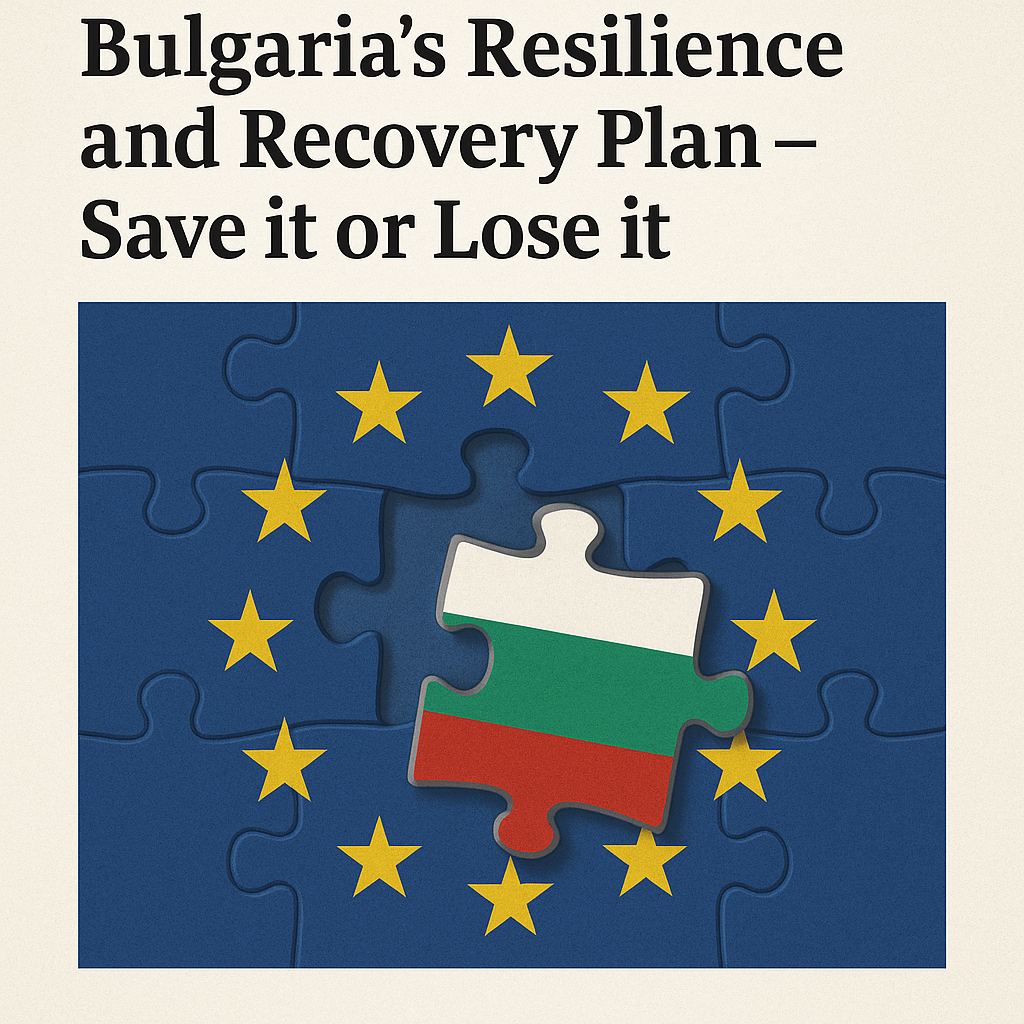
No reforms, no money

Do you remember the Resilience and Recovery Facility (RRF) the European Commission came up with to assist member states after the pandemic? Unlike traditional EU funds, this instrument in the form of national Resilience and Recovery Plans (RRPs) is meant to provide grants in exchange for specific reforms, making it a performance-based tool going hand in hand with time-bound milestones and targets (i.e. reforms). The completion of the latter is strictly tied to the disbursement of funds for public investments which literally means “no reforms, no money”.

For various reasons, in many EU member countries the implementation of the RRF is not going according to initial plans, and governments are currently submitting requests for revisions. They are to be reviewed and eventually approved by the European Commission. This is the case also with Bulgaria and its RRP that is financed with EUR 5.69bln in grants. As of mid-May 2025, though, the country has received less than 25% of the overall amount in the form of a first installment totaling EUR 1.36bln.

What is now at stake is the remaining EUR 4.32bln

The question is when this sum will be disbursed and whether the disbursement will be in full. The overall completion rate of the milestones and targets Bulgaria committed to in its RRP is at 38%, which stands for 122 finished reforms out of 321 in total.

To make things worse, the respective regulation at EU level says that all milestones and targets are to be achieved by 31 August 2026, and any payment under the RRF is be executed by 31 December 2026.

The new government is trying to speed up implementation and get full access to eligible funding

To address the accumulated delays (resulting also from a series of seven parliamentary elections in three years) and several underperforming parliaments that failed to adopt the respective legislative reforms, in April 2025 the new government submitted a request to the Commission to revise its RRP.

Bulgaria proposes to remove or modify several measures across the plan while cancelling or downsizing projects currently delayed. Since some of the proposed modifications concern outstanding issues under the second payment request, along with the modification request, Bulgaria also withdrew the payment request, with a view to resubmit it following the approval of the amended plan.

The biggest construction-related projects that are to drop out of the new RRP include a programme for the construction and reconstruction of water supply and sewerage systems (EUR 152mln), a project for heat and electricity co-generation from geothermal sources (EUR 123mln) and a pilot project for green hydrogen (EUR 33mln).

Other investments to see reduced funds are the construction of industrial parks and youth centres with an overall cut of EUR 15mln. While funding for all of these projects is to be potentially channeled from other EU programmes, there are projects that will receive more from the RRP than initially foreseen like the construction of the third metro line in Sofia with EUR 33mln in additional funding.

If proposed reforms and modified projects are approved in Brussels, the government expects to get the second and third RRF payment in the course of the year, while all remaining installments are to be disbursed by the deadline in 2026.

Needless to say, this seems like a very ambitious plan given the insufficient performance of the RRP in Bulgaria so far. This could also be seen in the official position of the government – the country may receive all payments by the deadline of August 2026 but will not have time to make all investments. This would mean that the projects underway at that time are either going to be downsized or put on hold until money from other sources is secured.

Segment-level construction forecast on Bulgaria can be found in the EECFA Construction Forecast Report. The new forecast will be out on 23 June. Orders and sample report: eecfa.com

This would impact public investments in Bulgarian construction

Written by Yasen Georgiev – EPI, EECFA Bulgaria

On 9 June 2024, Bulgarians are heading to the sixth parliamentary elections in the last three years. The lack of stable coalitions and the fragmented political landscape since 2021 will most probably lead to another fragile government construction with vague prospects for a 4-year term in power. This would have a detrimental effect on the absorption rate of EU money, and thus, public investments in construction.

The Bulgarian parliament building in Sofia by Angel Balashev on unsplash.com

Against this backdrop, Bulgaria’s economy is projected to grow by 1.9% in 2024 and 2.9% in 2025 according to the Spring 2024 Economic Forecast of the European Commission. These growth projections could have been significantly higher if public investments in general and government spending in infrastructure and construction in particular were in place. Traditionally, the main sources of public investments in energy efficiency of the residential and non-residential stock, urban mobility, road and railway connectivity, utilities, etc. are EU funds available for Bulgaria. However, as of May 2024 EU funding, along with national sources, prove to be absolutely underutilized for various internal and external reasons. These include the insufficient administrative capacity, the lack of project readiness, new priorities at EU level due to the pandemic (as the RRP was prepared as response to it) and Russia’s war against Ukraine. These setbacks have been additionally amplified by a series of government changes resulting in delays of administrative procedures and prolonged communication between Sofia and Brussels, but also by the lack of long-term mandates for the implementation of deep and sometimes painful reforms.

As of May 2024, the average disbursement rate of all EU-funded programmes and instruments during the ongoing budget cycle since 2021 is around 4%. What is more, EU-funded projects with a more extensive component of public investments in construction are disbursed at less than 2% (see table). In contrast, contracted amounts are ten times higher. Still, this shows a slow pace of implementation given the fact that the current financial framework ends in 2027, and certain instruments such as the Recovery and Resilience Plan (RRP) end in 2026. While funding within the classical Operational Programmes could be used up to two years after the period ends, if projects are duly contracted, the resources under the RRP are not transferable in time, according to the respective regulation.

On the one hand, the low absorption rate is due to the delays in finalizing EU projects within the previous financial framework (2014-2020) and the late approval of the new EU programmes within the current budgetary framework (2021-2027).

On the other hand, this performance is linked to home-made political and bureaucratic deficiencies that struggle with the new concepts for EU funding that is made available provided that commitments to reforms are met within strict deadlines. This is the case with the Recovery and Resilience Plan (RRP) that provides funds for green and digital transition projects based on a detailed reform agenda mutually agreed between Bulgaria and the European Commission. This agenda includes amendments of existing legislation or new laws that have to be passed by the parliament, which in recent years has been either not functioning or preoccupied with domestic issues. This barely left time for unpopular reforms, the majority of which have been avoided by political parties due to the constant prospects for new elections.

As a result, currently, Bulgaria is in the fifth implementation period of its Recovery and Resilience Plan but has met only the respective milestones and targets that are set in the first period (with a deadline in June 2022). Thus, projects under the RRP will have to be either downsized and/or implemented with national funding only.

In parallel, Bulgaria struggles with the absorption of EU money in coal-dependent regions under the Just Transition Mechanism, which secures funding for large-scale investments that also include construction activities. It remains to be seen if similar implementation difficulties will show up with the newly launched ‘Municipal Projects Investment’ programme that disburses national funding only.

This interplay of bottlenecks in utilizing available EU and national funding could be tackled appropriately only if a stable government is formed after the parliamentary elections in June. What is also very much needed is that the new government is reform-oriented and abstains from populist measures. The latter would lead to postponing reforms and thus would limit the absorption rate of the available EU funding, which could negatively impact meaningful public investments that come with the oversight of the EU, and which is likely to keep the economic growth below its potential.

More on Bulgarian construction and the segment-level forecast can be found in the EECFA Construction Forecast Report. The new forecast will be out on 25 June. Orders and sample report: eecfa.com