EECFA 2025 Winter Construction Forecast

EECFA released its 2025 Winter construction forecast on 12 December. Check out a sample report and place your order on eecfa.com. For discount, please contact us.

Southeast European construction markets

Bulgaria’s total construction output is forecasted to increase by 3% on average for 2026-2027” – says Yasen Georgiev at Economic Policy Institute (EPI), EECFA’s Bulgarian research institute. He adds that this is to follow estimates for a similar performance of almost 3% in 2025. The sectoral background, however, shows, a nuanced picture – cooling of residential construction, positive news from non-residential and a robust performance of civil engineering. The latter will benefit from investments which will be backed by the absorption of EU funds through the Recovery and Resilience Plan (RRP) and classical operational programmes, both with implementation deadlines in 2026 and 2027. At the same time, Bulgaria’s economy is to expand by 2.4% on average in 2026-2027 – a period continuously shaped also by the Euro adoption on 1 January 2026.

Michael Glazer (SEE Regional Advisors) and Tatjana Halapija (Nada Projekt), EECFA’s Croatian members, think that declining dwelling sales in Croatia have, paradoxically, failed to stop the growth in the value of Croatian residential output, because increases in the price per square meter of those dwellings that do get sold have more than compensated for the lower number of square meters bought. “But how long this can continue is unclear” – they add. “The policies that the Croatian government is implementing in order to ease the country’s housing crisis are confusing the residential picture still more, since a number of those policies have contradictory effects on output. As to non-residential building construction, output growth during the period covered by the current forecast will depend greatly on the sector, with some likely to continue to benefit from catch-up growth and EU support for a bit longer and others moving toward a steady state or even a decline. In civil engineering, EU funds continue to play the dominant role in financing construction of all sorts. Sports facility construction is experiencing a boom, but given the speed with which such projects are completed, the effect on output will be relatively brief. Renewable energy construction should be growing rapidly, but regulators’ hostility toward the sector are holding it back.”

Romania’s economy is entering a challenging period as the recently implemented measures to reduce the national account deficit begin to take effect” – reports Dr. Sebastian Sipos-Gug, EECFA’s Romanian researcher at Ebuild. “While most forecasters do not anticipate a recession, economic growth is expected to remain subdued over the next two years. Inflation is the highest in the EU, boosted in 2025 by increases in sales taxes. As a result, consumer prices are rising at a pace that is forecasted to outstrip wage growth, leading to a decline in real incomes in both 2025 and 2026. Government spending is also facing cuts, thus both private and public consumption are predicted to decline, with a chilling effect on most construction activity types. There is also the challenge of the massive level of public investment required by civil engineering projects that have started since 2023, which will be difficult to sustain under the austerity and the mounting pressure of losing even more EU funding. On the brighter side, both the economy at large and the labour market are expected to be quite resilient. By 2027, assuming the deficit reaches manageable levels, the effects of contractionary policies should fade out, inflation could ease, and interest rates could come down. This means that demand for construction would rebound and with it, construction activity.”

Dejan Krajinović, EECFA’s Serbian researcher (Beobuild) says that “Serbia’s overall construction output sank into a negative territory in 2025, primarily owing to the weaker performance in civil engineering. This year recorded growth in building construction, but the substantial consolidation in civil engineering dragged totals in red. The completion of major road, railway and energy projects contributed mostly, but delayed construction starts played a role as well. Residential construction is stable and is on historical levels, while non-residential construction is booming led by the hosting of the EXPO 2027 in Belgrade. Investments into commercial, hotel and office buildings are all spurred by the event, with the purposely built EXPO 2027 complex consisting of numerous venues being the single largest investment in non-residential. Improving financial conditions and sustained demand still support relatively high construction activity, but a lot of global political and economic uncertainties are dimming future prospects.”

Dr. Aleš Pustovrh at Bogatin, EECFA Slovenia, says that Slovenia’s construction sector is holding steady at EUR 6bn, though growth has cooled. Residential buildings remain the anchor, with output expected to show only a slight dip in 2025, helped by strong employment, rising wages and cheaper mortgages. Property transactions rebounded in early 2025, reversing last year’s slump, while prices continue to climb amid land shortages and slow permitting. Public housing programmes are ambitious, but private developers are concentrating on Ljubljana and coastal towns. Non-residential construction is mixed: offices are recovering slowly, retail stays subdued, but industrial and warehousing thrive on export demand and automation while health and education remain at very high levels. Civil engineering and public works lean on EU-backed projects and are anticipated to reach historically high levels by 2026. 

Eastern European construction markets

Andrey Vakulenko at Macon, EECFA’s Russian research institute notes that “the high key rate and the overall economic slowdown are constraining the Russian construction industry with negative trends expected for the current year and over the next two years. An easing of monetary policy, which has already begun, could help normalize the situation, but a positive effect is not expected until 2027. The main drag on construction output will likely be the residential subsector where high rates and revised government demand support principles are reducing activity among both buyers and developers. Negative trends will also likely persist in most non-residential segments due to declining growth rates of budget financing, a general decrease in business activity and a slowdown in consumption. The overall descending dynamics in the construction market may somewhat be mitigated by stable growth in civil engineering driven by export projects in energy and transport, but this growth is not predicted to be enough to keep the construction market in a positive zone”.

Prof. Ali Türel, EECFA’s Turkish researcher, reports that “the major effect of inflation-curb policies in Türkiye is the decline in disposable income and in the purchasing power of wage earners and pensioners. The moderate to lower-income population is unlikely to save enough equity for buying a home when rents have also become unaffordable for many. Ironically, housing sales have been increasing at a much higher rate than the growth of households. This can be attributed to the typical trend in Türkiye, where, during inflation, people expect a higher real return on their financial assets from real estate investments compared to alternative investment options. The reconstruction of earthquake-damaged buildings and infrastructure also contributed to the high rate of growth in building starts and completions from Q2 2025 onward, leading to the highest rates of change in the construction sector’s contribution to GDP compared to other sectors. Our latest forecast indicates that total construction output in Türkiye may reach 6.4 trillion TL in 2027 (EUR 180 billion), all at 2024 prices.”

According to Prof. Sergii Zapototskyi of Uvecon, EECFA Ukraine, despite the war and high risks, Ukraine’s construction industry remains one of the key drivers of economic recovery in 2025. The RDNA4 (the latest Rapid Damage and Needs Assessment Report) estimates Ukraine’s reconstruction needs for the next decade to be USD 486-524 billion, creating long-term demand for residential, non-residential and civil engineering construction works. Major challenges persist, including the uncertainty regarding the duration of the war, especially in frontline regions, labour shortages, bureaucratic barriers in the urban planning legislation, and logistical constraints due to the relocation of production facilities, and often, shortages in building materials. At the same time, the industry is demonstrating resilience: developers are diversifying supply chains, stabilizing procurement schedules, and increasing activity in the Central and Western regions. Demand for housing, intensive infrastructure restoration, and international investment from the EBRD, EIB, and other partners continue to support positive dynamics. The sector’s development prospects for 2026-2027 will largely depend on the security situation and the effectiveness of state recovery programs.

Q3 2025 Permit-Completion in EECFA area

The viz was updated on 29 November 2025 and it is great to see the recoveries here and there.
The text will be updated as soon as we have all the permit data (Ukraine Q3 is missing now).

When it comes to permits, Croatia and Serbia are still very stable. Both countries experienced massive expansion between 2014 and 2022 and they have remained close to their peak every since. Croatia has had around 4 million, while Serbia has had above 7 million permitted m2 for three years. Q2 in Slovenia was not soo good, so it remained well below the peak reached in 2022. Bulgaria is also below its latest peak, but permit data of the latest 3 quarters depict a growing optimism. In Romania the mild recovery is ongoing, led by the residential submarket. Hungary also turned upward, also because of the residential permits. The non-residential submarket looks very bad. Permits have fallen back to the level experienced in 2015.

You may use the dropdown in the viz for selecting either the residential or the non-residential submarket, or both.

See the full viz: EECFA Permit-Completion Quarterly – 29 November 2025

In the full visualization, not only permit but completion data can be followed (where available). Just click on the Country-by-country sheet.

Led by the residential submarket, Türkiye bounced back and up. And due to changing accounting method, all permit time series from 2010 have been revised. From Q2 2025 on, permits issued by authorities other than the municipalities are also reported by TUIK. So the scope is bigger, the results show the full picture. Click through the below viz for understanding the size and the impact of this revision. Mild optimism prevails in Ukraine, the permitted floor area keeps expanding. Since the beginning of this year the residential submarket drives this growth. Russia is stable when it comes to completion of buildings. Non-residential has been edging up, residential has been edging down lately.

Aparthotels: new growth spot for non-residential construction in Russia

Written by Andrey Vakulenko – MACON, EECFA Russia

Russia’s resort real estate market has seen a dynamic growth in recent years, partly due to the emergence of aparthotels – a format attractive to both developers and hotel operators. The coming years are also expected to see a sharp increase in aparthotel construction, supporting the non-residential construction market – according to Andrey Vakulenko, EECFA’s Russian analyst.

Thriving aparthotel segment

Resort real estate has been one of the fastest-growing segments of the Russian construction market in recent years. Aparthotels – apartment complexes with minimal infrastructure and services, and with the mandatory availability of a trust management – have particularly seen a rapid growth, though they are relatively new to the Russian market. The core of the supply is (and will be) resort projects, i.e. aparthotels in locations with developed recreational and tourist infrastructure for seasonal vacations. Urban aparthotels – primarily in metropolitan areas with minimal infrastructure – are rather aimed at business travelers and to a lesser extent at traditional tourism and long-term rentals.

As of Q3 2025, the aparthotel market size stood at 25,200 units with a total area of ​​612,500 sqm and by the end of this year, roughly 143,000 sqm of new aparthotels, or 4,300 new units are expected to open. Based on the announced plans, the next three to four years will register a sharp rise, and by the end of 2029 aparthotels may amount to around 109,800 units with over 3.6 million sqm, almost six times higher than the current level.

Behind the growth

One of the main reasons for the anticipated expansion of the aparthotel format is that domestic tourism gained popularity after 2022 due to the reduced accessibility of many international resorts (because of the suspension of air travel, the weak ruble, visa issues, and other internal or external restrictions). Rise in domestic tourism created stable high demand for accommodation in virtually all key resorts in Russia.

Another reason is that developers specialized in multi-unit residential construction began to start many projects in aparthotel and resort real estate construction amid the decline in the residential real estate market following the cancellation of the mass preferential mortgage program.

Also, there are significant incentives and state support for developing tourism infrastructure and the domestic tourism industry, including the construction of hotel complexes and aparthotels.

Furthermore, in 2024 the status of aparthotels was legalized; they were included in the official hotel classification system, creating uniform standards for the segment and transparent conditions for market participants.

Besides, the departure of many large foreign hotel operators from the market in 2022 led to the expansion of Russian hotel chains (Azimut Hotels, Cosmos Hotel Group, Alean Collection, ZONT Hotel Group, VALO Hotel Services, Mantera Group, among others), which began collaborating with aparthotels, increasing the latter’s attractiveness and guaranteeing a high level of service and trust management services.

Moreover, many investors appeared in the market who found the trust management model used in aparthotels and the opportunity of generating passive income attractive. The operating return on investments in aparthotels in developed resorts managed by well-known hotel brands can reach 7%-10% and higher. And given the rise in the market value of apartments, long-term returns can reach 13%-17% per annum, exceeding the return on long-term bank deposits (currently 8%-10% per year for a three-year deposit).

All this suggests that aparthotels will be a major segment of non-residential construction in the coming years.

Coastal regions: top locations for aparthotels

The aparthotel format is developing most actively on the Black Sea coast, currently accounting for over half of the total supply in this segment. Urban aparthotels are primarily in Moscow and St. Petersburg with just over one-fifth of the total supply.

In the coming years, it is also the Black Sea coast that will likely register the biggest expansion in supply, but new aparthotels are also set to be actively emerging on the Caspian Sea coast, in Dagestan.

In coastal regions (Krasnodar Krai, Crimea, Dagestan), aparthotels under construction already amount to more than a quarter of all multi-unit residential real estate under construction and this figure is expected to grow further.

There is also an increase in the construction of similar projects in other resorts across the country, for example, on the Baltic coast or at mountain and spa resorts in the North Caucasus, the Altai Mountains and the Urals, among others.

EXPO 2027 boosts Serbian non-residential construction

Written by Dejan Krajinović, Beobuild Core d.o.o., EECFA Serbia

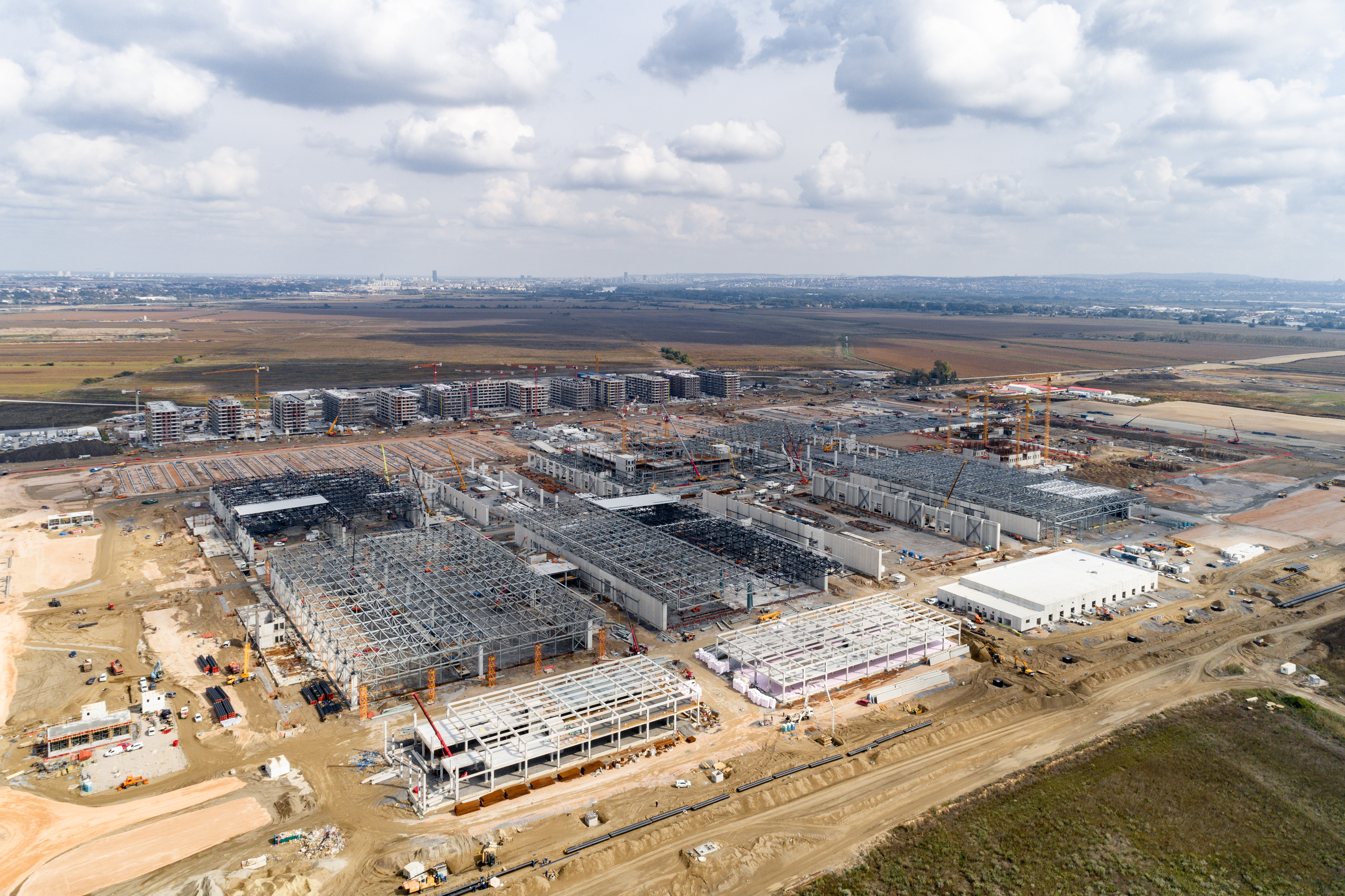
Overall construction output in Serbia is expected to decline this year, primarily due to the slowdown in civil engineering as several major road and railway projects were completed last year. By contrast, non-residential construction has entered a new growth cycle driven by investments connected to the hosting of EXPO 2027 in Belgrade. The event will be held in a purpose-built exhibition complex in the outskirts of the city, covering around 80 hectares. Alongside the construction of this complex, numerous public and private investments are indirectly tied to the event, including new hotels, accommodation, leisure, and commercial projects, as well as the reconstruction of museums, cultural heritage sites, and public spaces.

Aerial photo of the construction site of the EXPO 2027 complex – Photo: beobuild.rs

The EXPO 2027 complex itself is a vast construction site, comprising approximately 230,000 sqm of exhibition pavilions, multifunctional venues, congress and conference halls, as well as office and retail space. In addition, a residential complex with around 1,500 units is being built to house participating delegations. The exhibition will run for 93 days, from 15 May to 15 August 2027, featuring around 130 countries and hundreds of events spanning sports, science, culture, and innovation. Total investment could exceed EUR 2.5 billion, with EUR 1.5 billion allocated for the EXPO complex and a further EUR 1 billion for accompanying facilities and infrastructure. This project has been the key driver of growth in non-residential construction and is expected to sustain activity in the sector in the coming years.

The broader development zone around the EXPO 2027 complex extends far beyond the exhibition center itself. While the core site covers 80 hectares, total development area exceeds 200 hectares. It will include the new National Stadium complex, a center for aquatic sports, a theme park, recreation facilities, and hotels. The National Stadium alone is a EUR 600 million project, designed with 52,000 permanent seats and the capacity to expand by an additional 8,000. Construction began in early 2024 and, despite delays, it is expected to be completed in time for 2027. Other sporting and leisure facilities are also planned for delivery ahead of the event, though it remains uncertain whether all projects will meet the deadline.

Several other public and private developments across Belgrade are linked to the exhibition, including the reconstruction and expansion of museum facilities: a new Natural History Museum building, the relocation of the Nikola Tesla Museum, the renovation of the Aeronautical Museum, and the modernization of the City of Belgrade Museum, among others. The private sector is likewise preparing for the anticipated rise in visitors, with investments in accommodation accelerating. Notable projects under construction include new hotels under the Intercontinental and Ritz-Carlton brands, alongside numerous smaller ventures.

However, the high level of spending on the EXPO 2027 has placed considerable strain on the state budget. To maintain fiscal deficits at around 3% of GDP, funds have been reallocated from other public projects. This has been most evident in infrastructure development and civil engineering, where shifting priorities have led to significant delays on major planned projects. As a result, civil engineering output is contracting faster than expected in 2025, with negative implications for growth in 2026 as well. On the other hand, long-term economic benefits of hosting EXPO 2027 remain uncertain.

After the event concludes, the EXPO 2027 complex will be repurposed as the new Belgrade Fair Complex. The current fairgrounds in central Belgrade, built in the 1950s, are planned for redevelopment once operations move to the new site. This ensures that the EXPO facilities will continue to be used in the years ahead, supporting the economic rationale for the project. Moreover, new transport infrastructure, including a railway link to the city center, river dock facilities, and expanded commercial developments, should further enhance the attractiveness of the location for private investment.

EECFA 2025 Summer Construction Forecast

EECFA released its 2025 Summer construction forecast on 23 June. See a sample report and place your order on eecfa.com. To get discounts, you may contact us.

Southeast European construction markets up to 2027

According to Yasen Georgiev at Economic Policy Institute (EPI), EECFA’s Bulgarian research institute, total construction output in Bulgaria is anticipated to grow by 3% on average for 2025-2027 with a stronger growth in the middle of the period when the absorption of operational programmes and the implementation of the Recovery and Resilience Plan are to gain momentum. According to the sectoral breakdown, residential construction is expected to be the subsector with the weakest performance, while non-residential construction and particularly civil engineering are predicted to see stronger growth figures. Against this backdrop, the country’s economy is set to register a slower-than-expected growth in 2025 and 2026. In parallel, it is awaited to benefit from the effects from the full Schengen area membership effective from the beginning of 2025 and from the euro adoption expected on 1 January 2026.

Michael Glazer (SEE Regional Advisors) and Tatjana Halapija (Nada Projekt), EECFA’s Croatian members think that Croatia’s construction as a whole continues vibrant due to the combination of continuing transitioning-economy catch-up growth and large inflows of EU money. Both are beginning to diminish, however, and that will affect all construction segments, some more strongly and more quickly than others. In building construction several sectors have seen the end or are close to seeing the end of catch-up growth. Others, particularly those that benefit most from EU finance, are still going strong. Civil engineering continues to profit greatly from EU funding, and because of the poor initial condition of Croatia’s infrastructure after independence, much catch-up construction remains to be done. Certain government policies will have a great influence on specific building and civil engineering sectors. Those policies include the housing policies embodied in Croatia’s new National Housing Policy Plan until 2030, the new tax on real estate and the country’s renewable energy permitting and electrical grid hook-up fee rules.

Romania’s macroeconomic outlook remains positive, but more reserved as the political instability and fiscal uncertainty have done little to improve growth opportunities’ – says Dr. Sebastian Sipos-Gug, EECFA’s Romanian researcher at Ebuild. At the same time, he adds, the country has the largest government deficit in the EU, which will dampen public investment capabilities. All these will make it harder to finance public works and could negatively impact civil engineering. This is doubly worrying as this subsector countered the decline in other construction segments in 2024, and thus the outlook for total construction remains negative in 2025 and 2026 in real terms. Not all is gloom and doom, however. As inflation and interest rates come down, and employment indicators remain strong, private consumption could boost demand for residential and non-residential construction.

‘In 2025 Serbia’s construction is making new gains in building construction, while civil engineering has entered a period of consolidation after the strong expansion during 2023 and 2024′ – believes Dejan Krajinović, EECFA’s Serbian researcher at Beobuild. Building construction is supported by both public and private investments, boosted by the hosting of the EXPO 2027 in Belgrade. Non-residential construction is the main beneficiary of this event, particularly commercial, office and hotel segments, while residential construction is also keeping historically high volumes. Some delays are seen in civil engineering, but the overall performance is still strong with a long list of planned projects in all major subsegments. Domestic demand is still relatively strong, but economic growth and the level of investments are being muffled this year by uncertainties in the global markets, particularly the weak EU economy, international trade issues and the ongoing wars in Ukraine and the Middle East.

‘Total construction output in Slovenia is expected to decrease from the historic high of EUR 5,5 billion reached in 2023. In both 2024 and 2025, it could contract but remain above EUR 5 billion annually’ – as per the opinion of Dr. Aleš Pustovrh at Bogatin, EECFA’s Slovenian member institute. He predicts the sector to return to growth in 2026 and 2027, mostly on the back of a healthy growth in residential construction buoyed by decreasing mortgage rates. On the other hand, civil engineering is prognosticated to shrink significantly in 2024 and 2025 due to some large projects nearing completion, like the new railroad connecting Port Koper. Both non-residential and civil engineering depend to a large degree on public financing that was widely available in the post-Covid period but will become much less available in 2025-2027. Especially if the overall economic activity continues to slow down. This deceleration and more foreign labourers have also caused lower construction cost growth, but other challenges persist such as the additional bureaucratic burdens (changed permitting process, increase in tax, ongoing discussion on changes to short-term rental legislation, among others) and many external risks in the global economic and political environment. 

Eastern European construction markets up to 2027

‘In the forecast horizon, the construction sector of Russia will be under pressure from a range of macroeconomic factors, the main one being the high key rate, which will negatively affect the pace and volume of construction projects’ – according to Andrey Vakulenko at MACON, EECFA’s Russian research institute. The tight monetary policy and the reduced availability of mortgages will likely slow down housing construction, on the one hand. On the other, the high cost of project financing, the general cooling of the economy as well as reduced consumption and business activity will likely shrink the volume of investment in non-residential construction. However, these trends can partly be offset by high volumes of government financing of priority infrastructure and energy projects, which can support civil engineering and ensure near-zero growth in total construction market in 2025-2027.

Prof. Ali Türel, EECFA’s Turkish researcher says that Türkiye has been trying to control high inflation by raising the base rate and managing exchange rate increases through market instruments by the Central Bank and maintaining wage growth at zero or negative rates. This created financing difficulties for industries and businesses, reduced demand for basic consumer goods, and led to affordability problems for mortgage credits. Big declines in building starts and completions in Q1 2025 may also be related to these measures. Yet, the Central Bank’s inflation target for 2025 remains high at 24%. Positive real changes in housing prices relative to building construction costs encourage house building, while their negative real change compared to inflation may be the leading factor in the increase of home sales through equity financing when mortgage credits are not affordable for most households. Rebuilding the quake-damaged 870 thousand units requires about EUR 100 billion and these expenditures have been the primary factor of the large national deficits in recent years.

‘This year, in spite of the continuing war and the economic instability in the country, Ukraine’s construction industry shows signs of recovery and growth on the back of successful programs financing both the construction of new facilities and the reconstruction and restoration of infrastructure in eastern and southern regions’ – according to Prof. Sergii Zapototskyi at Uvecon, EECFA Ukraine. The World Bank estimates that reconstruction would require USD 486 billion. On the negative side for the sector are bureaucratic barriers in the urban planning legislation, shortage of workers caused by mobilization, shortage and high cost of building materials, and logistical difficulties. On the positive side for the sector is demand for housing and the need to restore damaged infrastructure. The near-term future of the industry depends on the level of security, the effectiveness of restoration programs and the volume of international investments.

BCG tanulmány: 2035-re megnő a kereslet az energiahatékony építőanyagokra

A Boston Consulting Group (BCG) idén februárban publikált egy tanulmányt a tavaly felülvizsgált EU-s EPBD irányelv apropójából, amelyben az energiahatékony anyagok és technológiák iránti jövőbeli keresletet modellezte. A tanulmány szerzői: Johannes Blauhuth, Lorenzo Fantini, Martin Feth, Jannik Leiendecker, és Alberto Pizcueta. Kőrösi Péter (ELTINGA) összefoglalója.

Klímasemleges új épületek az EU-ban 2030-tól

A klímavédelem célkeresztjébe került a legnagyobb energiafogyasztó Európában: az építőipar.  Európa szén-dioxid-kibocsátásának több mint egyharmadáért az épületek felelősek, ami összefügg azzal, hogy energiahatékonyságuk átlagosan igen alacsony. Emiatt az épületállomány dekarbonizációja középtávú uniós irány – már rövid távon is érzékelhető célkitűzésekkel.

Az Európai Unió célja a fosszilis tüzelőanyagok fokozatos kivezetése és a megújuló energiaforrások elterjedésének felgyorsítása, ezért tavaly májusban felülvizsgálták az épületek energiahatékonyságáról szóló irányelvet (Energy Performance of Buildings Directive – EPBD). Az új irányelv előírja, hogy a 2030-as évek elejére az épületállomány legrosszabbul teljesítő elemeit fel kell újítani, 2035-re pedig a lakóépületek energiafogyasztását 20–22%-kal kell csökkenteni. Továbbá 2028-tól minden új középületnek, 2030-tól pedig minden egyes új épületnek zéró kibocsátásúnak kell lennie.

A tagállamoknak 2026 májusáig kell átültetniük az irányelvet a nemzeti jogrendbe.

A BCG előrejelzése az energiahatékony építési technikák és anyagok iránti keresletre

Az új irányelv várhatóan már a következő negyedévekben hatással lesz az európai építőipar működésére. Bár a nemzeti szabályozás kidolgozása némi időt vehet igénybe, az első lépések már befolyásolhatják a befektetői döntéseket és a közbeszerzési szabályokat, különösen a középületek és az energetikai felújítások esetében.

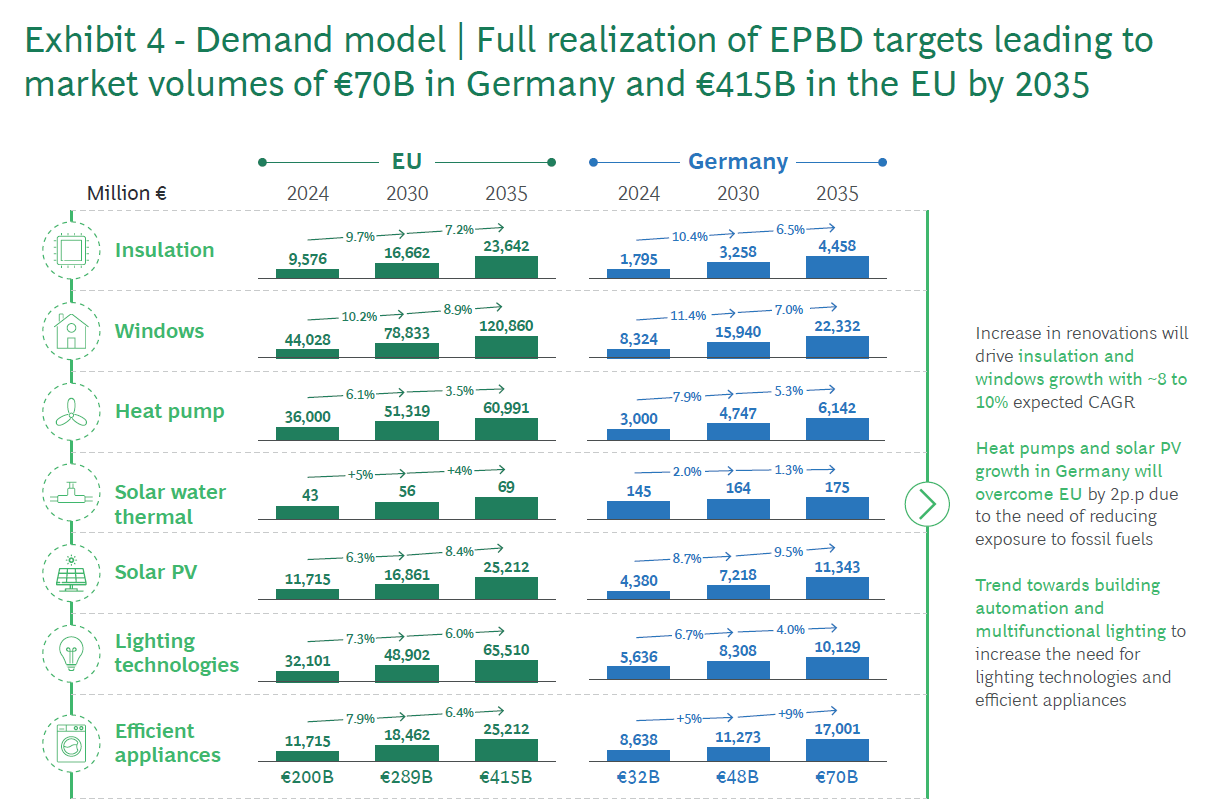
Ha az EU-s célok teljes mértékben teljesülnek, jelentős felújítási hullámra számíthatunk és a zöld építkezés is fellendülhet. A BCG előrejelzése szerint a modern szigetelőanyagok és a nagy hatékonyságú ablakok iránti kereslet évi körülbelül 10%-kal, míg a hőszivattyúk és napelemek iránti kereslet évi 6-8%-kal bővülhet.

A lenti ábra a keresletet modellezi az EPBD-célok teljes megvalósulása esetén, mely 2035-re 70 milliárd eurós piaci volument jelent Németországban és 415 milliárd eurós piaci volument az EU-ban.

Az EPBD célkitűzéseihez időben alkalmazkodó vállalatok előnyre tehetnek szert versenytársaikkal szemben az egyre szigorúbb energiaszabványok és a fenntartható építési trendek környezetében.

Forrás: Boston Consulting Group (BCG), White paper: The building sector and EPBD – Demand impications for energy-efficient materials and technologies, February 2025 by Johannes Blauhuth, Lorenzo Fantini, Martin Feth, Jannik Leiendecker, and Alberto Pizcueta.

Összefoglaló: Kőrösi Péter (ELTINGA)

EECFA 2024 Winter Construction Forecast

EECFA released its 2024 Winter construction forecast on 16 December. Check out a sample report and purchase any of the 8 reports or the package of 8 reports at eecfa.com. For discounts, contact us.

Southeast European construction markets

Total construction output in Bulgaria is forecasted to grow by an average of 3.3% in 2024-2026, which is slightly above real GDP growth projections for the same period. The subsector breakdown shows that residential construction is expected to lose momentum, but this is likely to be compensated by a more dynamic performance of non-residential construction and civil engineering. In parallel, general economic activity in Bulgaria in the forecast period is to be influenced by the effects from the full membership in the Schengen area from 2025 onward and the prospects for the country to introduce the euro on 1 January 2026.

Croatian building construction presents a varied picture across subsectors, with anticipated output growth ranging from significantly positive to somewhat negative. Civil engineering is more uniformly positive, but certain sectors show the effects of the completion and commencement of large projects. Both building and civil engineering output growth will be strongly influenced by new government laws and regulations, the consequences of which, while likely to be large, are difficult to predict for both the short and medium terms. These include the new National Housing Policy Plan until 2030, the new tax on real estate and measures to balance the playing field between different types of tourism accommodations.

Despite the rise in investment, Romania will likely continue to see a stifled growth in construction in real terms due to costs remaining high. Stubborn inflation and the slightly disappointing macroeconomic performance combined with increased wages and still high interest rates create a less appealing environment for investors in building construction. On the bright side, high income and importsare indicative of strong demand for consumption and could translate to demand for construction. While infrastructure did well, the current political turmoil and uncertainty could hobble performance going forwards. Even assuming deficit remains high but stable, as the EC expects, it would continue to raise public debt and make financing further projects more politically difficult. As some downside factors could improve by then, construction growth is forecasted to return to positive in 2026.

Serbia’s construction is likely to have closed another strong year led by civil engineering, but non-residential also entered a new growth cycle with positive outlook boosted by public investments and the hosting of the EXPO 2027 in Belgrade. The construction of commercial, office and hotel buildings are all set to grow in the coming period, followed by education and health. Residential construction is already on historically high levels with a relatively stable performance. In civil engineering, road and railway construction continues unabated, breaking new record volumes on the way, but other segments also have an impressive project pipeline. The economy is set to expand by 4% in 2024 and 2025 on the back of strong consumption and high investment, so construction outputs may sustain formidable levels up to 2026.

Slovenia’s construction sector is expected to maintain post-pandemic levels with annual output consistently exceeding EUR 5 billion up to 2026 against the EUR 3 billion pre-pandemic. Public financing has been a key driver with national budget expenditure up from EUR 10 billion in 2019 to over EUR 15 billion in 2024, though there will be spending limits in 2025-2026. Civil engineering in the forecast period will be supported by major infrastructure projects. Residential construction is set to drop slightly first in 2024 before rebounding by 2026 driven by lower mortgage rates. Non-residential construction is forecast to grow steadily but remain dependant on the availability of public financing. Other challenges remain such as labour shortages, permit backlogs and high costs, but construction cost growth is set to stabilize at under 3% annually.

Eastern European construction markets

In 2024, the Russian construction industry fared better than previously expected driven by the high pace of project implementation and the massive budget support in civil engineering and non-residential construction. It could even offset the negative impacts of the decline in housing construction caused by the end of the mass preferential mortgage program. However, this positive momentum is expected to gradually fade owing to the tight monetary policy of the Central Bank and several other internal and external factors that are slowing down the economy in general and the construction industry in particular. In 2025-2026, the record budget expenditures planned within the framework of new national projects and other measures of state financing will likely maintain construction market volumes in Russia in the positive territory, but with minimal growth.

In Türkiye, increased interest rates and the Central Bank’s policy to reduce the depreciation of the national currency to curb inflation has not yet produced the intended outcomes. And high interest rates are blamed for shrinking industrial output and decelerated trade growth. The interest rate and the Central Bank’s policies had two major effects on the construction sector: big negative real rates of change in construction costs and housing prices. Housing sales are growing as real prices drop and rely on equity financing since mortgage loans have become unaffordable at high interest rates. Building permits in most segments decreased in Q3 2024, while completions had a positive trend. The government’s legal obligation to rebuild the earthquake-damaged 350 thousand buildings with 870 thousand independent units has been the main factor in huge budget deficits that impede the Government from providing sufficient funds for civil engineering projects.

As a consequence of the war ongoing for over 1000 days, Ukraine’s construction market is facing economic difficulties, limited resources, huge losses in buildings, hike in building material prices, lack of skilled workers and limited access to financing, topped with the unpredictability of government decisions and the instability of property rights. The destroyed homes of more than 1.5 million families create a huge demand. Non-residential construction also focuses on the restoration of destroyed buildings and the construction of new ones in safer central and western regions. Civil engineering is also boosted by the renovation of bridges, roads, railways, pipelines, communication and power lines. The ‘Unified portfolio of public investment projects’ recently approved by the government includes 750 big reconstruction projects on roughly UAH 2.36 trillion, while the state budget also has UAH 256.1 billion for public projects in 2025. First, the EUR 50 billion under the EU’s Ukraine Facility are to be used. Financing is also planned through international financial organizations and foreign governments. The priority is energy, transport, utility and public buildings such as schools.

The Croatian hotel sector: Will it lead the way?

Written by Michael Glazer (SEE Regional Advisors) and Tatjana Halapija (Nada Projekt), EECFA’s Croatian members

The rate of growth in the number of foreign tourists visiting Croatia declined in 2024. This, combined with a more stringent tourism tax regime and inflation, is impacting hotel construction and the construction of other accommodation facilities. Will the hotel segment, which has boosted overall construction in Croatia in a variety of ways, continue to do so?

Supetar, Brač Island, Croatia. Photo by Tatjana Halapija

Croatia’s tourism growth is slowing down, at least in the high season and especially among foreigners. Year-on-year growth in overnights for the high season of July and August 2024 versus the same period in 2023 was 0.8% overall. While domestic tourist overnights climbed 10.0%, foreign tourist overnights stagnated, growing only 0.11%. This contrasted sharply with the much better numbers for May and June, for which overall overnights increased by 3.6%, with a 3.8% and 3.6% increase for domestic and foreign tourists, respectively. Figures for the year through August 2024 compared to that period in 2023 showed a rise of 1.6% overall, 7.2% for domestic tourists and 1.1% for foreign.

Revenues for the year through August 2024 were said by the Ministry of Tourism to have grown 11% over the same period in 2023. Subtracting August-2023-to-August-2024 inflation of 3.0%, this gives a real increase of 8.0% for the period. Meanwhile, total rooms and beds for tourists in Croatia rose 1.5% and 2.4%, respectively, in 2024 over their numbers in 2023. Occupancy data is not yet available for 2024, but the Minister of Tourism expressed the view that there is little room for further expansion during the high season, indicating that Croatia’s tourism infrastructure is reaching capacity during peak periods.

The question then is what all this means for hotel construction. While the data initially seem promising in this regard, there are a number of countervailing factors that suggest a less optimistic view might be appropriate.

Part of the problem in assessing the likelihood of robust hotel construction in Croatia is that the country is entering into a time of political and policy change. The tax regime for tourism is being modified, and in some important ways tightened, while the years-delayed property tax is again rearing its head. Higher this time than ever before, because the recent parliamentary elections theoretically give the ruling party years to tamp down property-owner wrath before it has to face the voters again. Unless, of course, the precarious governing coalition falls apart, bringing the date of electoral reckoning much closer. The upcoming presidential elections further complicate the picture, since the ruling party will not want to alienate voters before that election is held.

Of course, many of these factors affect the Croatian construction sector as a whole, adding to the normal uncertainty in forecasting its evolution. So does inflation, which is at last coming under control. Gradually. Significantly more gradually than the EU average, but the 2% goal is now at least within sight. That said, the consequences of inflation for many Croatians, and particularly for pensioners who make up 30% of the country’s population, have already been severe. They are now looking to recoup some of the losses in purchasing power that they’ve experienced. The government seems to have succeeded in threading the needle of combining pay rises for public sector workers with fiscal responsibility when it raised public sector salaries by more than 20% prior to this year’s parliamentary elections. It remains to be seen if it can do so with the inflation-related demands on its resources.

Croatia’s hotel sector is in itself an important influence on the country’s construction sectors. Its income provides tax revenues that fund government construction projects, and the payments that it makes to employees and suppliers provide the means for them to invest in, among other things, buildings and other construction. Accordingly, the 8% real increase in hotel income is likely to boost construction overall, at least to an extent. How much requires more data (e.g., more up-to-date hotel income figures) and further analysis.  

There’s also the question of how much the increase in hotel income reflects the fortunes of non-hotel tourism accommodation providers. It’s not clear that they have done as well as the hotels in this regard. This is important, because they provide by far the majority of tourist beds. Their construction projects are individually more modest, but they do add up.

We should know considerably more by the time we prepare our 2024 Winter Forecast Report (available on 16 December). This additional information that we will collect by then will guide us in assessing the potential for hotel and other tourist accommodation construction. It will also help us to evaluate the actual strength of the current Croatian tourism season and the likely strength of the coming one, important influences on the output potential of the Croatian construction industry in its entirety. 

Croatian construction output makeup changes: more hospitals, fewer flats?

Written by Michael Glazer (SEE Regional Advisors) and Tatjana Halapija (Nada Projekt), EECFA’s Croatia members

The composition of Croatia’s construction output is changing. While the residential segment may soon experience a slowdown, health-related construction – public and private renovations and new builds alike – is seeing a considerable boom.

Photo by Hajnalka Hurta

Construction continues strong in Croatia. The country’s State Bureau of Statistics announced earlier this month that construction permits issued in January 2023 were up 19.1% in number and 40.5% in value compared to January 2022. While permitting in Croatia can vary significantly from month to month, these data certainly suggest that the sector remains vibrant. So do the Bureau’s statistics for 2022 construction volume versus that for 2021. According to the Bureau, the value of completed construction work carried out by business entities in Croatia with 20 or more employees increased by 12.9% in 2022 compared to 2021, while the value of new orders increased by 27.1%.

But while construction as a whole remains robust, a number of sectors are weakening as changes in the composition of construction volume continue. Where once the tide of construction activity raised all sector’s boats, airport and highway construction has now given way to rail on the civil engineering side. On the buildings side, construction of residences may at last be cooling down from its white-hot heat of the last few years. The Statistics Bureau’s recent announcement of a 9.8% decline between January 2022 and January 2023 in the number of apartments for which permit applications were submitted suggests this.

Current forecast for Croatia is available in the EECFA Construction Forecast Report. EECFA (Eastern European Construction Forecasting Association) conducts research on the construction markets of 8 Eastern-European countries. For orders and sample report: eecfa.com

So, paradoxically, does the 20.2% rise in the average price of new apartments between 2021 and 2022. Inflation clearly accounts for a substantial part of this increase. And supply may have shifted to higher priced units. But it nonetheless appears that a significant increase in real prices for equivalent apartments has likely occurred. In this regard, the Governor of the Croatian National Bank recently pointed out that the volume of residential property sales is decreasing, something that he notes usually precedes a fall in prices. Tighter mortgage conditions and higher interest rates also likely played a role.

On the other hand, a type of construction is that is booming but not getting the attention that it deserves is construction of healthcare facilities. Both public and private facilities have been and are being built in unprecedented numbers. The subsector’s strength has come from both public and private projects and from both renovations and new builds. This despite a push, so far not highly successful, on the part of the Croatian government to, in the name of efficiency, consolidate a number of healthcare facilities that now exist in low population localities.

On the public side, significant construction has been ongoing for some time now. Among the larger projects have been the consolidation and expansion of the Rijeka Clinical Hospital Center, a multi-year, more-than-hundred-fifty-million euro project that is now in its third phase. This project includes the Hospital for Mother and Child, a new facility to consolidate gynecology, obstetrics and pediatric facilities previously housed in outdated facilities in two different towns. In Zagreb, projects completed or already underway include the total reconstruction of the city’s Clinic for Infectious Diseases and the renovation of the Zagreb Clinical Hospital Center’s Jordanovac, Rebro and Petrova facilities, the Sisters of Mercy Clinical Hospital Center, the Merkur Clinical Hospital and the Children’s Hospital. Elsewhere, a new, 100-million-euro General Hospital was built in Pula, and various smaller, regional facilities were upgraded, including in Bjelovar and Varazdin.

While a good deal of Croatia’s public medical facility construction has been completed, much still remains to be undertaken. In addition to further upgrades to current facilities nationwide and the possible construction of a National Children’s Hospital in Zagreb, considerable work remains to be done to repair the damage caused by the two earthquakes that struck Croatia in 2020, including significant reconstruction at Zagreb’s Faculty of Medicine. The government is also pushing health tourism, with a minimum of EUR 61 million to be invested in public and private projects in this field.

Private healthcare construction projects are also proliferating. Among those recently built are Akromion’s 10,000 m2 hospital for orthopedics and trauma and Sveta Katarina’s 4,000 m2 facility, both in Zagreb. A variety of other facilities are in the planning stages, although their exact characteristics, e.g., as to size and in some cases even nature, remain either confidential or as yet undecided. The government’s increased focus on and funding of healthcare tourism is likely to significantly increase activity in the healthcare subsector.

As the Croatian economy evolves, particularly as it responds to Croatia’s entry into the Schengen Area and the Eurozone, more changes in the composition of construction volume must be expected. As an example, it is claimed that already one in three Croatian residences is bought by a foreigner. And the country seems to at last be being discovered as a manufacturing location, with Jabil, a major US-based manufacturer, building a large facility in Osijek. The consequences of these changes for total volume are hard to predict, but are certain to occur.