M1 motorway boosting Activity-Start in Hungarian construction

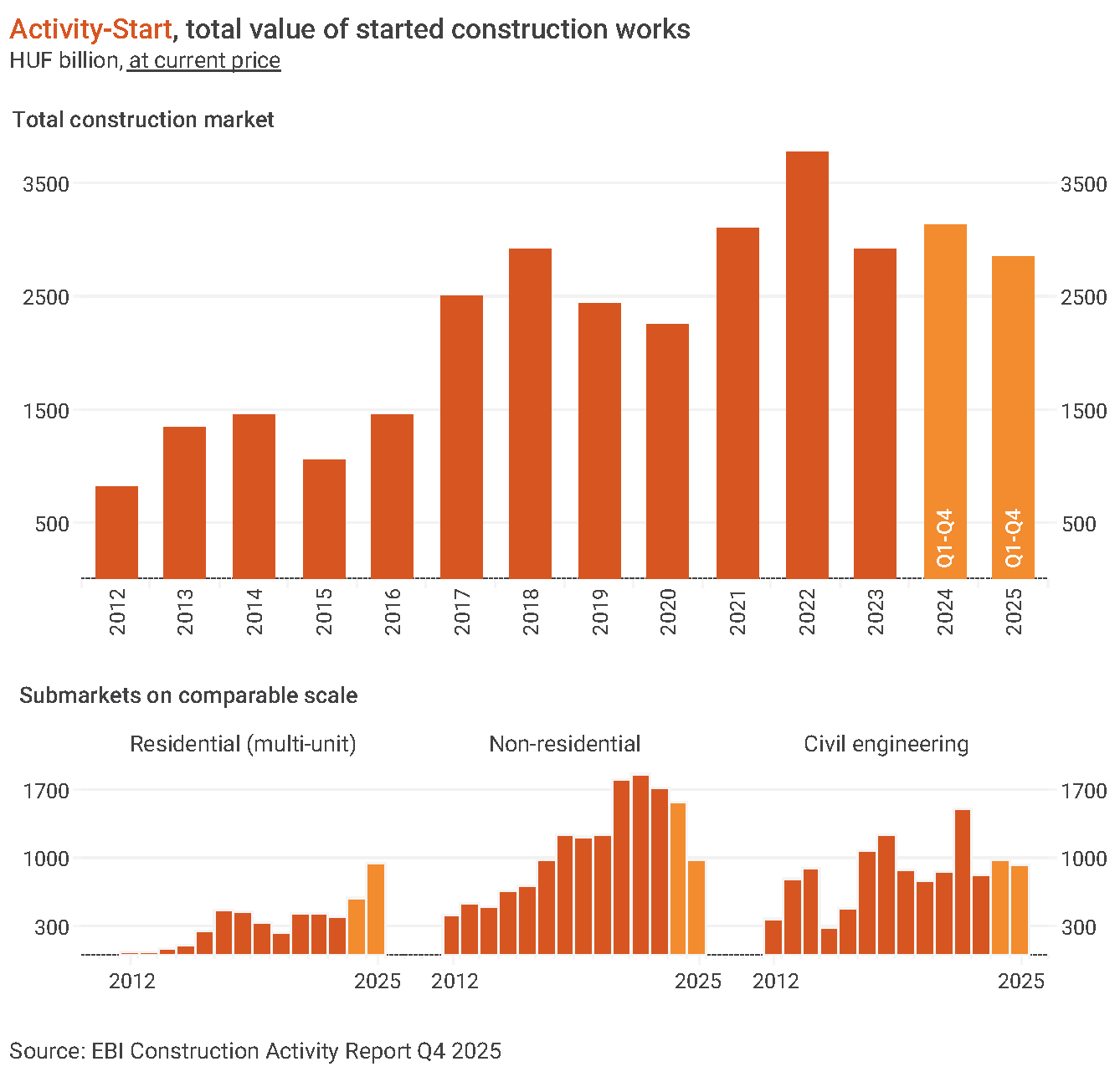
The latest EBI Construction Activity Report Hungary has found that it was mainly due to the ongoing M1 motorway expansion that the value of started construction projects rose significantly in the third quarter of this year. The value of projects entering construction in July-September 2025 exceeded HUF 1,000 billion at current price – the second highest level in the past ten years. Without this motorway expansion, accounting for around 60% of Activity-Start, the figures would have been much more modest, though.

Building Construction Activity-Start

In Q3 2025 the value of started building construction projects was HUF 400 billion, around the same value as between April and June. Thanks to the outstanding figures between January and March, the value of building construction projects entering construction phase exceeded HUF 1,500 billion, only 4 points short of the same period in 2023 and 2024. At constant price, Activity-Start between January and September of this year was the lowest in the past 9 years.

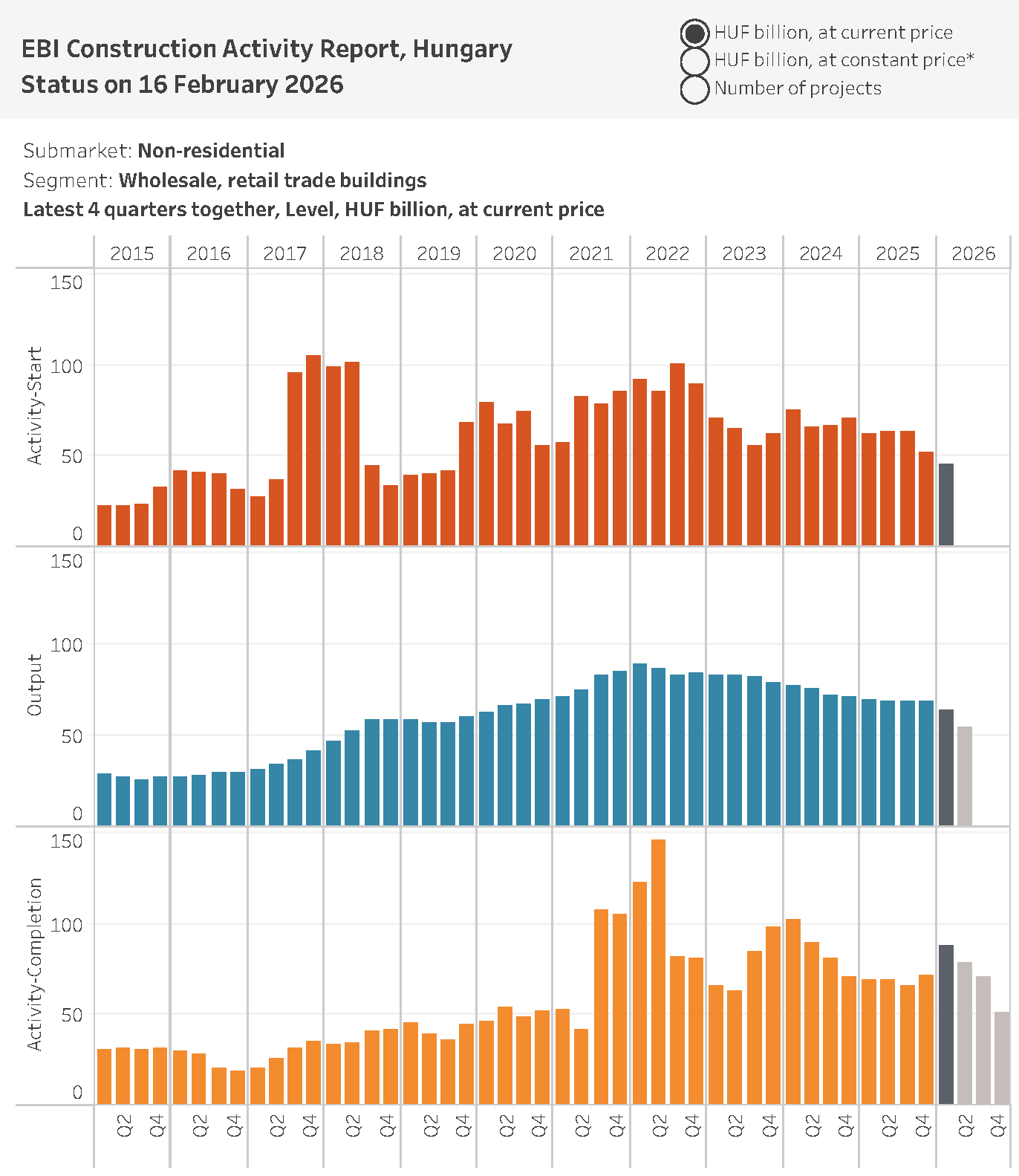
Activity-Start of EBI Construction Activity Report in multi-unit housing construction, although greatly sank, stayed at a high level, with the total value of projects started in Q3 2025 exceeding HUF 170 billion. The situation was the opposite in non-residential construction. The segment recovered somewhat between July and September from the previous quarter’s low point, but projects still entered construction at a low value: Activity-Start was around HUF 230 billion. Since 2017 non-residential construction projects haven’t started at a lower value than in the first 9 months of this year.

The largest non-residential projects entering construction in Q3 2025 included MCC’s talent centre in Miskolc, BYD’s electric bus assembly plant in Komárom, Panattoni Logistics Park Building A in Mosonmagyaróvár, IGPark automotive parts manufacturing hall in Nyíregyháza, Phase 2 of Weerts Ebes logistics centre, and MVM Neuron headquarters office building in the 3rd district of Budapest.

Civil engineering Activity-Start

Civil Engineering Activity-Start of EBI Construction Activity Report registered a surge in Q3 2025 due to M1 motorway expansion (M0-Concó rest area). Outside road construction, the value of construction projects started in other civil engineering segments was moderate. While total Civil Engineering Activity-Start exceeded HUF 760 billion, the value of non-road and railway projects started was only around HUF 50 billion in Q3. In addition to the two phases of M1 motorway expansion, only Phase 7 of the closure of the Gyöngyösoroszi ore mine could make it to the list of the biggest started civil engineering projects.

Budapest on top among regions

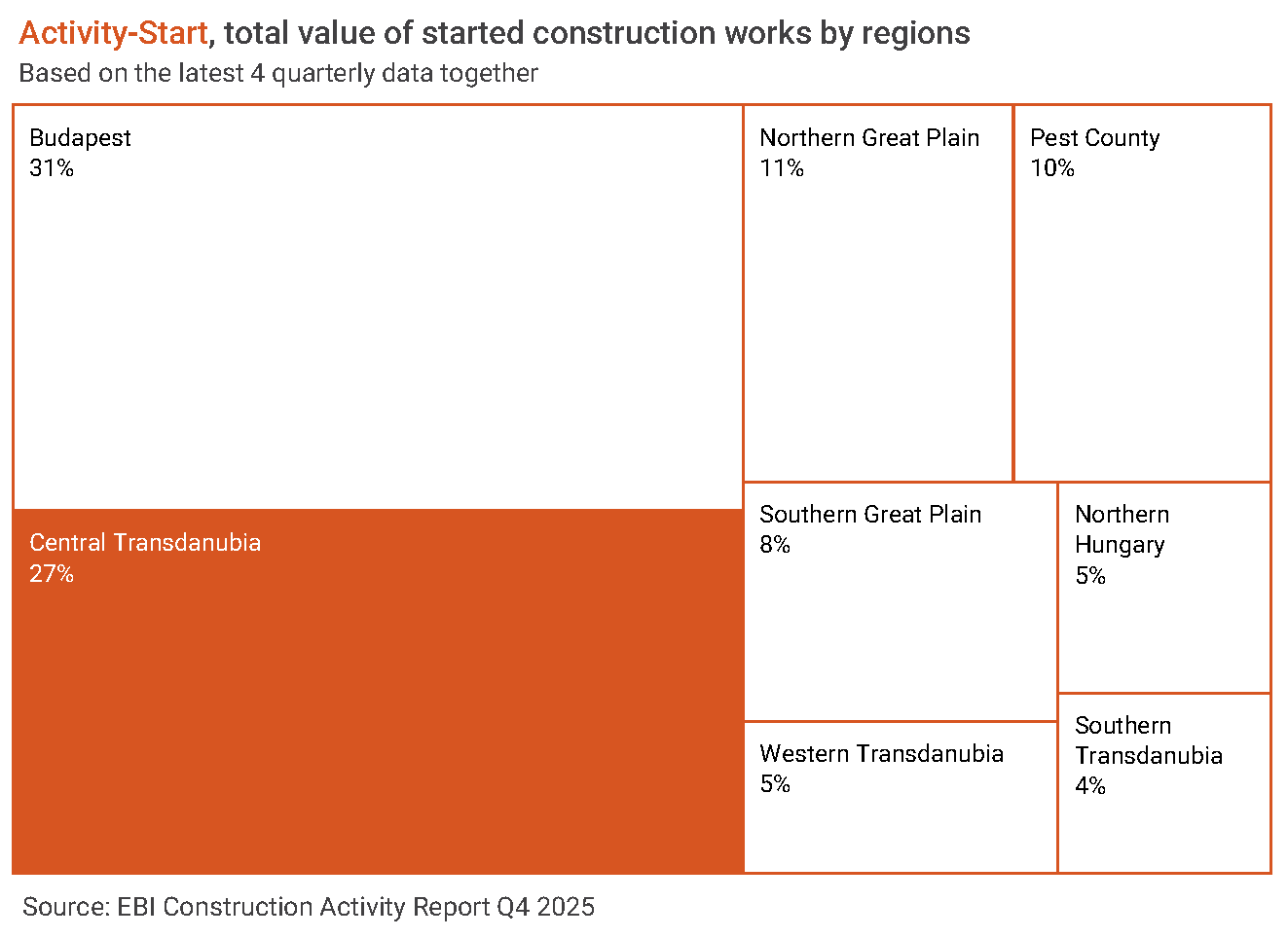
In the past four quarters, the highest value of construction projects in Hungary started in Budapest and its share in total Activity-Start was 28%. Central Transdanubia also had a large share of 23%. 39% of projects started in Western Hungary, 38% in Central Hungary, while Eastern Hungary’s share was 23%.

Still high multi-unit housing Activity-Start

Although Q3 2025 was the second consecutive year to see a significant drop in the value of started multi-unit housing construction works, Activity-Start stayed high, far exceeding the average of recent years. At current price, multi-unit housing construction works started at an over HUF 170 billion, the fourth highest value after the first two quarters of 2025 and the last quarter of 2024. Overall, the successful first 9 months of this year brought a huge jump in multi-unit housing Activity-Start at current price, but it was also outstanding at constant price, only surpassed by the same period in 2017 in the last 10 years.

Multi-unit housing construction is likely to remain strong. There was a high number of building permits issued in the first three quarters of this year, meaning plenty of projects to get started. In Q3 2025 permitting was boosted by the preferential loan program dubbed Otthon Start available since September which could continue to have a positive impact on the number of homes under construction.

In Q3 this year, multi-unit homes worth around HUF 80 billion were completed at current price, while in the first 9 months, multi-unit housing Activity-Completion was well over HUF 200 billion, only slightly lower than in the same period in 2023-2024.

Looking at the past 4 quarters, Budapest continued to have a major share in multi-unit constructions entering construction (73%). Central Hungary had a 76%, while Western Hungary and Eastern Hungary had a share of 12% each.

Still weak Activity-Start in industrial buildings and warehouses

Industrial buildings and warehouses thrived between 2022 and 2024 when construction works worth between HUF 700 billion and 1,000 billion started annually. For example, construction started on several BMW plants around Debrecen, on Mercedes-Benz projects in Kecskemét, and on several battery factories. This year has seen a decline so far and the value of projects started during three months in Q2-Q3 2025 has been the lowest since 2021. Overall, in the first 9 months of 2025, Activity-Start in industrial buildings and warehouses was around HUF 400 billion, 37% lower than in the same period of 2024, and 29%-39% lower than the 2022-2023 values. Trends are similar at constant price: the period of 2021-2023 was exceptionally good for industrial buildings and warehouses, while there was a strong decline in 2025. In the last 10 years, Activity-Start at constant price in the first 9 months has not been so low as now.

The biggest projects started between January and September 2025 were CTP’s logistics halls in Biatorbágy and Vecsés, HelloParks’ logistics hall in Fót and BYD’s projects in Szeged and Komárom. Construction of Phase 1 of Halms automotive parts manufacturing plant in Miskolc and Panattoni Logistics Park Building A in Mosonmagyaróvár also started.

Activity-Completion was relatively high in all three quarters of 2025 as several projects that started in 2022-2024 reached completion. The value of projects completed since the beginning of 2025 neared HUF 700 billion. For example, this year saw the completion of CATL warehouse and metalworking plant in Debrecen and its surroundings, two BMW factories, and the hangar complex of the Helicopter Base in Szolnok. And Activity-Completion may also remain high in the last quarter of this year.

Original article: Tünde Tancsics (ELTINGA); English version: Eszter Falucskai (Buildecon)
EBI Hungary – megkezdett kivitelezési munkák – 2025. november 13-i állapot

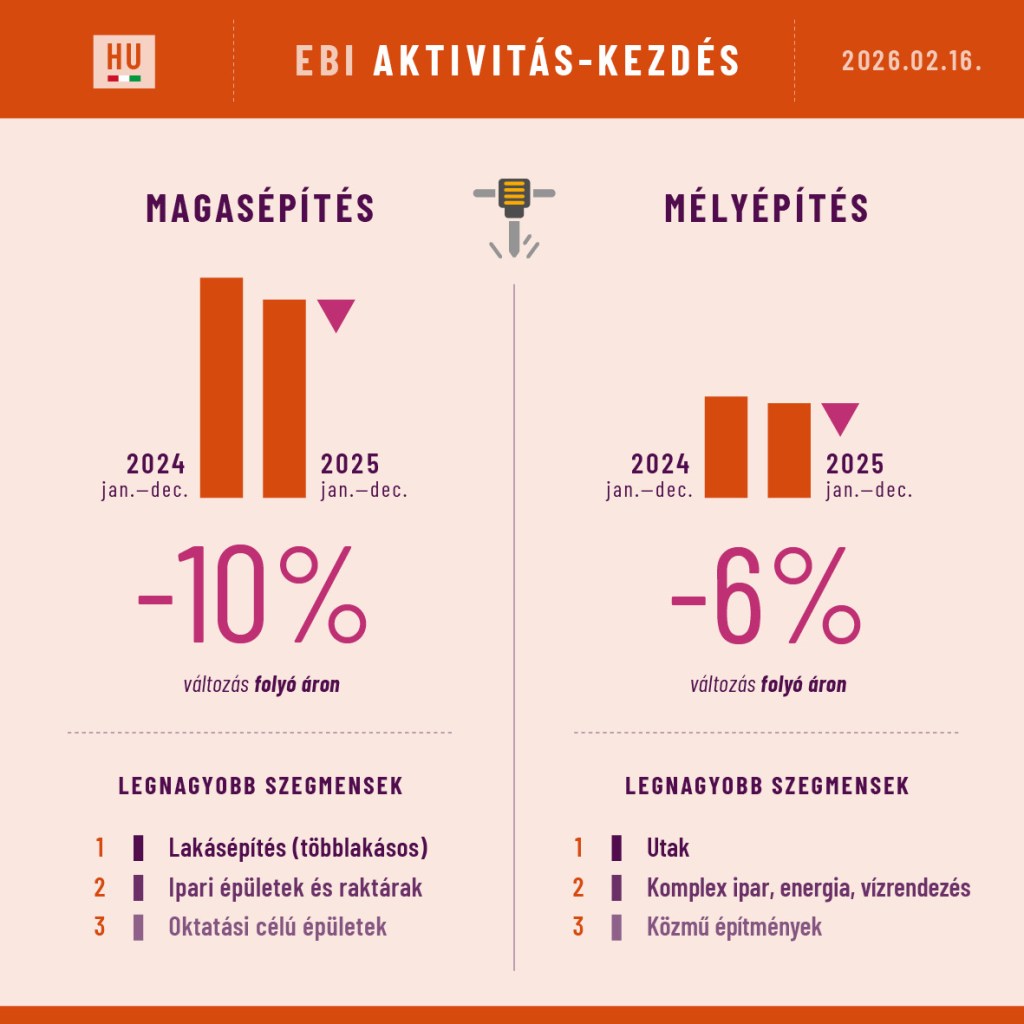
Egyértelműen lelassult az Aktivitás-Kezdés bővülése a társasházi lakáspiacon. A harmadik negyedév már messze nem volt olyan kiemelkedő, mint a korábbiak. Az építés előtti projektek viszont nagyon mozognak az adatbázisban, így a lassulás inkább átmenetinek tűnik most. A nem-lakás magasépítés részpiacon a projektkezdések még mindig nagyon gyengén alakulnak. A mélyépítés Aktivitás-Kezdése leginkább az M1-es bővítésének megkezdése miatt néz ki sokkal jobban, mint tavaly.

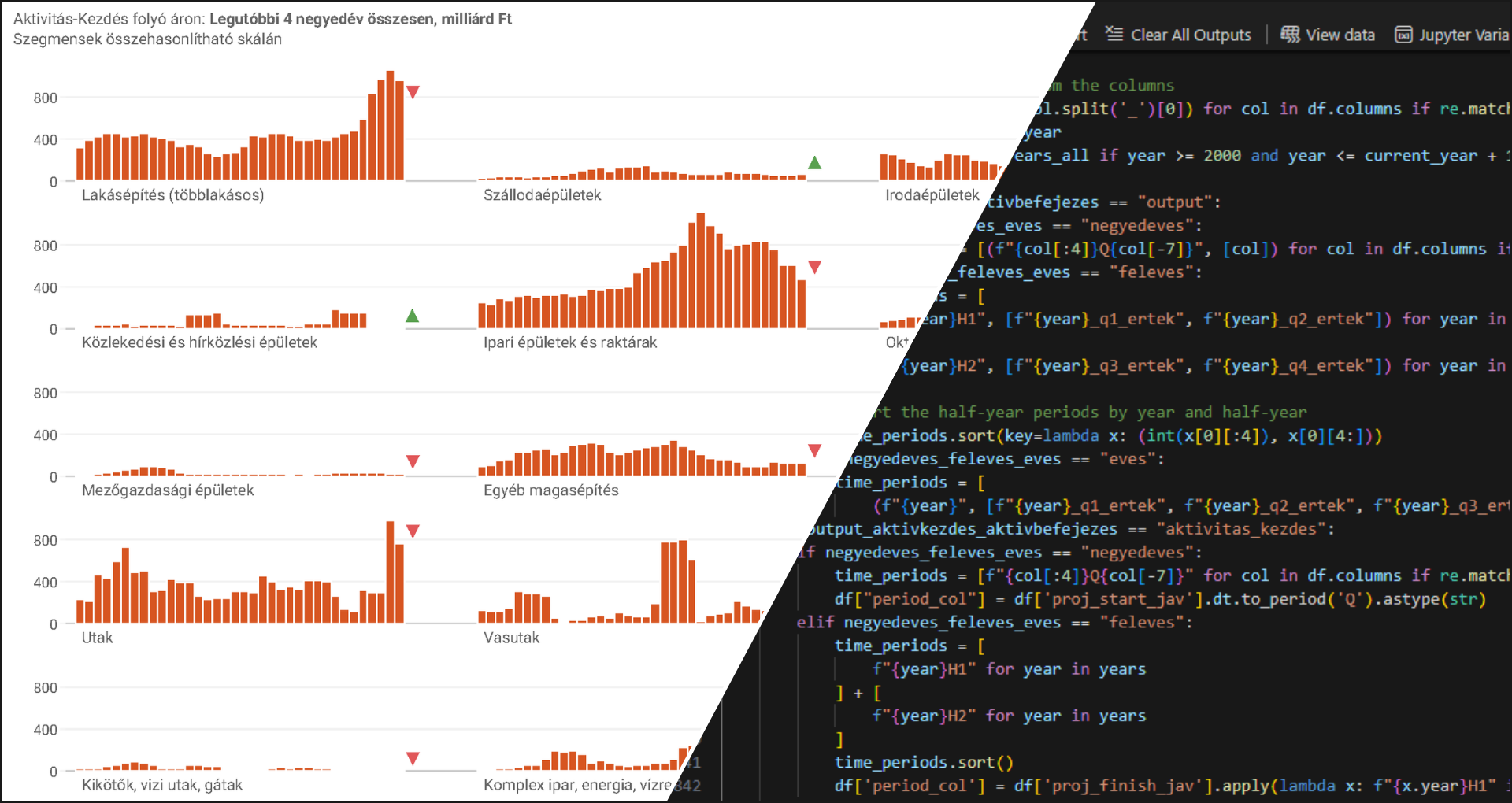
A poszter a két nagy építési részpiac Aktivitás-Kezdés indikátorának időszak/időszak változását mutatja, valamint a szegmenseket amelyekben a legnagyobb értékben indultak kivitelezések. Ezt a posztert minden hónapban kitesszük ide a blogunkra. A teljes építési piacot részletesen bemutató EBI Építésaktivitási Adatvizualizációt (összesen 18 szegmens adataival) is havonta frissítjük, és negyedévente az EBI Építésaktivitási Jelentésben is elmondjuk, hogy mit látunk a piacon. Ha érdeklik a részletek akkor a contact oldalon írjon nekünk.

The expansion of Activity-Start in multi-unit housing construction has clearly slowed down. The third quarter was nowhere near as outstanding as the previous ones. However, many large projects with before construction status have moved closer to implementation, so the slowdown seems temporary now. In the non-residential submarket, project starts are still very weak. Activity-Start in civil engineering looks much better than last year, mainly due to the start of the M1 highway expansion.

The poster (above) shows the period/period changes of the Activity-Start indicator in the 2 main submarkets and the segments with the largest value of started works. This poster is published every month here in the blog. The EBI Construction Activity Data visualization with the details on the whole construction market (with altogether 18 segments) is also updated monthly and the EBI Construction Activity Report, summarizing what’s happening in the market, is published in each quarter. If your interest in construction markets is deeper, please contact us for the details.

Rusty

With the latest governmental decision, the number of projects in designated rust belt action areas reached 68 in Hungary. Estimated 40 thousand dwellings1 are being built or will be built on these sites. The sole purpose of this post is to follow these projects and to see how they will or will not help the recovery of the new residential construction sub-market in Hungary.

Status on 1 October 2025.
The upswing has continued, but less intensively.

Completed: 3 102 dwellings
Under construction: 9 770 dwellings
Before construction: 19 490 dwellings

Brief background

Rust belt action areas (let me shorten them to rusty) are practically brownfield areas with special benefits. The owner of the site or the developer should initiate the process (with specific development plans) and there is a Committee to examine if the proposed site is entitled for the rusty status. Based on the opinion of the Committee, the final decision is made by the government. The decisions (about the exact sites) are announced in a decree and the special benefits coming with it are:

  • priority investment status, meaning e.g. faster permitting procedures2,
  • newly built homes can be sold at 5% VAT without limitation in time3,
  • this 5% can be reclaimed by the buyers4.

By the current regulations, it means a min. 5% and a max. 27% price advantage over competitors developing on non-rusty area until 2030 (depending on when the permit was obtained) and a 27% price advantage from 2031 on.

Our focus

What we do is to turn the mentioned decree into information we need for forecasting. With the help of Eltinga Building Permit Monitor database and the iBuild project information database, actual projects are identified from the lot numbers specified in the decree. Among all the general project specifics, the number of dwellings (where it is known), are attached to these projects.

The map shows the stages of the housing projects that were given rusty status. Bluish dots are those before construction, neon yellow dots are those under construction and the dot disappears once the project is completed.

OK, it is very convenient to see projects on a map, but our focus is more on the chart under the map where the yellow is the number of homes under construction.

What we are curious about is if and when the right end of the yellow curve shows a strong upturn.

In other words, we are curious whether the regulation ignites a recovery or not. As of now, it is more common that the yellow line has increased because projects having started in the past were given the rusty status. (So they were just re-qualified, it did not mean new project starts.) In parallel, it is less common that projects start after they were given the status. Just two extreme examples for these: Unipark Buda has been under construction since 2019 and it got the rusty status at the end of 2023, while Láng quarter was given the rusty status in 2021 and it is still before construction.

The charts will be updated quarterly, so check back if you are also curious.

Another way we like to look at it is a list. Here we do not separate the projects to phases (like on the map) and it gives a quick understanding on how each rusty project moves ahead from 1 February 2024 on.

Data sources

The data mostly come from Eltinga Building Permit Monitor (in Hungarian: Építési Engedély Figyelő). This is a very detailed database on before construction multi-unit housing projects in Budapest. It is aiming primarily at developers who would like to understand the competition. For further information on this, please turn to Mr Zoltán Sápi, Eltinga, sapiz@eltinga.hu. Besides, we used the iBuild project information database.


  1. This is an estimation based on the median size of those rusty projects where the number of homes were announced ↩︎
  2. 619/2021. (XI. 8.) Korm. rendelet
    a rozsdaövezeti akcióterületek kijelöléséről és egyes akcióterületeken megvalósuló beruházásokra irányadó sajátos követelményekről
    ↩︎
  3. 2021/8. Adózási kérdés – A rozsdaövezeti lakások értékesítésének adómértéke ↩︎
  4. Rozsdaövezeti adó-visszatérítési támogatás ↩︎

EECFA countries in the European Commission’s 2025 Macro Forecast

Written by Dóra Barát – ELTINGA, EECFA Research

This summer ELTINGA at EECFA Research has again looked at how the European Commission sees the EECFA countries. Here is what has changed in the prospects between Autumn 2024 and Spring 2025.

Compared to Autumn 2024, economic outlook has deteriorated in all countries covered, although the projected growth remains positive across the board. The most significant downward revisions have occurred in Romania, Bulgaria, and Hungary, while countries like Croatia, Slovenia, and Russia have seen more moderate adjustments. Growth expectations for both the EU and the Euro Area have also slightly declined, mirroring the broader cooling of optimism across the region.

Average GDP growth in 2025-2026 is projected to be positive in all examined countries, though to differing degrees. Serbia is expected to record the highest expansion at 3.5%, followed by Türkiye (3.15%) and Croatia (3.05%), while Russia (1.45%) is forecast to have the slowest growth in the region. Growth in Euroconstruct member Hungary is projected at 1.65%, falling between the regional average and the broader EU outlook. The remaining EECFA countries (Romania, Bulgaria, and Slovenia) are expected to grow between 1.8% and 2.2%. Despite downward revisions, all countries in the region are forecast to outperform the averages of the EU (1.3%) and the Euro Area (1.15%), continuing the trend of a stronger growth in Eastern and Southeast Europe.

The projected growth rate of gross fixed capital formation (GFCF) for 2025-2026 has weakened in nearly all countries since the Autumn 2024 forecast. Romania has witnessed a major downward revision with the expected growth dropping by just over 4 percentage points, while Hungary has also registered a significant cut of around 2.4 percentage points. Türkiye, Slovenia, and Bulgaria have experienced more moderate declines. In Croatia, the outlook remained unchanged at 3.75%, and Russia was the only country with a slight upward revision. Despite the general slowdown, Serbia is projected to post the strongest GFCF growth at 6.7%, followed by Croatia (3.75%) and Romania (2.95%), while most other countries are set to grow between 1.25% and 2.75%. The EU (1.95%) and Euro Area (1.75%) are to remain at the lower end of the spectrum.

Expectations for the growth rate of gross fixed capital formation into construction have also been revised downward in all countries where data is available. Romania has seen the steepest decline with its projected growth falling from 8.45% to 3.9%, though it still holds the highest rate among the observed countries. Hungary and Slovenia have experienced similar reductions, both dropping by more than 2.5 percentage points. Smaller adjustments have been recorded in Bulgaria and Croatia where the outlook for GFCF into construction growth remains relatively strong at 2.85% and 3.8%, respectively. In the broader European context, the EU and the Euro Area are projected to see only a respective modest growth of 1.9% and 1.6%, slightly below most national forecasts in the region.

The Commission’s view on construction investment is somewhat different from ours. Partly it is because we examine the sector from the bottom. For each segment we come up with an individual story and this is how the total construction market is formed. Our latest forecast is in the 2025 Summer EECFA Construction Forecast Reports. Sample report and order

We, in EECFA, are also less optimistic about the near future than half a year ago. The direction of the revision is mostly downward. In cases of Bulgaria, Croatia and Hungary we project moderate growth which is pretty close to the Commission’s expectations. In four countries, however, we do not think average real growth until 2026 could be positive.

Q1 2025 sees weak Activity-Start in Hungarian construction

2025 started off weak in Hungarian construction despite the much higher Activity-Start at the end of 2024 fuelled by launched major projects then. In Q1 2025 the value of started construction works greatly dropped compared to both the previous quarter and the same period of the previous year. The Activity-Start of EBI Construction Activity Report at current price was around HUF 570 billion in Q1 2025; the second lowest quarterly value since July 2020. At constant price, and if adjusted with price changes, it has been the second worst three-month Activity-Start since 2015.

Value of started building construction works fuelled by multi-unit residential projects

Building construction has slightly improved compared to the previous two weaker quarters: the value of started works was well over HUF 500 billion, 18% up from Q4 2024. The improvement, which was also evident at constant price compared to H2 2024, was attributable to the surge in multi-unit residential works. At the same time, Non-Residential Activity-Start continued to see the low levels of the last two quarters of 2024. In the first three months of this year, non-residential construction works of slightly more than HUF 240 billion started, the lowest quarterly figure since 2017. At constant price, no building construction works have started in such a low quarterly value in the past 10 years.

Among biggest building projects launched in Q1 2025 were mainly logistics buildings: CTP logistics halls in Vecsés (Phase 2) and Biatorbágy, and HelloParks logistics hall in Fót. Construction also began on Phase 2 of Building A of H2Offices in Budapest, and the Hungerit poultry processing plant in Szentes.

Critically low value of started civil engineering projects

Civil Engineering Activity-Start was extremely low in Q1 2025 with started construction works worth only HUF 31 billion. This has by no means been the lowest value recorded in the subsector since 2014, both at current and constant prices. Activity-Start in road and railways and in non-road and non-railways amounted to around HUF 16 billion, respectively. Sadly, not a single civil engineering project made it into the largest projects entering construction phase in the quarter.

Regional comparison: Budapest on the lead

According to EBI Construction Activity Report, Budapest had the highest value of construction projects started in Hungary in the last four quarters. And although its share in total Activity-Start slightly dropped, it still stood at 32%, exceeding the 20%-30% typical in the period between 2021 and 2023.

In Northern Great Plain, the region that previously was on the lead, 14% of projects started in Q1 2025. The share of Southern Transdanubia was 16%, while that of Southern Great Plain 11%. Western Transdanubia and Northern Hungary registered the lowest value at 5%, respectively. In Central Transdanubia, 7% of projects started, whereas in the Pest region, 10%.

Multi-unit residential projects shooting up

The latest EBI Construction Activity Report Hungary has found that 2025 started off greatly in the multi-unit residential segment as in the first three months the value of construction starts was almost HUF 300 billion at current price. It has been a record since 2014 and exceeds the previous quarter’s highest value (HUF 209 billion). Even at constant price, the growth in Activity-Start is a 39% rise over the previous quarter.

This increased activity comes as no surprise: the last quarter of last year already witnessed recovery with developers responding to growing demand and preparing for increased interest at the beginning of this year.

The market has confirmed these expectations, and as per ELTINGA’s Housing Market Report, the latest two quarters saw a record in Budapest in the number of sold new multi-unit dwellings. Although a major part of demand came from investors, the question is how long this can last. Developers might become more cautious with project starts towards the end of the year as demand might decrease following interest payments and maturing government bonds.

When it comes to completions, the value of completed multi-unit residential projects in Q1 2025 was around HUF 76 billion, a drop compared to both the previous quarter and the same period last year. At constant price, Activity-Completion in Q1 2025 has been the third worst value since 2019.

Regionally, looking at the past four quarters, Budapest accounted for 70% of multi-unit projects entering construction, while Central Hungary recorded slightly more than 72% of the value of such projects. Eastern Hungary had a 13%, while Western Hungary had a 16% share in Activity-Start.

Better Q1 2025 in industrial buildings and warehouses than in the construction industry as a whole

In Q1 2025 the total value of construction starts of industrial buildings and warehouseswithover HUF 150 billion was slightly higher than in the previous two quarters. True, if we look at the period between 2022 and H1 2024, it was the second lowest value. Last year, in addition to automotive industry projects, several food industry projects started such as Pick’s plant in Szeged, Master Good-Sága plant in Sárvár, or Félegyházi Bakery plant and warehouse in Kiskunfélegyháza.

In the first quarter of this year, as previously mentioned, the largest projects entering construction phase included several logistics projects such as CTP’s logistics halls in Biatorbágy and Vecsés, and HelloParks’ project in Fót. Besides, the construction of several plants began: Unilever’s deodorant factory in Nyírbátor, Phase 2 of Scheider Electric’s Duna Smart Power Systems smart factory in Dunavecse, or Kométa’s packaging plant in Kaposvár.

As for completions in the segment, industrial buildings and warehouses were completed at a value of HUF 250 billion in the first quarter of this year – the third highest value since 2014. Biggest completed industrial projects include CATL warehouse and metalworking plant in Debrecen and HelloParks AN1 logistics hall in Alsónémedi. And we expect to see further major completions this year.

Original article: Tünde Tancsics (ELTINGA); English version: Eszter Falucskai (Buildecon)
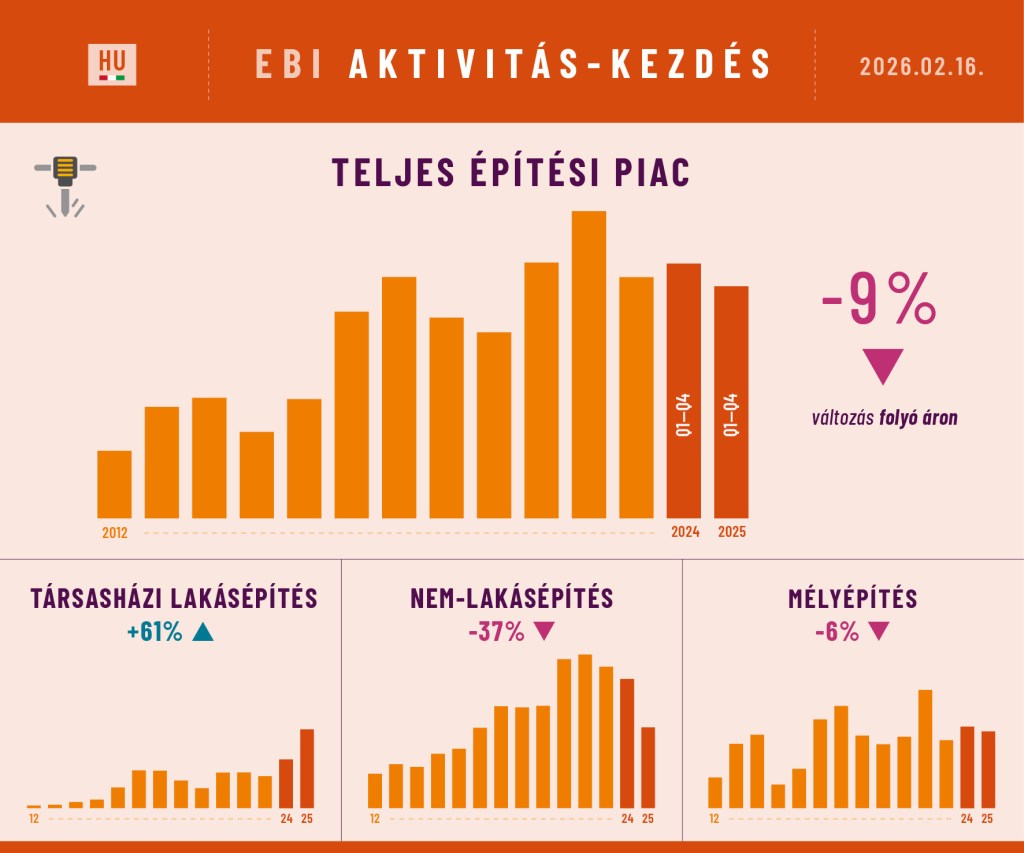
Last quarter of 2024 registers great rise in started constructions in Hungary

The Activity-Start of the latest EBI Construction Activity Report surpassed HUF 830 billion, a value considered to be exceptionally high. It should be added though, that these outstanding numbers were mostly thanks to the start of the construction works of the Mohács Danube Bridge project.

Despite the weaker Q2 and Q3, thanks to the good Q4, in the whole 2024 started construction works totalled about HUF 2800 billion, almost the same level as in 2023. Yet, it was a significant lag compared to the 2021-2022 figures, and at constant price it was still the lowest Activity-Start of recent years. Last time we saw a lower value of construction start than the 2024 level was in 2016.

Multi-unit residential projects boosting building construction

Building construction projects worth a total of around HUF 500 billion were launched between October and December last year. For the whole of 2024, the value of building projects entering construction phase was nearly HUF 2000 billion. Yet, last year’s Activity-Start fell short of the yearly figures for 2021-2023; the difference compared to 2023 was 5.9%, while compared to 2022 and 2021 it was 15% and 13%, respectively. At constant price, the last time a value lower than in 2024 was recorded was in 2015.

The reason for the better Building Construction Activity-Start in Q4 was clearly the multi-unit residential segment that posted a record growth over previous quarters. Activity-Start in the non-residential segment was low in Q4, though, almost the same as in Q3 (just over HUF 200 billion), still a very modest level compared to the quarterly figures of previous years. At constant price, Non-residential Activity-Start has not been as low in the past 11 years as in Q4 2024. Looking at the whole of 2024, construction works started here on slightly more than HUF 1,300 billion at current price, the lowest value since 2021. At constant price, the last time Non-residential Activity-Start was lower than last year was in 2014.

The biggest building construction projects that started in Q1 2024 included many multi-unit residential ones such as several phases of Kincsem by Bayer, the next phases of Park West and City Pearl. Also, the highest-value projects comprised the start of construction of several industrial and logistics buildings (Waberer’s logistics centre in Ecser, Phoenix Pharma logistics warehouse and office in Győr, the production facility of Félegyházi Bakery in Kiskunfélegyháza, Fémalk’s industrial plant in Dunavarsány and Phase 4 of Hankook tire factory in Rácalmás).

Civil engineering posted a good last quarter last year

In Q4 2024 civil engineering works worth more than HUF 330 billion started, approaching the exceptionally high value registered in Q1. Thus, overall, the level of Civil Engineering Activity-Start of EBI Construction Activity Report in 2024 exceeded HUF 800 billion, more than the 2023 figure and nearing the 2021 value. True, almost the entire Q4 Civil Engineering Activity-Start was due to the start of the Mohács Danube Bridge project.

Around half of the Activity-Start in Q4 2024 was related to road and railway projects with their level roughly being the same as in Q1. The situation was similar in case of non-road and non-railway construction works. The weak numbers in the middle of the year were followed by a larger number of construction starts in the last three months of the year. Yet, looking at the whole of 2024, projects worth less than HUF 400 billion entered construction in roads and railways, not even reaching the level recorded in 2023. At constant price, the last time Activity-Start was lower than last year was in 2015.

Most projects started in Central Hungary

Looking at the past 4 quarters, roughly half of the projects started in Central Hungary. Within, nearly 40% of the works started in Budapest. Eastern Hungary had a 23%, while Western Hungary had a 26% share in Activity-Start. Among the regions, thanks to the Mohács Danube Bridge project, the share of Southern Transdanubia spiked (14% after the previous 5%). The share of Northern Great Plain dropped; it was only 9% against the previous double-digit rates.

Multi-unit housing construction has picked up

In Q4 2024 multi-unit housing construction works practically exploded. The value of started works reached nearly HUF 300 billion, almost doubling the previous record of Activity-Start of EBI Construction Activity Report. Thanks to the outstanding last three months, 2024 was ultimately a record year with the value of started multi-unit construction works surpassing HUF 600 billion. It outnumbered the Activity-Start of 2023 by 66% and represented a growth of about 45% at current price over 2021 and 2022. At constant price, the value of multi-unit construction starts in 2024 was higher than in 2023 and 2022, roughly the same as in 2019 and 2021.

The acceleration in multi-unit housing constructions in Q4 2024 comes as no surprise. Developers may have responded to the pick-up in demand already noticeable last year, plus, they may have prepared for an even greater increase in demand this year – in line with market expectations. Subsidies in 2025 (maturing government bonds and interest payments, private pension fund savings that can only be used for housing purposes this year) may considerably spur the willingness to buy a home this year.

As for completions in the multi-unit segment, construction works of about HUF 400 billion were completed in 2024, exceeding the Activity-Completion indicator of EBI Construction Activity Report of the previous three years. Last year’s multi-unit residential completions were the second highest value registered after 2020.

Regionally, most multi-unit residential projects still started in Budapest, accounting for more than 70% of the value of construction starts in 2024, compared to the previous figure of under 60%. However, Eastern and Western Hungary posted a major decrease and had shares of 10% and 18%, respectively.

Weak H2 2024 in the value of started office construction projects

Activity-Start in office constructions fell sharply between July and December last year with works worth less than HUF 20 billion. Although H1 2024 managed to reach the figures of H1 2022 and H1 2023, overall, there was a large drop in 2024. The value of Activity-Start of EBI Construction Activity Report did not reach HUF 130 billion in 2024. This was a 24% decline compared to 2022, while a 68% and 66% lag behind the outstandingly successful years of 2023 and 2021. After 2015, even at current price, only in 2020 did office projects start in a lower value than last year. At constant price, the office market had not registered such a low Activity-Start as in 2024 in the past 11 years.

The start of MBH Bankholding HQ and the central office next to Rossmann warehouse was the two office construction projects with the biggest value last year. The decline in market-based office projects has not started now. Rather, in recent years, state orders have been able to enable growth in the segment. For instance, the fact that the overhaul of the former Ministry of Finance building in the Buda Castle, the historic reconstruction of the Hungarian National Bank HQ and Phases 1-3 of the reconstruction of the former Palace of Archduke Joseph all started at the same time in 2021 boosted Activity-Start that year. Or, in 2023, the start of renovation works on the Ministry of Agriculture building and on the Palace of Justice building, as well as the start of construction of the BudaPart and Zugló City Centre offices all contributed to high Activity-Start that year. A large part of these will also house state agencies and companies.

When it comes to office completions in 2024, the Activity-Completion indicator was nearing HUF 300 billion, the highest value ever measured in the market. For example, the Hungarian National Bank HQ and the reconstruction of the Ministry of Finance building both reached completion. 2025 may be another record-breaking year in terms of office completions as several office buildings in BudaPart and Zugló City Centre may also be completed.

Original article: Tünde Tancsics (ELTINGA); English version: Eszter Falucskai (Buildecon)
Value of started projects in Hungary between January and September 2024 almost 17% down y-o-y

According to the Q3 2024 EBI Construction Activity Report Hungary, after Q2 brought a decline in the value of started construction projects, in Q3 a further decrease followed. Since 2016, the Activity-Start of less than HUF 360bln between July and September has been a new negative record, even at current price. These weak numbers were not even offset by the better Q1 and Activity-Start accounted for slightly more than HUF 1800bln. The value of projects entering construction between January and September 2024 was nearly 17% lower than in the same period of 2023.

Photo by Hajnalka Hurta

Shrinking Building Construction Activity-Start

Q3 saw a continued decline in Building Construction Activity-Start with only HUF 310bln worth of started works. Except for the pandemic year of 2020, only 2017 and earlier years saw lower quarterly numbers. Looking at the first 9 months of this year, the value of started construction works was slightly less than HUF 1360bln, 15%-22% lower than in the same period of 2021-2023. At constant price, the drop was even more considerable: since 2014 there has not been a lower Activity-Start in the first three quarters than this year.

Multi-unit housing constructions posted a slight decrease in Activity-Start in Q3, but non-residential projects registered a larger drop with only HUF 200bln worth of projects entering construction phase between July and September. In the first 9 months, the Activity-Start of non-residential constructions was around HUF 1000bln, 21%-27% lower at current price than in the same period of 2021-2023. At constant price, the last time the number for the first three quarters was lower than this year’s was in 2014.

The largest construction projects launched between July and September 2024 included Lidl’s logistics center in Kiskunfélegyháza, HelloParks Páty PT5 logistics hall, Pick’s production plant in Szeged, Intretech’s plant in Kapuvár, Rheinmetall’s hydrogen and e-mobility parts production plant in Szeged and IGPark’s logistics hall in Debrecen. The construction of the hotel in Kígyó street in Budapest also started. Out of the 10 biggest projects in the quarter, 5 were multi-unit residential buildings or dormitories.

Civil engineering Activity-Start hits rock bottom

There was a further decline in civil engineering after Q2, Activity-Start in Q3 was only less than HUF 50bln – a new negative record of the last 8 years. But in terms of Activity-Start in the first 9 months, the 2024 result is not much better either. The value of construction works started in the first three quarters at current price has not been lower than this year since 2016, while at constant price it was the negative peak of the last 10 years.

Compared to the same period in 2021 and 2023, Activity-Start between January and September this year was 22%-24% lower, while it was only a little more than a third of the exceptionally high 2022.

Within civil engineering, only a negligible railway construction project started in Q3, and the value of road construction projects was also very low. In the first three quarters, road and railway construction accounted for roughly 45% in Activity-Start, their value slightly exceeding HUF 200bln.

Due to the rather low civil engineering activity, hardly any civil engineering project could get into the list of biggest projects. Only the wastewater projects in Dejtár agglomeration and the Rétság agglomeration are worth mentioning.

Budapest leads still

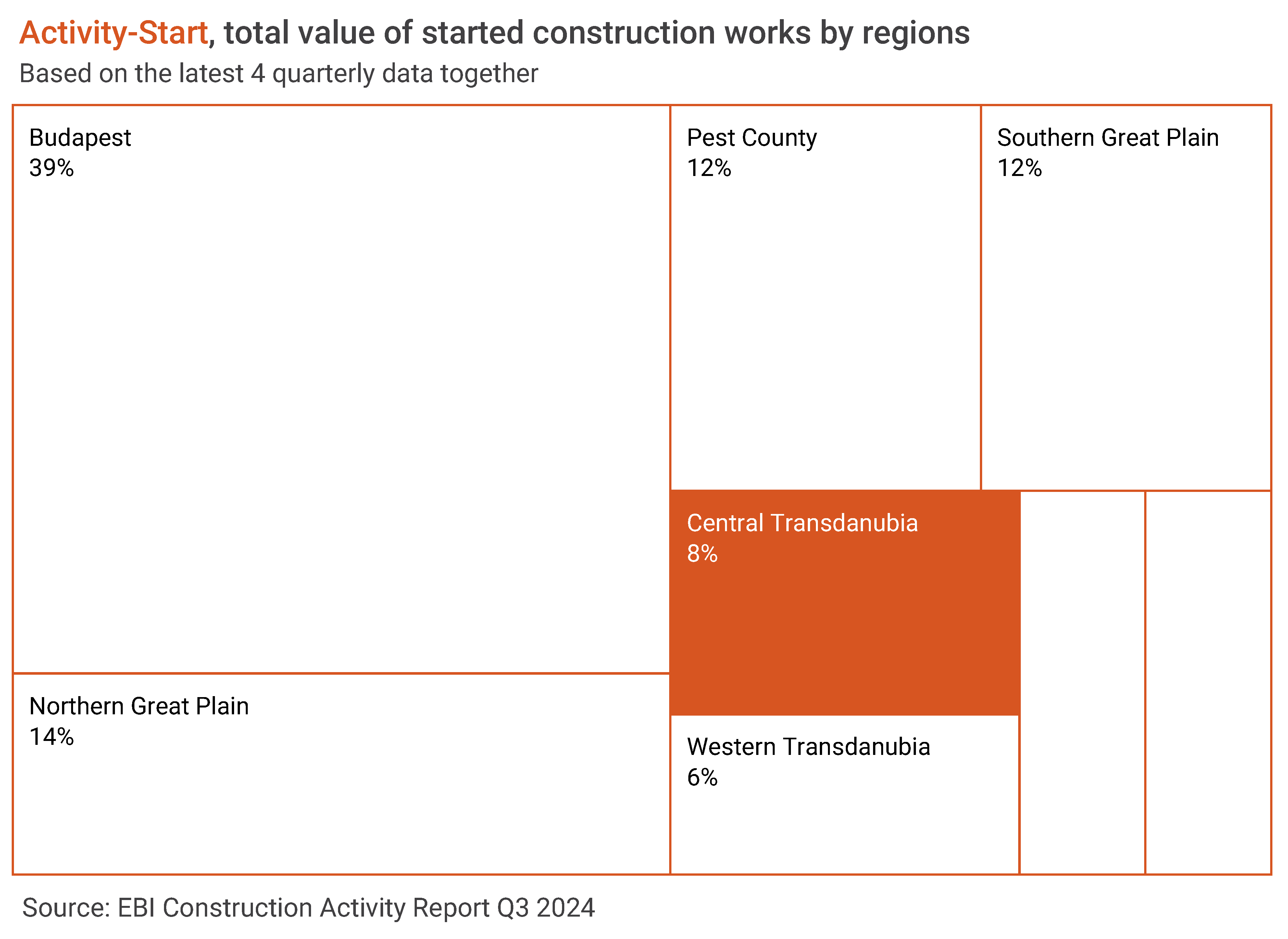
Looking at the last 4 quarters, 39% of all started construction works were in Budapest. The second largest Activity-Start was characterized by the Northern Great Plain (14%), followed by the Southern Great Plain and Pest County (12%). Northern Hungary and Southern Transdanubia recorded the lowest value of started construction works with their respective share of around 5%.

Multi-unit construction works are keeping up

Even though somewhat fewer multi-unit housing constructions started in Q3 than in Q2, Activity-Start significantly exceeded Q1. Construction works started in the segment on slightly more than HUF 100bln. Looking at the first 9 months of the year, there was an overall higher Activity-Start at current price than in the same period of 2019-2023. The value of projects entering construction was roughly the same as in the same period of 2022. At constant price, the Activity-Start for the first 9 months of this year outstripped the first three quarters of 2023; yet it was the second lowest since 2016.

This suggests that developers are still cautious with project starts even though this year’s demand for new homes increased compared to last year’s. Based on housing market trends, supply is expected to grow. A strengthening demand and rising prices may encourage more investors to start projects, and thus Activity-Start in multi-unit construction works may also increase in the future.

In Q3 the value of completed multi-unit housing buildings continued to drop, barely surpassing HUF 60bln. At the same time, in the first 9 months, approximately HUF 265bln worth of such buildings were completed, a slight rise over the same period last year. For the time being, a larger volume of homes is expected to reach completion in the last quarter, however, due to project delays, some may only be completed next year.

The biggest share of multi-unit residential constructions still started in Budapest. Based on the data of the last 4 quarters, the share of the capital city was around 60%. Eastern Hungary accounted for 14% of the Activity-Start, while Western Hungary for 24.5%, up from the previous quarters.

Central Transdanubia

Activity-Start in Central Transdanubia was roughly HUF 40bln in all three quarters this year. Thus, in the first 9 months, construction projects started at a total of HUF 123bln, a major drop compared to the same period of previous years. In the first 3 quarters of 2023, Activity-Start in the region was almost HUF 200bln, while in the first 3 quarters of 2022, it reached around HUF 300bln.

After the weaker Q1, Activity-Start for building constructions in Central Transdanubia in Q2-Q3 was roughly at last year’s levels. Thus, overall, the value of projects entering construction was around HUF 100bln in the first 9 months of this year, lower than in the corresponding period in 2023, and particularly lower than in the same period of 2021-2022.

The outstanding building construction Activity of 2021-2022 was boosted by the start of several big-league projects in 2021 (SK On’s battery factory in Iváncsa, Alba Aréna multifunctional hall in Székesfehérvár) and in 2022 (Kovács Katalin National Kayak-Canoe Sports Academy, the renovation of the church buildings in the castle quarter of Veszprém).

Projects entering construction phase between January and September 2024 in the region included the Huayou Cobalt-Bamo cathode factory in Ács and Phase 3 of Campus Lane Condo in Székesfehérvár.

In the first 9 months of 2024, hardly any civil engineering projects started in Central Transdanubia and the value of started works only reached a bit more than HUF 20bln. Among major civil engineering projects this year only Phase 1 of the dam between Mária-Valéria Bridge and Prímás island ramp can be mentioned. Last year bigger-value civil engineering projects started in the region in Q3 and Q4, for example, several water utility or wastewater projects, and the Biatorbágy-Szárliget railway line.

Original article: Tünde Tancsics (ELTINGA); English version: Eszter Falucskai (Buildecon)

Q2 registers historically low quarterly Activity-Start in Hungarian construction, but H1 is not so bad

As per the latest EBI Construction Activity Report Hungary, in the second quarter this year started construction works barely exceeded HUF 400 billion – the lowest quarterly Activity-Start even at current prices since 2016. But due to the exceptional Q1 value, H1 2024 overall did not show a massive decline (only -11%) over H1 2023. Compared to 2021, however, the drop was 18%, and against the exceptionally good H1 2022, the decline was a whopping 45%. And at constant prices, Activity-Start was the negative record of the past 9 years.

EBI Construction Activity Report Hungary analyses the construction industry on a quarterly basis, including the volume of newly started construction works and the value of projects completed in each quarter in aggregate and by segment as well. It is prepared by Eltinga, Buildecon (creation of indicators and development of algorithms for aggregation) and iBuild (project research and project database). For more details on how to obtain the full report, please contact us.

Lowest quarterly value of started building construction works since 2020

As per EBI Construction Activity Report Hungary, Q1 2024 saw a high Activity-Start but was followed by Q2 that recorded a decline in buildings as well. The value of started building construction works did not reach HUF 360 billion – the lowest quarterly figure since 2020. Overall, the subsector was characterized by a weaker Activity-Start even in the first half of the year: compared to H1 2023, the value of started construction works dropped by 11.8%, while over the same period of 2022 and 2021, at current prices, the decline was almost 30% and 21.5%, respectively. At constant prices, only H1 2014 was weaker than H1 2024.

Most of the decline occurred owing to the more moderate non-residential project starts. The decrease in multi-unit residential buildings was much smaller and the value of started construction works was roughly at the level of Q1. In non-residential buildings, Activity-Start was slightly higher than HUF 260 billion between April and June this year (a drop of almost 43% over Q1) but was also much lower than in the same period of the previous 3 years. Looking at individual quarters between 2021 and 2023, this year’s Q2 was the second lowest at current prices, and at constant prices, it was the lowest value since 2013. Due to the weaker Q2, Activity-Start in H1 2024 was also lower than in the same period of the previous 3 years at current prices. At constant prices, it was only H1 2014 that saw a lower value.

Biggest-league building construction projects launched in Q2 this year comprised the construction of MBH Bank HQ in Budapest, Phase I of BYD electric car factory in Szeged, and Huayou Cobalt-Bamo cathode factory in Ács. The construction of Moxy Budapest Downtown (hotel) and that of several multi-unit residential buildings also began.

The value of civil engineering project starts hit rock bottom in Q2

The stellar numbers in Q1 were followed by a massive decline in Civil Engineering Activity-Start of EBI Construction Activity Report Hungary between April and June this year. Q2 brought minimal civil engineering project starts, and the value of started works did not reach HUF 70 billion – the lowest quarterly value since 2016. However, comparing the first half of the year with previous years, 2024 is not exceptionally bad. The value of Activity-Start was 10.5% and 9% less than in the same period of 2023 and 2021, and it even exceeded that of 2020. There was a major drop only compared to the outstanding figures between January and June 2022. Within civil engineering, in H1 2024 road and railway construction works accounted for around 45% of Activity-Start and their value did not go up to HUF 200 billion.

It is very telling about the rock-bottom level of Civil Engineering Activity-Start that in the period between April and June this year no civil engineering project could make it to the top 10 biggest started construction projects.

Most construction works continued to start in the capital city

Looking at the past 4 quarters, the largest share of construction works again started in Budapest. The capital city’s share in the nationwide Activity-Start even surpassed 40%. Northern Great Plain had the second largest share, but its 13% was a great drop compared to the 20%-30% of the previous quarters. Pest County came third with 12%, while the smallest share of projects started in Southern Transdanubia with only 5% of launched construction projects in the last 4 quarters.

Practically no change in the value of started multi-unit residential projects

The latest EBI Construction Activity Report Hungary has found that after Q1 2024, in Q2 the value of multi-unit residential construction works started during 3 months was almost unchanged with a total of slightly more than HUF 90 billion. In the first half of this year, Activity-Start in the segment was less than HUF 200 billion, roughly corresponding to the level of the same period in 2021. At constant prices, although in H1 2024 the Activity-Start of multi-unit residential construction exceeded the one in H1 2023, it fell short of the one registered in the January-June period of previous years. It was only in H1 2015 when it was lower. Nevertheless, compared to other construction segments, multi-unit performed much better in Q2: the 10 largest-scale projects entering construction phase included several multi-unit ones, even with just over 100 flats.

The value of completed multi-unit residential construction works shrank in Q2 against Q1, but it stayed high, outstripping HUF 200 billion in H1 2024, making it the strongest first half year recently. Activity-Completion in H1 2024 was almost 42% higher than in the same period of 2023 and even surpassed the record H1 2020 by more than 22%. Further on, Activity-Completion may continue to be high, and, based on expected completion dates, this year may break a new record.

During the last 4 quarters, the largest share of multi-unit residential construction works continued to start in Budapest whose share also grew compared to the previous quarter with two-thirds of Activity-Start. Eastern Hungary’s share was 15.5%, while in Western Hungary 16.6% of such works began.

Southern Great Plain saw some growth in half-yearly Activity-Start

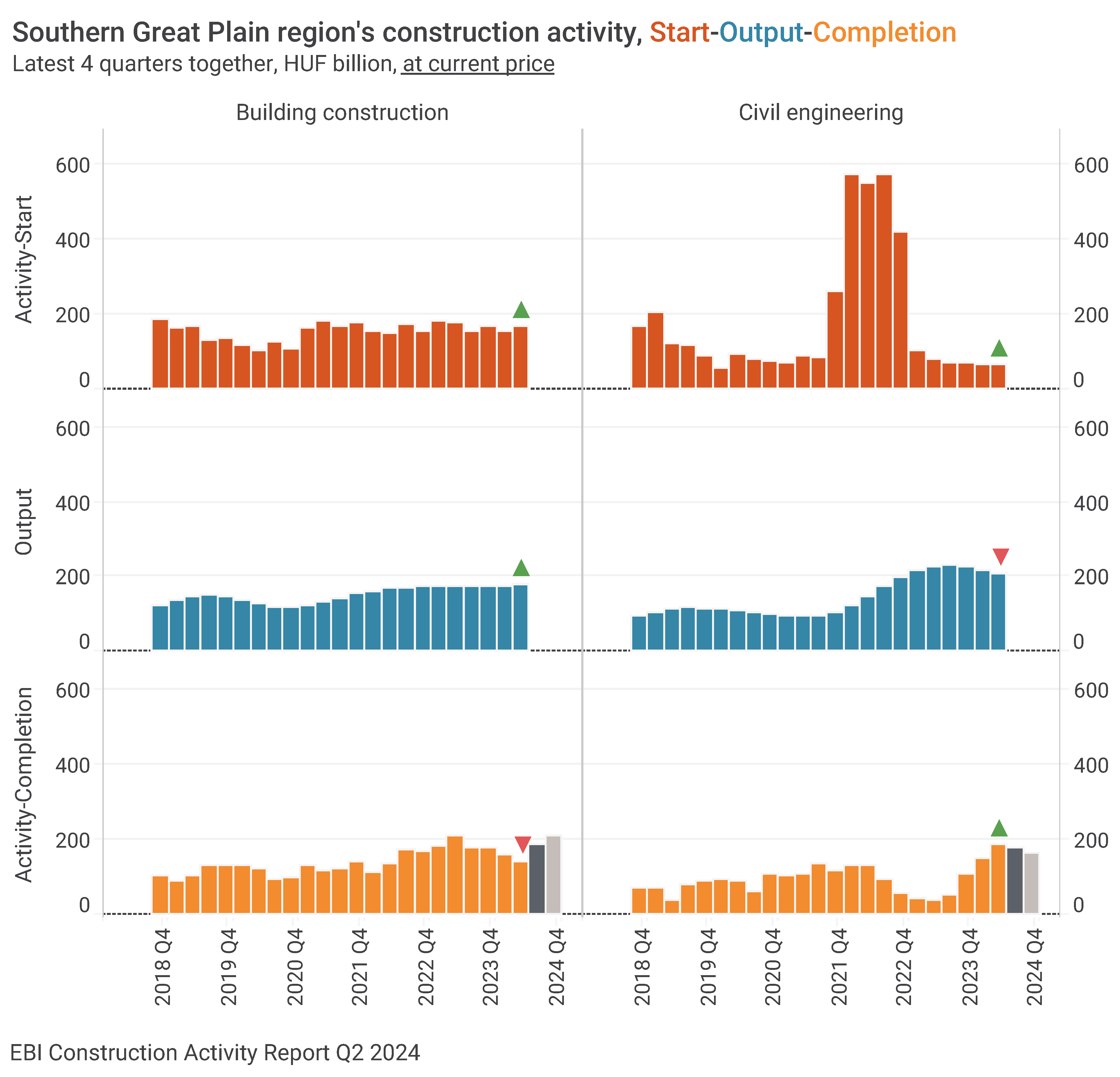
Southern Great Plain also saw some expansion in construction during the first half of this year, even though Q2 brought a decrease after Q1 – as per the latest EBI Construction Activity Report Hungary. Activity-Start here amounted to HUF 126 billion between January and June 2024. Building construction projects contributed most to the Activity-Start of this region: the value of started construction works in H1 2024 was HUF 110 billion – the level of H1 2023. But it was also true for regional building constructions that the higher Q1 values pushed up the half-yearly ones and Q2 brought a more moderate Activity-Start. Within buildings, multi-unit residential buildings represented a minimal level in the region, as in previous years, only 6% of such projects nationwide started here in the first half of the year.

Among the biggest non-residential projects entering construction phase in H1 2024 in the region were Benepack’s packaging materials factory in Makó, Mercedes-Benz battery assembly plant in Kecskemét, and Phase I of BYD electric car factory in Szeged. These projects were also considered large in terms of works started in recent years: in value, between 2021 and 2024 they ranked second, third and fifth, respectively.

Hardly any civil engineering project began in Southern Great Plain this year. Activity-Start in civil engineering in H1 2024 was less than HUF 16 billion – one of the lowest half-yearly results in recent years. Civil engineering works in the region reached an outstanding value in late 2021 and in early 2022 that saw the construction start of the Békéscsaba-Lőkösháza railway line, the Soroksár-Kelebia section of the Budapest-Belgrade railway line, and the Kecskemét-Szentkirály section of M44 expressway whose total value was hundreds of billions of Hungarian Forints and whose construction is still ongoing.

Article: Tünde Tancsics (ELTINGA); English version: Eszter Falucskai (Buildecon)

EECFA countries in the European Commission’s 2024 Macro Forecast

Written by Tünde Tancsics and Dóra Barát – ELTINGA-EECFA Research

Similarly to every summer, this summer too we have looked at how the European Commission sees our countries. Here is how GDP, investment and construction investment forecast have changed in the past half year.

Between Autumn 2023 and Spring 2024 economic outlook has improved for the majority of countries in the Eastern and Central Eastern European region (EECFA countries) for 2024-2025. Exceptions only included Türkiye, Romania and Hungary (this latter is covered by Euroconstruct), but the deterioration of the outlook was minimal. Expected GDP growth also decreased in case of the EU and the Eurozone.

Economic growth in the examined countries is expected to be between 2.3% and 3.9% by 2024-2025. The largest GDP expansion is related to Serbia, while Russia’s economy may grow least. At the same time, the expansion in the countries of the region is set to be much higher than in the EU and the Eurozone where projected GDP growth is only 1.1% and 1.3%, respectively.

Projected gross fixed capital formation (GFCF) growth rate for 2024-2025 sank in the majority of the countries by Spring 2024 from the previous level in Autumn 2023 with the only exceptions being Russia and Serbia. In Russia, a slight increase was seen from Autumn 2023 to Spring 2024. Prospects in Serbia significantly improved and next to Romania, its growth rate became the highest (6,45%) in the Eastern- and Central Eastern-European region (EECFA countries).

Expected GFCF (investment) growth is also high in Hungary, 4.9%, while for the other countries in the region, projected GFCF increase in 2024-2025 is between 3.05% and 3.6%. In the EU and the Eurozone, a much more modest expansion is estimated than in the region; GFCF prospects decreased from Autumn 2023 to Spring 2024, and they are only 1.15% and 0.85%.

Growth rate for investment into construction for 2024-2025 improved in Croatia, Hungary and Bulgaria, while in Romania, Slovenia, and in the EU and the Eurozone the outlook deteriorated from Autumn 2023 to Spring 2024. When it comes to the EU, growth is foreseen to be close to zero, whereas in the Eurozone a slight drop is projected for 2024-2025. The predicted growth for investment into construction in Spring 2024 was the highest in Romania (8.05%), followed by Hungary, Bulgaria, Slovenia (between 4.1% and 4.4%) and Croatia (2.45%).

This above represents the Commission’s view and it is different from ours at some point. It might be because our focus is exclusively on construction. For each segment we come up with an individual story and this is how the total construction market is formed. The latest predictions are in the 2024 Summer EECFA Construction Forecast Reports. Sample report and order: eecfa.com

As we see, Türkiye and Croatia could be top performers, while Russia and Romania are forecast to shrink. Although the Ukrainian growth rate is impressive it is because the market is coming back from a very low level.

Hungarian construction industry kicked off well in 2024

The value of construction works launched in three months rose in Q1 2024, Activity-Start hasn’t been so high in the last six quarters. EBI Construction Activity Report Hungary Q1 2024 measured the total value of started construction works at HUF 807bln. Looking at the period between 2018 and 2023, there were very only five quarters when Activity-Start surpassed this number. At constant prices, Q1 2024 was also considered good when looking at the period since June 2022. Nevertheless, when compared to the period between 2018 and H1 2022, it fell into the lower range.

EBI Construction Activity Report Hungary analyses the construction industry on a quarterly basis, including the volume of newly started construction works and the value of projects completed in each quarter in aggregate and by segment as well. It is prepared by Eltinga, Buildecon (creation of indicators and development of algorithms for aggregation) and iBuild (project research and project database). For more details on how to obtain the full report, please contact us.

Building construction failed to improve in Q1 2024

Building construction could not regain senses in early 2024: Activity-Start was at the level of the last quarter of 2023. The value of started construction works was slightly more than HUF 400bln, almost the same as between October and December last year, but 17%-26% lower than in the first quarters of previous years. At constant prices there was a decline in the value of started building projects: last time Activity-Start was lower was in Q4 2015.

The Activity-Start indicator of non-residential buildings slightly grew in the first three months of 2024 compared to Q4 2023, thus exceeding HUF 350bln. Yet, examining individual quarters between 2021 and 2023, Q1 2024 was the second lowest. At constant price, the last time Activity-Start was lower than in Q1 2024 was in 2015. In case of housing construction, 2024 started better than 2023, but the value of started construction works continued to drop after Q4 2023.

Biggest building projects launched in the first three months this year mainly included logistics and industrial buildings, like the construction of Mercedes-Benz battery integrating plant (Kecskemét), Weerts Ebes logistics hall (Ebes), Benepack packaging materials factory (Makó), Phase I of Evoring electric car parts factory (Jászfényszaru), building C of VGP Park logistics center (Győr), and the storage hall and HQ of Rossmann (Üllő). Large office projects such as Zugló-Városközpont Office7 and several multi-unit residential projects also started, as well as the construction of Hilton Garden Inn Hotel (mixed-use) and the development of Hungaroring Paddock.

Civil engineering getting back to life

After several weak quarters, civil engineering seems to have improved and Activity-Start in Q1 2024 was nearly HUF 400bln, an increase of roughly 70% against Q1 2023. The improvement was visible in non-road and non-railway constructions and in road and railway ones alike. The former saw a 180% growth over the first quarter of last year, but Activity-Start was more than 50% higher than in the last quarter (which was also stronger). The value of non-road and non-railway projects at current price was last higher in Q1 2017 than in Q1 2024, but even at constant price, it has been the fourth highest Activity-Start since 2020.

In road and railway constructions, the recovery was mainly due to the Ferencváros-Kelenföld railway line 1 project, considered to be the highest-value work started in Q1 2024 in the entire construction sector. The Southern Industrial Park in Nyíregyháza and the flood protection facility in Esztergom were also among the biggest started civil engineering projects.

Budapest took the lead again

Looking at the construction works started in the last four quarters, the highest value ones were in Budapest whose share in total Activity-Start was 36% (the 20%-30% in the last quarters). Northern Great Plain, the leader in previous periods, slipped back to the second place (21% of works started here). Southern Transdanubia had the lowest Activity-Start (its share barely exceeded 5%), Western Transdanubia had a share of 5%, while Northern Hungary had 6%.

Multi-unit residential building still stumbling

Although this year started better than the last one in multi-unit residential construction, the value of such started projects dropped further and was lower than in the last two quarters of 2023. Starting from Q2 2016, the segment registered the fourth lowest Activity-Start in Q1 2024 at current price. Looking at constant price, the value of works started in early 2024 has been the third lowest since 2016.

Yet the market outlook improved compared to the previous year. Mortgage rates sank greatly by end 2023 and continued to do so in 2024, while the economic outlook also became better. The rosier environment has lured buyers back to the residential market with the revival already noticeable in the first quarter of this year, both in the secondary and primary markets. Good news: the reduced VAT rate for new homes has been extended, so instead of end 2024, building permits can be obtained by end 2026 and homes can be sold at 5% VAT until 2030.

Many multi-unit residential projects were completed in the first three months of this year with their value exceeding HUF 120bln, the highest quarterly Activity-Completion since 2021. Many units are expected to be completed this year, too, however, in the long run, the value of completions is set to decrease due to previously shrinking construction works.

Looking at the past four quarters, Budapest accounted for 63% of multi-unit residential projects entering construction phase, and slightly more than 64% of the value of such projects was concentrated in Central Hungary. Eastern Hungary accounted for 14.8% of the Activity-Start, while Western Transdanubia’s share was 20.9%.

Northern Hungary in focus

Although the year started well in the construction industry nationally, it is not true to Northern Hungary where the total value of started construction works did not reach HUF 22bln. It was the lowest quarterly amount in 2018-2023.

In Northern Hungary, both building construction and civil engineering shrank in the first quarter of this year. Building Construction Activity-Start was one of the lowest in the quarters of recent years with the drop clearly attributed to non-residential buildings. Although the value of the started multi-unit residential constructions grew at the beginning of 2024, the region still has a very low willingness to build such buildings (its share in the national multi-unit residential Activity-Start was less than 3% in the last 4 quarters). Low activity in multi-unit residential works is well illustrated by the fact that, despite the improvement, no project made it into the largest construction projects in the region in Q1 2024.

Among non-residential buildings, the biggest regional projects launched between January and March 2024 include Phase II of Horváth Rudolf logistics centre in Hatvan. In recent years the largest ones comprised the logistics hall of Robert Bosch Power Tool MC301 in Miskolc (starting in 2023), the manufacturing plant of GKN Automotive in Felsőzsolca (starting in 2022), Chervon manufacturing plant and the reconstruction of Diósgyőr Castle in Miskolc (starting in 2021).

In early 2024 Civil engineering Activity-Start in Northern Hungary continued to drop. Looking at the period of 2018-2023, the total value of construction works started in Q1 2024 was the third lowest: Activity-Start did not reach HUF 4bln. In Q1 civil engineering projects were not even among the largest started ones. The value of civil engineering projects started in the region was higher in Q2 2023, in Q2 2022 and in Q3 2021 when such projects entered construction phase as the Szentdomonkos-Borsodnádasd section of main road 25, the Sajószentpéter-Berente bypass 260, and the Gesztely-Szerencs section of main road 37. The peak so far in regional civil engineering Activity-Start was Q2 2019 when the construction of sections A, B and C of M30 expressway began.

Article: Tünde Tancsics (ELTINGA); English version: Eszter Falucskai (Buildecon)