Q1 2025 sees weak Activity-Start in Hungarian construction

2025 started off weak in Hungarian construction despite the much higher Activity-Start at the end of 2024 fuelled by launched major projects then. In Q1 2025 the value of started construction works greatly dropped compared to both the previous quarter and the same period of the previous year. The Activity-Start of EBI Construction Activity Report at current price was around HUF 570 billion in Q1 2025; the second lowest quarterly value since July 2020. At constant price, and if adjusted with price changes, it has been the second worst three-month Activity-Start since 2015.

Value of started building construction works fuelled by multi-unit residential projects

Building construction has slightly improved compared to the previous two weaker quarters: the value of started works was well over HUF 500 billion, 18% up from Q4 2024. The improvement, which was also evident at constant price compared to H2 2024, was attributable to the surge in multi-unit residential works. At the same time, Non-Residential Activity-Start continued to see the low levels of the last two quarters of 2024. In the first three months of this year, non-residential construction works of slightly more than HUF 240 billion started, the lowest quarterly figure since 2017. At constant price, no building construction works have started in such a low quarterly value in the past 10 years.

Among biggest building projects launched in Q1 2025 were mainly logistics buildings: CTP logistics halls in Vecsés (Phase 2) and Biatorbágy, and HelloParks logistics hall in Fót. Construction also began on Phase 2 of Building A of H2Offices in Budapest, and the Hungerit poultry processing plant in Szentes.

Critically low value of started civil engineering projects

Civil Engineering Activity-Start was extremely low in Q1 2025 with started construction works worth only HUF 31 billion. This has by no means been the lowest value recorded in the subsector since 2014, both at current and constant prices. Activity-Start in road and railways and in non-road and non-railways amounted to around HUF 16 billion, respectively. Sadly, not a single civil engineering project made it into the largest projects entering construction phase in the quarter.

Regional comparison: Budapest on the lead

According to EBI Construction Activity Report, Budapest had the highest value of construction projects started in Hungary in the last four quarters. And although its share in total Activity-Start slightly dropped, it still stood at 32%, exceeding the 20%-30% typical in the period between 2021 and 2023.

In Northern Great Plain, the region that previously was on the lead, 14% of projects started in Q1 2025. The share of Southern Transdanubia was 16%, while that of Southern Great Plain 11%. Western Transdanubia and Northern Hungary registered the lowest value at 5%, respectively. In Central Transdanubia, 7% of projects started, whereas in the Pest region, 10%.

Multi-unit residential projects shooting up

The latest EBI Construction Activity Report Hungary has found that 2025 started off greatly in the multi-unit residential segment as in the first three months the value of construction starts was almost HUF 300 billion at current price. It has been a record since 2014 and exceeds the previous quarter’s highest value (HUF 209 billion). Even at constant price, the growth in Activity-Start is a 39% rise over the previous quarter.

This increased activity comes as no surprise: the last quarter of last year already witnessed recovery with developers responding to growing demand and preparing for increased interest at the beginning of this year.

The market has confirmed these expectations, and as per ELTINGA’s Housing Market Report, the latest two quarters saw a record in Budapest in the number of sold new multi-unit dwellings. Although a major part of demand came from investors, the question is how long this can last. Developers might become more cautious with project starts towards the end of the year as demand might decrease following interest payments and maturing government bonds.

When it comes to completions, the value of completed multi-unit residential projects in Q1 2025 was around HUF 76 billion, a drop compared to both the previous quarter and the same period last year. At constant price, Activity-Completion in Q1 2025 has been the third worst value since 2019.

Regionally, looking at the past four quarters, Budapest accounted for 70% of multi-unit projects entering construction, while Central Hungary recorded slightly more than 72% of the value of such projects. Eastern Hungary had a 13%, while Western Hungary had a 16% share in Activity-Start.

Better Q1 2025 in industrial buildings and warehouses than in the construction industry as a whole

In Q1 2025 the total value of construction starts of industrial buildings and warehouseswithover HUF 150 billion was slightly higher than in the previous two quarters. True, if we look at the period between 2022 and H1 2024, it was the second lowest value. Last year, in addition to automotive industry projects, several food industry projects started such as Pick’s plant in Szeged, Master Good-Sága plant in Sárvár, or Félegyházi Bakery plant and warehouse in Kiskunfélegyháza.

In the first quarter of this year, as previously mentioned, the largest projects entering construction phase included several logistics projects such as CTP’s logistics halls in Biatorbágy and Vecsés, and HelloParks’ project in Fót. Besides, the construction of several plants began: Unilever’s deodorant factory in Nyírbátor, Phase 2 of Scheider Electric’s Duna Smart Power Systems smart factory in Dunavecse, or Kométa’s packaging plant in Kaposvár.

As for completions in the segment, industrial buildings and warehouses were completed at a value of HUF 250 billion in the first quarter of this year – the third highest value since 2014. Biggest completed industrial projects include CATL warehouse and metalworking plant in Debrecen and HelloParks AN1 logistics hall in Alsónémedi. And we expect to see further major completions this year.

Original article: Tünde Tancsics (ELTINGA); English version: Eszter Falucskai (Buildecon)

Bulgaria’s Resilience and Recovery Plan – Save it or Lose it  

Written by Yasen Georgiev (EPI, EECFA Bulgaria)

Less than 25% of the funding for its Resilience and Recovery Plan has landed in Bulgaria so far. Last month, the new Bulgarian government, which took office this January, submitted a request to revise its Plan. Will all milestones and targets be achieved and will the country get all payments by the deadline of August 2026?

No reforms, no money

Do you remember the Resilience and Recovery Facility (RRF) the European Commission came up with to assist member states after the pandemic? Unlike traditional EU funds, this instrument in the form of national Resilience and Recovery Plans (RRPs) is meant to provide grants in exchange for specific reforms, making it a performance-based tool going hand in hand with time-bound milestones and targets (i.e. reforms). The completion of the latter is strictly tied to the disbursement of funds for public investments which literally means “no reforms, no money”.

For various reasons, in many EU member countries the implementation of the RRF is not going according to initial plans, and governments are currently submitting requests for revisions. They are to be reviewed and eventually approved by the European Commission. This is the case also with Bulgaria and its RRP that is financed with EUR 5.69bln in grants. As of mid-May 2025, though, the country has received less than 25% of the overall amount in the form of a first installment totaling EUR 1.36bln.

What is now at stake is the remaining EUR 4.32bln

The question is when this sum will be disbursed and whether the disbursement will be in full. The overall completion rate of the milestones and targets Bulgaria committed to in its RRP is at 38%, which stands for 122 finished reforms out of 321 in total.

To make things worse, the respective regulation at EU level says that all milestones and targets are to be achieved by 31 August 2026, and any payment under the RRF is be executed by 31 December 2026.

The new government is trying to speed up implementation and get full access to eligible funding

To address the accumulated delays (resulting also from a series of seven parliamentary elections in three years) and several underperforming parliaments that failed to adopt the respective legislative reforms, in April 2025 the new government submitted a request to the Commission to revise its RRP.

Bulgaria proposes to remove or modify several measures across the plan while cancelling or downsizing projects currently delayed. Since some of the proposed modifications concern outstanding issues under the second payment request, along with the modification request, Bulgaria also withdrew the payment request, with a view to resubmit it following the approval of the amended plan.

The biggest construction-related projects that are to drop out of the new RRP include a programme for the construction and reconstruction of water supply and sewerage systems (EUR 152mln), a project for heat and electricity co-generation from geothermal sources (EUR 123mln) and a pilot project for green hydrogen (EUR 33mln).

Other investments to see reduced funds are the construction of industrial parks and youth centres with an overall cut of EUR 15mln. While funding for all of these projects is to be potentially channeled from other EU programmes, there are projects that will receive more from the RRP than initially foreseen like the construction of the third metro line in Sofia with EUR 33mln in additional funding.

If proposed reforms and modified projects are approved in Brussels, the government expects to get the second and third RRF payment in the course of the year, while all remaining installments are to be disbursed by the deadline in 2026.

Needless to say, this seems like a very ambitious plan given the insufficient performance of the RRP in Bulgaria so far. This could also be seen in the official position of the government – the country may receive all payments by the deadline of August 2026 but will not have time to make all investments. This would mean that the projects underway at that time are either going to be downsized or put on hold until money from other sources is secured.

Segment-level construction forecast on Bulgaria can be found in the EECFA Construction Forecast Report. The new forecast will be out on 23 June. Orders and sample report: eecfa.com

BCG tanulmány: 2035-re megnő a kereslet az energiahatékony építőanyagokra

A Boston Consulting Group (BCG) idén februárban publikált egy tanulmányt a tavaly felülvizsgált EU-s EPBD irányelv apropójából, amelyben az energiahatékony anyagok és technológiák iránti jövőbeli keresletet modellezte. A tanulmány szerzői: Johannes Blauhuth, Lorenzo Fantini, Martin Feth, Jannik Leiendecker, és Alberto Pizcueta. Kőrösi Péter (ELTINGA) összefoglalója.

Klímasemleges új épületek az EU-ban 2030-tól

A klímavédelem célkeresztjébe került a legnagyobb energiafogyasztó Európában: az építőipar.  Európa szén-dioxid-kibocsátásának több mint egyharmadáért az épületek felelősek, ami összefügg azzal, hogy energiahatékonyságuk átlagosan igen alacsony. Emiatt az épületállomány dekarbonizációja középtávú uniós irány – már rövid távon is érzékelhető célkitűzésekkel.

Az Európai Unió célja a fosszilis tüzelőanyagok fokozatos kivezetése és a megújuló energiaforrások elterjedésének felgyorsítása, ezért tavaly májusban felülvizsgálták az épületek energiahatékonyságáról szóló irányelvet (Energy Performance of Buildings Directive – EPBD). Az új irányelv előírja, hogy a 2030-as évek elejére az épületállomány legrosszabbul teljesítő elemeit fel kell újítani, 2035-re pedig a lakóépületek energiafogyasztását 20–22%-kal kell csökkenteni. Továbbá 2028-tól minden új középületnek, 2030-tól pedig minden egyes új épületnek zéró kibocsátásúnak kell lennie.

A tagállamoknak 2026 májusáig kell átültetniük az irányelvet a nemzeti jogrendbe.

A BCG előrejelzése az energiahatékony építési technikák és anyagok iránti keresletre

Az új irányelv várhatóan már a következő negyedévekben hatással lesz az európai építőipar működésére. Bár a nemzeti szabályozás kidolgozása némi időt vehet igénybe, az első lépések már befolyásolhatják a befektetői döntéseket és a közbeszerzési szabályokat, különösen a középületek és az energetikai felújítások esetében.

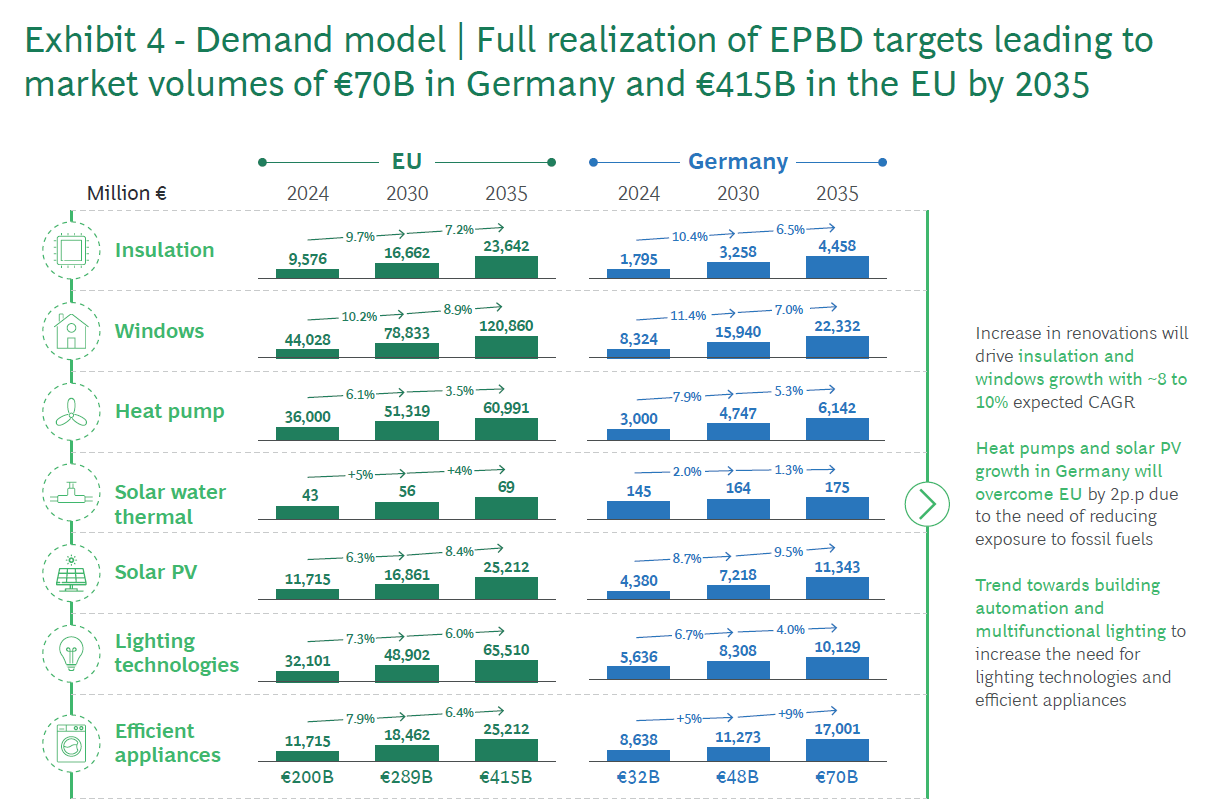
Ha az EU-s célok teljes mértékben teljesülnek, jelentős felújítási hullámra számíthatunk és a zöld építkezés is fellendülhet. A BCG előrejelzése szerint a modern szigetelőanyagok és a nagy hatékonyságú ablakok iránti kereslet évi körülbelül 10%-kal, míg a hőszivattyúk és napelemek iránti kereslet évi 6-8%-kal bővülhet.

A lenti ábra a keresletet modellezi az EPBD-célok teljes megvalósulása esetén, mely 2035-re 70 milliárd eurós piaci volument jelent Németországban és 415 milliárd eurós piaci volument az EU-ban.

Az EPBD célkitűzéseihez időben alkalmazkodó vállalatok előnyre tehetnek szert versenytársaikkal szemben az egyre szigorúbb energiaszabványok és a fenntartható építési trendek környezetében.

Forrás: Boston Consulting Group (BCG), White paper: The building sector and EPBD – Demand impications for energy-efficient materials and technologies, February 2025 by Johannes Blauhuth, Lorenzo Fantini, Martin Feth, Jannik Leiendecker, and Alberto Pizcueta.

Összefoglaló: Kőrösi Péter (ELTINGA)